
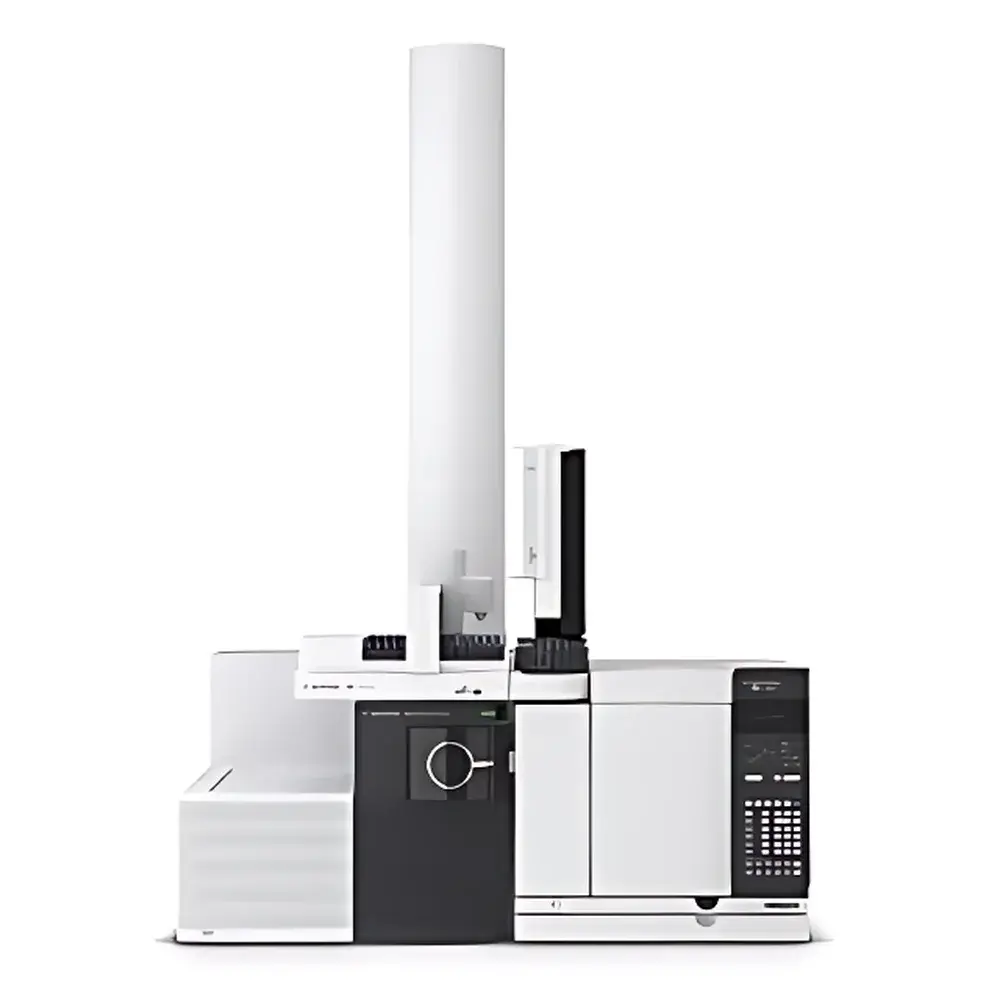
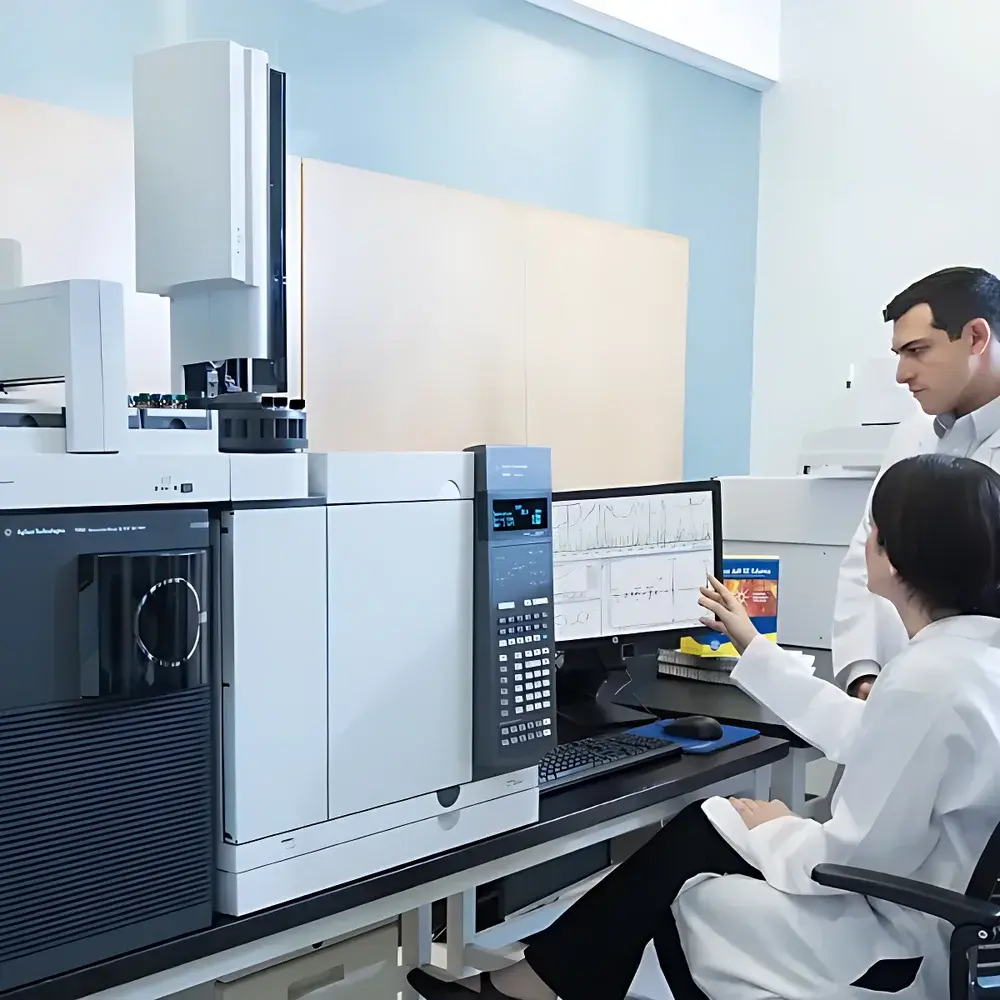

Agilent 7250 GC/Q-TOF Gas Chromatography Quadrupole Time-of-Flight Mass Spectrometer
| Brand | Agilent Technologies |
|---|---|
| Origin | Imported |
| Manufacturer Type | Original Equipment Manufacturer (OEM) |
| Instrument Type | Quadrupole-Time-of-Flight (Q-TOF) |
| GC Configuration | Conventional GC/MS |
| Mass Range | m/z 20–3000 |
| Resolution | >25,000 FWHM at m/z 271.9867, acquisition-rate independent |
| Sensitivity | IDL <60 fg for 100 fg OFN injection |
| Detector | Microchannel plate/scintillator/PMT with ADC electronics |
| Mass Accuracy | <2 ppm (1 pg OFN, m/z 271.9867) |
| Quadrupole Mass Range | m/z 20–1050 |
| Acquisition Rate | 1–50 spectra/sec, resolution-independent |
| Software Platform | Agilent MassHunter |
| GC Compatibility | Fully compatible with Agilent 8890/8860 GC systems and ZOEX thermal modulator for comprehensive 2D-GC (GC×GC) |
Overview
The Agilent 7250 GC/Q-TOF is a high-resolution, accurate-mass gas chromatography quadrupole time-of-flight mass spectrometer engineered for untargeted screening, structural elucidation, and quantitative analysis of volatile and semi-volatile organic compounds. It combines a robust quadrupole mass filter—capable of precursor ion selection—with a high-performance orthogonal acceleration time-of-flight (oa-TOF) analyzer to deliver full-spectrum, high-fidelity data across a wide dynamic range (up to 5 orders of magnitude). Unlike unit-resolution quadrupole or single-quadrupole instruments, the 7250 leverages true high-resolution accurate-mass (HRAM) measurement principles rooted in time-of-flight physics: ions are accelerated into a field-free drift tube where separation occurs strictly by their mass-to-charge ratio (m/z) and kinetic energy homogeneity. This enables simultaneous detection of isotopic fine structure, empirical formula assignment, and interference-free quantitation—even in complex matrices such as biological extracts, environmental samples, or food volatiles.
Key Features
- Quadrupole pre-filtering for enhanced selectivity: Enables targeted MS/MS experiments without sacrificing spectral fidelity or duty cycle.
- Low-energy electron ionization (EI) mode: Reduces in-source fragmentation while preserving molecular ion intensity—critical for confident formula generation and library matching.
- Complementary chemical ionization (CI) capability: Supports soft ionization for labile compounds, expanding coverage beyond standard EI-applicable analytes.
- SureMass algorithm (integrated in MassHunter): Automatically reconstructs chromatographic peaks from high-resolution extracted ion chromatograms with sub-ppm mass tolerance, improving compound detection confidence and reducing false positives.
- Mass spectral fidelity assurance: Isotopic pattern matching against theoretical distributions (within ±3% relative intensity tolerance) validates elemental composition assignments under GLP-compliant workflows.
- GC×GC compatibility: Fully supports ZOEX thermal modulators for comprehensive two-dimensional separation—increasing peak capacity by 5–10× versus 1D-GC, essential for metabolomics and natural product profiling.
- Stable acquisition architecture: Delivers consistent 50 spectra/sec throughput without resolution degradation—enabling reliable deconvolution of narrow chromatographic peaks (<0.5 s width) typical of fast GC or GC×GC methods.
Sample Compatibility & Compliance
The Agilent 7250 GC/Q-TOF accommodates a broad range of sample types requiring derivatization or direct injection, including environmental water extracts, pesticide residues in produce, volatile organic compounds (VOCs) in polymer leachates, flavor compounds in beverages, and thermally stable metabolites in serum or urine. Its hardware and software architecture comply with analytical data integrity requirements outlined in FDA 21 CFR Part 11, EU Annex 11, and ISO/IEC 17025. Audit trails, electronic signatures, and secure user access controls are natively embedded in MassHunter Workstation software. Method validation parameters—including linearity (R² ≥0.999 over 4 orders), repeatability (RSD <5% for retention time and peak area), and intermediate precision—are documented per ICH Q2(R2) guidelines. The system meets ASTM D7593 (petroleum hydrocarbons), USP (validation of compendial procedures), and EN 16622 (pesticide residue analysis in food) performance criteria when operated with validated methods.
Software & Data Management
Data acquisition, processing, and reporting are unified within Agilent MassHunter Qualitative and Quantitative Analysis platforms. MassHunter’s SureMass algorithm performs real-time, high-accuracy deconvolution using centroided HRAM data, enabling automated identification of co-eluting compounds based on exact mass, isotope ratios, and retention index alignment. Batch processing supports automated library searching against NIST, Wiley, and custom-built spectral libraries with configurable match thresholds (e.g., reverse fit ≥800, probability-based scoring). For discovery workflows, Molecular Structure Correlator (MSC) integrates fragmentation tree prediction with in silico MS/MS simulation to propose candidate structures ranked by spectral similarity and chemical plausibility. Raw data files (.d format) are stored in a vendor-neutral, metadata-rich container compliant with mzML 1.1 standards—facilitating long-term archival and third-party reprocessing. All processing steps—including peak integration, calibration, and compound annotation—are fully traceable and exportable as PDF reports compliant with GLP audit requirements.
Applications
- Extractables and Leachables (E&L) profiling: Identification and quantification of low-abundance organics migrating from pharmaceutical packaging or medical device polymers—validated against PQRI and USP guidance.
- Food authenticity and flavor chemistry: Discrimination of geographic origin, adulteration, or thermal processing history via volatile marker profiling (e.g., terpenes, lactones, sulfur compounds) with sub-ppm mass accuracy.
- Environmental contaminant screening: Simultaneous detection of legacy pollutants (PCBs, PAHs), emerging contaminants (PFAS precursors, flame retardants), and transformation products in soil/water extracts without prior target selection.
- Metabolomics and natural product discovery: High-confidence annotation of unknown features in GC-amenable polar metabolite fractions (e.g., amino acids, organic acids, sugars after MSTFA derivatization).
- Pesticide residue analysis: Multi-residue quantification in challenging matrices (e.g., leafy greens, spices) using matrix-matched calibration and isotope dilution where applicable.
FAQ
Is the Agilent 7250 GC/Q-TOF compliant with 21 CFR Part 11 for regulated laboratories?
Yes—the MassHunter software includes role-based access control, electronic signatures, full audit trail logging, and data integrity safeguards aligned with FDA 21 CFR Part 11 and EU Annex 11 requirements.
Can it be integrated with comprehensive two-dimensional gas chromatography (GC×GC)?
Yes—it is fully compatible with ZOEX thermal modulators and supports synchronized data acquisition for GC×GC-HRAM workflows, delivering up to 10× greater peak capacity than 1D-GC.
What is the minimum detectable level for polycyclic aromatic hydrocarbons (PAHs) using this system?
Under optimized conditions (splitless injection, DB-5ms column, low-energy EI), IDLs for 16 EPA priority PAHs range from 10–50 fg on-column, verified per ISO 17025-accredited validation protocols.
Does the system support retrospective data mining after acquisition?
Yes—full-spectrum HRAM data enables post-acquisition re-extraction of any compound within the m/z 20–3000 range at user-defined mass tolerances (e.g., 1–5 ppm), eliminating the need for re-injection.
How does low-energy EI improve molecular ion stability compared to standard 70 eV EI?
By reducing electron energy to 10–20 eV, low-energy EI suppresses bond cleavage while maintaining sufficient ionization efficiency—yielding stronger M⁺• signals and simplified spectra for confident formula generation and library matching.
Related Products





