
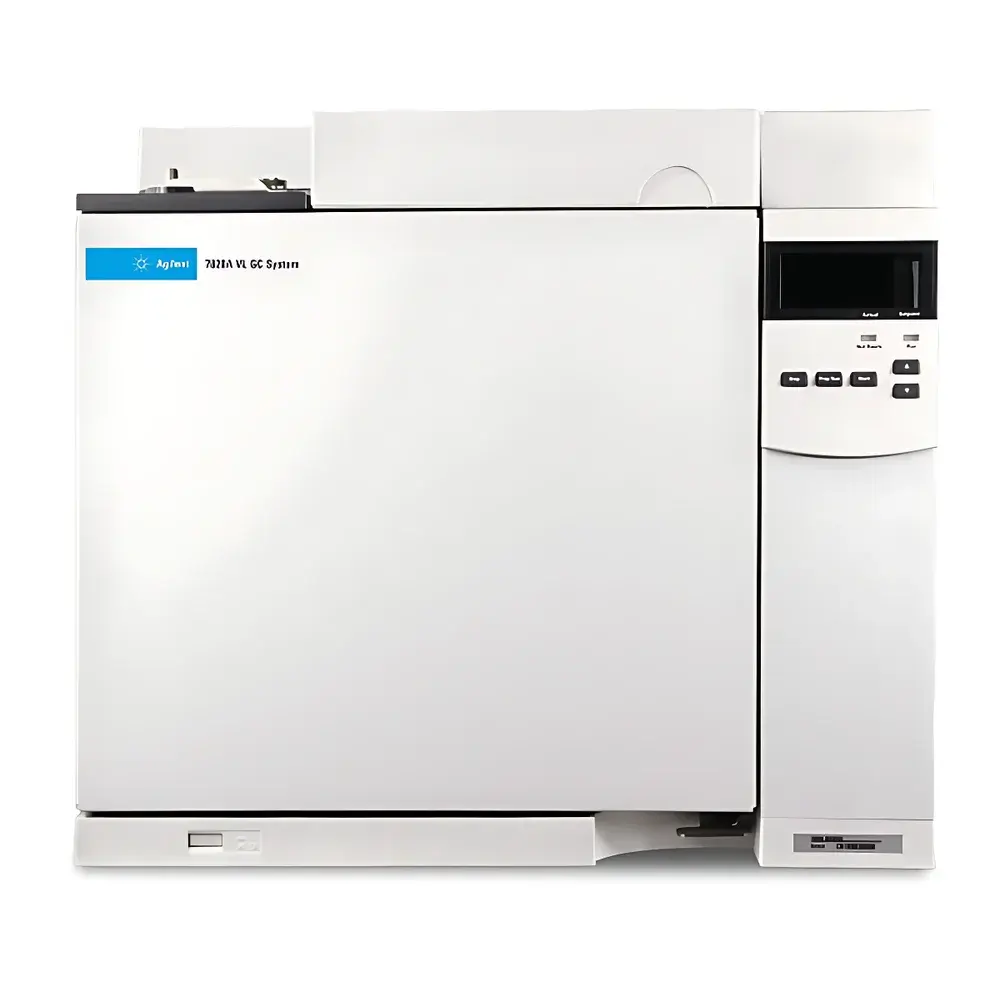
Agilent 7820A VL Gas Chromatograph
| Brand | Agilent Technologies |
|---|---|
| Origin | Shanghai, China |
| Manufacturer Type | Original Equipment Manufacturer (OEM) |
| Regional Classification | Domestic (China-manufactured) |
| Model | 7820A VL |
| Instrument Type | Laboratory Gas Chromatograph |
| Application Scope | General-purpose analysis |
| Control System | Electronic Pressure Control (EPC) at inlet |
| Detector Regulation | Electronic Pressure Regulation (EPR) for FID |
| Included Configuration Options | SSL/EPC inlet + FID/EPR detector |
| Software | OpenLab CDS VL |
Overview
The Agilent 7820A VL Gas Chromatograph is a robust, entry-level laboratory GC engineered for routine quantitative and qualitative analysis across diverse chemical laboratories. Based on proven Agilent GC architecture and manufactured in Shanghai under strict global quality standards, the 7820A VL delivers consistent chromatographic performance through precise pneumatic control and thermally stable column oven design. It operates on the fundamental principle of gas–solid or gas–liquid partition chromatography: sample components are volatilized, separated in a capillary or packed column under controlled temperature and carrier gas flow, and detected based on physicochemical response—most commonly via flame ionization (FID). Designed for high reproducibility in daily QC/QA workflows, the system supports method transfer from higher-tier Agilent platforms (e.g., 7890B/8890) while maintaining compatibility with standard ASTM D3606, USP , ISO 17025, and GLP-compliant operational protocols.
Key Features
- Full electronic pressure control (EPC) at the split/splitless (SSL) inlet ensures accurate, repeatable injection parameters—including pressure, flow, and split ratio—without manual adjustment or mechanical regulators.
- Electronic pressure regulation (EPR) for the flame ionization detector (FID) enables real-time optimization of hydrogen, air, and makeup gas flows, improving baseline stability and detection sensitivity across extended run times.
- Thermally insulated, precision-controlled oven accommodates columns up to 4 m in length with ramp rates up to 40 °C/min and temperature stability of ±0.01 °C—critical for retention time reproducibility.
- Integrated hardware interface for Agilent OpenLab CDS VL software provides seamless instrument control, sequence management, and raw data acquisition with audit-trail-ready metadata logging.
- Modular design supports future expansion: compatible with optional accessories including the 12-position 7697 Headspace Sampler, nitrogen phosphorus detector (NPD), electron capture detector (ECD), and automated liquid sampler (ALS).
- Complies with IEC 61010-1 safety standards and meets electromagnetic compatibility (EMC) requirements per EN 61326-1 for laboratory environments.
Sample Compatibility & Compliance
The 7820A VL accepts liquid, gaseous, and volatile solid samples introduced via syringe, autosampler, or headspace vial. It is routinely deployed for residual solvent analysis (ICH Q3C), hydrocarbon profiling (ASTM D5503), environmental VOC screening (EPA Method 8260D), and food flavor compound quantification. All configurations meet ISO/IEC 17025 documentation requirements when operated under documented SOPs. The OpenLab CDS VL software supports 21 CFR Part 11 compliance through role-based user access, electronic signatures, and immutable audit trails—enabling validation readiness for regulated pharmaceutical and clinical labs.
Software & Data Management
OpenLab CDS VL provides intuitive method development, sequence scheduling, peak integration, and reporting tools optimized for routine lab throughput. Raw data files (.D format) are stored with embedded instrument configuration, calibration history, and acquisition parameters. Data integrity safeguards include automatic backup to network drives, configurable retention policies, and export to CSV, PDF, or LIMS-compatible XML formats. Validation packages—including IQ/OQ documentation templates and installation qualification checklists—are available directly from Agilent Technical Support upon request.
Applications
- Quality control of raw materials and finished products in pharmaceutical manufacturing (e.g., assay of active ingredients, residual solvents in APIs)
- Environmental monitoring of soil, water, and air extracts for chlorinated hydrocarbons, BTEX, and PAHs
- Food and beverage testing for pesticides, mycotoxins (after derivatization), and aroma volatiles
- Petrochemical analysis including gasoline composition (ASTM D1319), diesel cetane improvers, and refinery stream profiling
- Academic research requiring reliable, low-maintenance GC platforms for method development and teaching laboratories
FAQ
Is the 7820A VL GC manufactured to the same specifications as Agilent’s U.S.- or Singapore-assembled instruments?
Yes. The Shanghai production facility operates under Agilent’s global quality management system (QMS), certified to ISO 9001 and aligned with FDA Quality System Regulation (21 CFR Part 820). Component sourcing, assembly processes, and final functional testing follow identical protocols across all manufacturing sites.
Can OpenLab CDS VL support multi-instrument networks and centralized data archiving?
Yes. OpenLab CDS VL supports distributed deployment across local area networks (LAN), with centralized database options (Microsoft SQL Server) for enterprise-scale data governance and cross-lab collaboration.
What regulatory documentation is provided for GMP/GLP compliance?
Agilent supplies comprehensive validation support documents—including Factory Acceptance Test (FAT) reports, Installation Qualification (IQ) checklists, and Operational Qualification (OQ) test protocols—as part of the standard delivery package.
Does the 7820A VL support method transfer from legacy Agilent GC systems?
Yes. Its firmware and OpenLab CDS VL maintain backward compatibility with methods developed on 6890N, 7890A/B, and 8890 platforms, minimizing revalidation effort during instrument upgrades.
Is preventive maintenance training included with purchase?
All standard configurations include on-site installation and operator training covering startup procedures, routine maintenance (e.g., septum replacement, liner cleaning, detector tuning), and basic troubleshooting—delivered by Agilent-certified field application specialists.





