
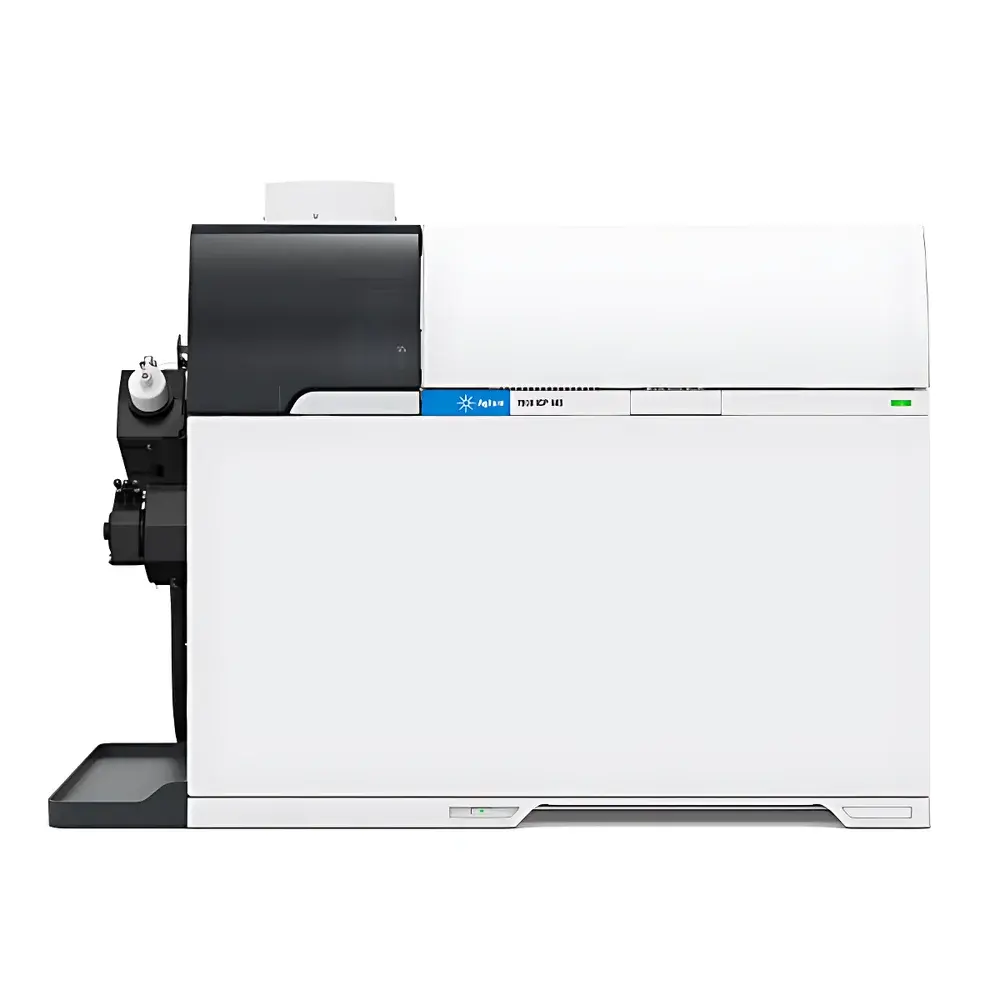
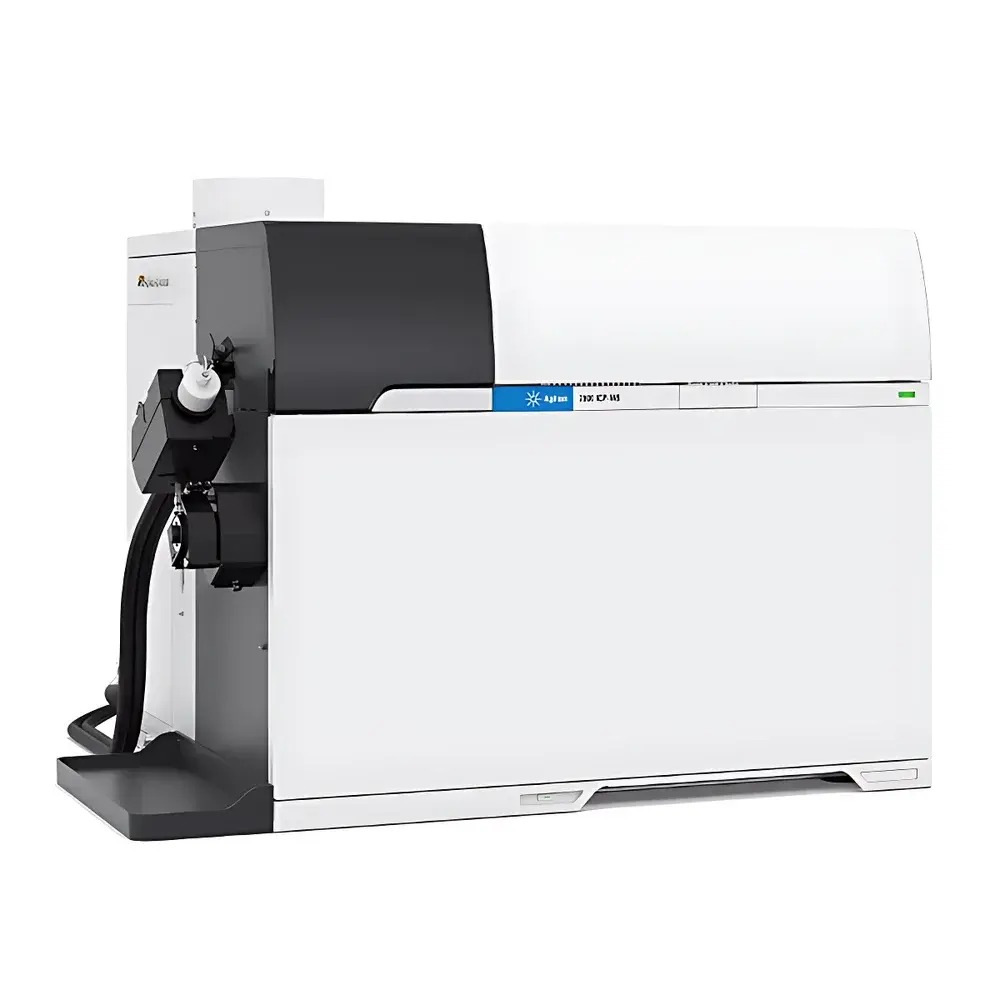
Agilent 7900 ICP-MS Inductively Coupled Plasma Mass Spectrometer
| Brand | Agilent Technologies |
|---|---|
| Origin | Singapore |
| Manufacturer Type | Original Equipment Manufacturer (OEM) |
| Origin Category | Imported |
| Model | 7900 |
| Instrument Type | Quadrupole Mass Spectrometer |
| Application Environment | Laboratory |
| Detection Principle | Inductively Coupled Plasma Ionization with Quadrupole Mass Filtering |
Overview
The Agilent 7900 ICP-MS is a high-performance, single-quadrupole inductively coupled plasma mass spectrometer engineered for precision multi-element analysis across demanding laboratory environments. It operates on the fundamental principle of inductively coupled plasma ionization followed by mass separation using a radiofrequency-driven quadrupole mass filter and detection via a high-dynamic-range electron multiplier. Liquid samples are nebulized into an argon plasma (~7,000–10,000 K), where complete desolvation, atomization, and ionization occur. Resulting analyte ions pass through a dual-cone interface into high-vacuum regions, where ion optics—including off-axis lenses—minimize background noise and enhance transmission efficiency across the full mass range (5–280 u). The instrument integrates a helium collision cell to mitigate polyatomic interferences (e.g., 40Ar16O+ on 56Fe+) without compromising sensitivity, enabling robust quantitation in complex matrices such as seawater, biological digests, and high-TDS industrial effluents.
Key Features
- Ultra-stable plasma generation with low CeO/Ce oxide ratio (<1.5%), ensuring exceptional matrix tolerance and long-term signal stability
- Ultra-High Matrix Introduction (UHMI) system capable of handling samples with up to 25% total dissolved solids (TDS), eliminating need for extensive dilution
- Helium-mode collision cell with optimized gas flow control for reproducible suppression of isobaric and polyatomic interferences
- Off-axis ion optics delivering high sensitivity (>107 cps/ppq for 238U) and sub-femtogram detection limits across the mass range
- Wide dynamic range detector (up to 12 orders of magnitude) supporting simultaneous quantification of major, minor, and trace elements in a single run
- Fast dwell time capability (as low as 0.1 ms) enabling high-fidelity transient signal acquisition for single-particle ICP-MS (spICP-MS), laser ablation (LA-ICP-MS), and single-cell analysis
- MassHunter Method Wizard for automated method development, including internal standard selection, mass calibration, and interference correction setup
- Modular architecture with standardized vacuum and electrical interfaces for seamless integration with optional peripherals: HPLC, GC, CE, FFF, and laser ablation systems
Sample Compatibility & Compliance
The Agilent 7900 ICP-MS accommodates liquid samples introduced via concentric or microflow nebulizers, solid samples via laser ablation (with compatible ablation cells), and gaseous species via direct injection or cryo-trapping. It supports regulatory-compliant workflows aligned with ISO/IEC 17025, ASTM D5673 (water analysis), USP / (elemental impurities), and EPA Methods 200.8 and 6020B. Data integrity features include audit-trail-enabled MassHunter software compliant with FDA 21 CFR Part 11 requirements for electronic records and signatures. Instrument qualification documentation supports GLP and GMP laboratory validation protocols.
Software & Data Management
Controlled exclusively via Agilent MassHunter Workstation software (v10.2 or later), the system provides integrated method development, real-time data acquisition, quantitative and semi-quantitative analysis, isotope ratio calculation, and customizable reporting. The software includes built-in compliance tools: user access levels, electronic signature support, change history logging, and secure data archiving. For hyphenated techniques, MassHunter offers synchronized timing control between chromatographic separation and mass spectral acquisition, including automatic valve switching, gradient synchronization, and post-run peak deconvolution for speciation analysis.
Applications
The Agilent 7900 ICP-MS serves as a core analytical platform in environmental monitoring (trace metal speciation in wastewater and soil extracts), clinical and pharmaceutical research (elemental impurity screening per ICH Q3D), semiconductor manufacturing (ultra-trace contamination control in process chemicals), geochemistry (isotopic fingerprinting of rock digests), and nanomaterial characterization (size distribution and particle number concentration via spICP-MS). Its compatibility with HPLC-ICP-MS enables routine arsenic, selenium, and mercury speciation; GC-ICP-MS supports organometallic compound analysis (e.g., methylmercury); while LA-ICP-MS facilitates spatially resolved elemental mapping in geological thin sections and biological tissues.
FAQ
What sample introduction systems are supported?
Nebulizers (concentric, microconcentric, PFA), desolvating spray chambers (Aridus III, Apex Q), laser ablation cells (two-volume, fast-washout designs), and direct injection high-efficiency nebulizers (DIHEN) for volatile species.
Does the system meet regulatory requirements for pharmaceutical testing?
Yes — fully compliant with ICH Q3D, USP /, and FDA 21 CFR Part 11 when configured with validated MassHunter software and documented IQ/OQ/PQ protocols.
Can it perform isotope ratio measurements?
Yes — supports high-precision isotope ratio analysis for applications such as Pb, Sr, Nd, and Hf isotopic geochronology, with stability suitable for external normalization and bracketing calibration.
Is remote monitoring and diagnostics available?
Yes — MassHunter includes Agilent Remote Monitoring Services (RMS) for secure cloud-based instrument status tracking, predictive maintenance alerts, and firmware update management.
What vacuum system configuration does it use?
Three-stage differential pumping: roughing pump + two turbomolecular pumps (600 L/s and 300 L/s), maintaining base pressure below 1×10⁻⁸ Torr in the quadrupole and detector regions.







