
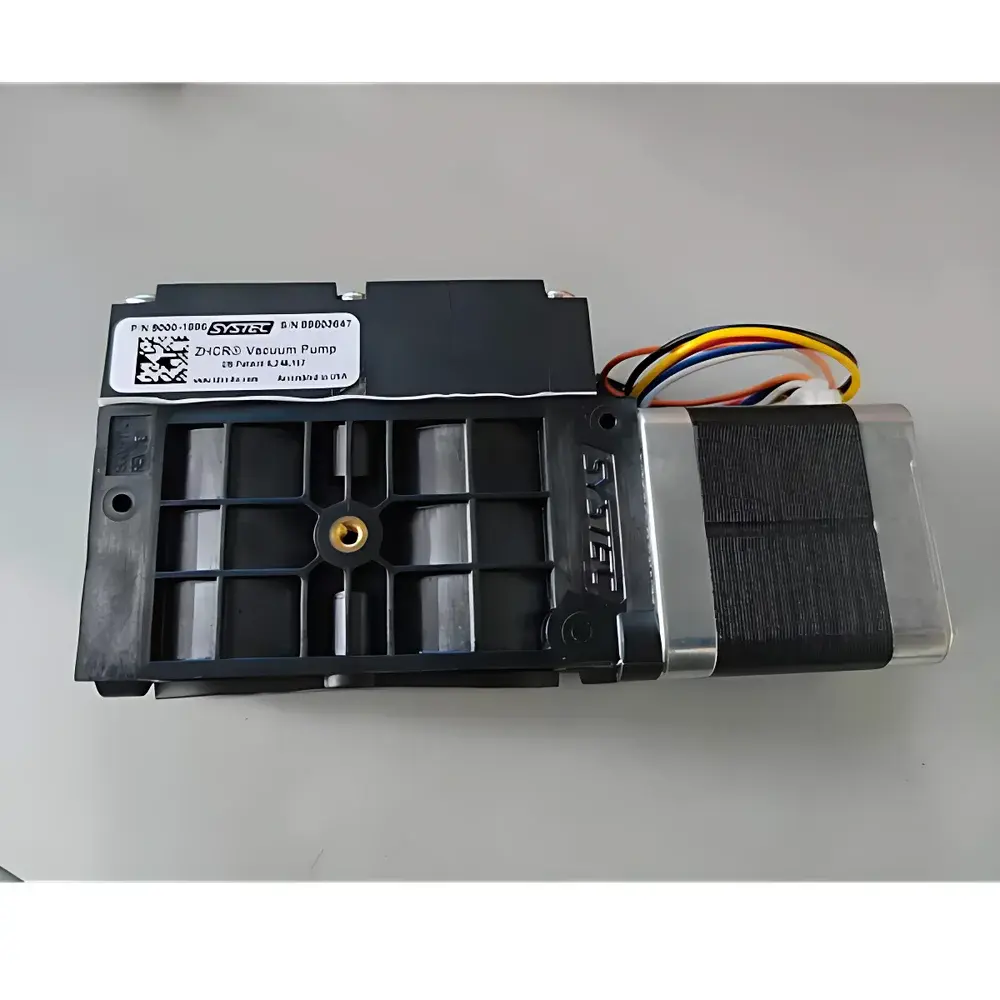
Agilent 9000-1926 Systec Membrane Vacuum Degasser Pump
| Brand | Systec |
|---|---|
| Origin | USA |
| Model | Agilent 9000-1926 |
| Type | Membrane Vacuum Pump for HPLC Mobile Phase Degassing |
| Drive Motor | Brushless DC Stepper Motor |
| Vacuum Level | ≤5 mbar (absolute) |
| Flow Path Materials | PTFE, FFKM, 316 Stainless Steel |
| Diaphragm Design | Continuously Purged Two-Stage Teflon® |
| Compliance | Compatible with ASTM D4052, USP <621>, ISO 13877 |
| Power Supply | 12–24 VDC, Low-Wattage Operation |
| Noise Level | <42 dBA at 1 m |
| Operating Temperature Range | 10–40 °C |
| IP Rating | IP20 |
| Dimensions | 125 × 85 × 65 mm |
| Weight | 0.85 kg |
Overview
The Agilent 9000-1926 Systec Membrane Vacuum Degasser Pump is an engineered solution for continuous, stable vacuum generation in high-performance liquid chromatography (HPLC) and ultra-high-performance liquid chromatography (UHPLC) solvent degassing systems. Designed specifically for membrane-based vacuum degassing of aqueous-organic mobile phases—including acetonitrile/water, methanol/water, and tetrahydrofuran blends—the pump operates on a dual-speed micro-stepping RPM control strategy. This architecture eliminates the vacuum hysteresis commonly observed with single-speed on/off pumps, thereby preventing baseline drift caused by transient pressure fluctuations during pump cycling. Unlike traditional rotary vane or diaphragm pumps requiring oil lubrication or frequent maintenance, this unit employs a dry, brushless DC stepper motor coupled with precision ball-bearing drive mechanics—ensuring silent, cool, and reliable operation in solvent-rich laboratory environments.
Key Features
- Continuously purged two-stage PTFE diaphragm head with integrated anti-backflow duckbill check valves—eliminates need for external venting and prevents solvent vapor ingress during power interruption
- Brushless DC stepper motor delivering low-noise (<42 dBA), low-heat operation; rated for continuous duty at reduced RPM to extend service life beyond 20,000 hours
- Inert flow path constructed from PTFE, perfluoroelastomer (FFKM), and electropolished 316 stainless steel—fully compatible with aggressive organic solvents and resistant to hydrolysis and oxidation
- Stable vacuum output ≤5 mbar (absolute) with minimal pulsation—critical for reproducible degassing efficiency across varying solvent compositions and flow rates
- Compact footprint (125 × 85 × 65 mm) and lightweight design (0.85 kg) enable seamless integration into OEM degassing modules or benchtop HPLC systems from Agilent, Waters, Shimadzu, and Thermo Fisher Scientific
- Wide-input DC power architecture (12–24 VDC) supports flexible integration into centralized lab power systems or battery-backed configurations for GMP-critical applications
Sample Compatibility & Compliance
The pump is validated for use with standard HPLC-grade mobile phases containing up to 100% organic content (e.g., pure acetonitrile, methanol, isopropanol) and mixed aqueous-organic buffers (e.g., 0.1% TFA in water/acetonitrile). Its chemically inert wetted materials meet USP Class VI biocompatibility requirements and comply with ISO 10993-5 cytotoxicity standards. The sealed, vent-free architecture satisfies ICH Q5C stability testing environmental controls and supports GLP/GMP-compliant workflows where vacuum integrity must persist through scheduled power cycles or emergency shutdowns. It is routinely deployed in laboratories adhering to ASTM D4052 (density determination), USP <621> (chromatography), and ISO 13877 (liquid chromatographic system performance verification).
Software & Data Management
While the Agilent 9000-1926 operates as a standalone hardware component without embedded firmware or digital interface, its analog-compatible speed control input (0–5 VDC or PWM) enables integration with third-party instrument controllers supporting ASTM E1381/E1382 data acquisition protocols. When installed within OEM degassing manifolds—such as Agilent’s 1260/1290 Infinity II series or Waters’ ACQUITY UPLC systems—it participates in full-system audit trails compliant with FDA 21 CFR Part 11 when paired with validated chromatography data systems (CDS) like OpenLab CDS or Empower 3. Real-time vacuum status monitoring is achieved via optional external pressure transducers (e.g., MKS Baratron series), feeding calibrated analog signals into lab-wide SCADA or LIMS platforms.
Applications
- Online degassing of mobile phase reservoirs in HPLC, UHPLC, and preparative LC systems
- Stabilization of baseline signal integrity in UV-Vis, fluorescence, and mass spectrometric detection
- Support of gradient elution methods requiring consistent solvent density and compressibility
- Integration into automated sample preparation workstations where solvent outgassing precedes injection
- Use in regulated QC/QA labs performing pharmacopeial assays (USP, EP, JP) where vacuum consistency directly impacts retention time precision and peak symmetry
- Deployment in environmental and food safety labs conducting EPA Method 8081B, 8270, or AOAC 2017.12 analyses requiring low-part-per-trillion baseline noise
FAQ
Does this pump require oil or periodic lubrication?
No. It is a dry-running, oil-free membrane pump with a brushless DC motor and PTFE-coated diaphragm assembly—no scheduled lubrication or oil changes are required.
Can it maintain vacuum during a power failure?
Yes. The non-return duckbill valves and sealed head design retain vacuum integrity indefinitely after power loss, eliminating re-degassing delays upon restart.
Is it compatible with corrosive solvents such as trifluoroacetic acid (TFA) or hydrochloric acid buffers?
Yes—when used within specified concentration limits (≤0.5% v/v TFA; pH 2–12 for aqueous buffers) and with appropriate system-level corrosion mitigation (e.g., upstream filtration, inert tubing).
What is the expected service life under continuous operation?
Rated for >20,000 hours at nominal load (low-RPM sustained mode), corresponding to approximately 8–10 years of typical 24/7 lab use with no scheduled maintenance.
Does it meet electromagnetic compatibility (EMC) requirements for laboratory environments?
Yes. It complies with CISPR 11 Group 1, Class B emission limits and EN 61326-1:2013 for laboratory electrical equipment, ensuring coexistence with sensitive mass spectrometers and NMR consoles.



