
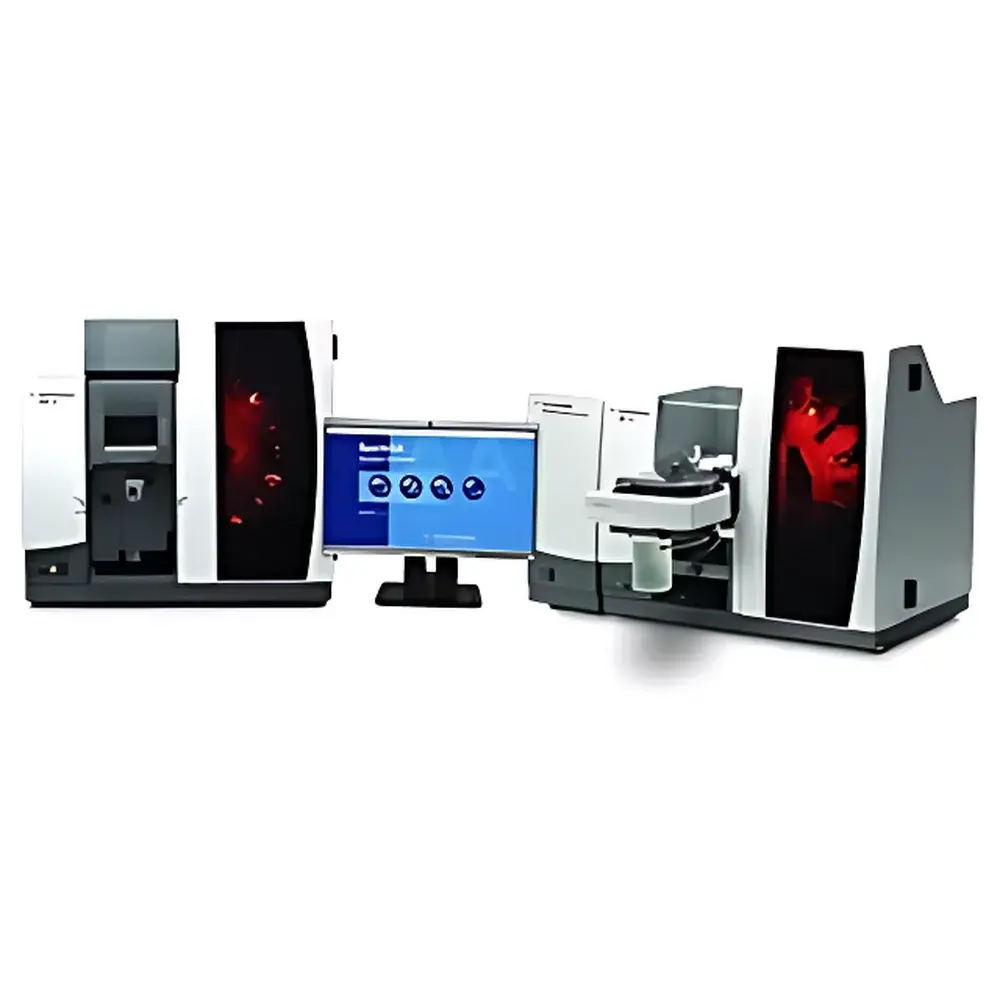
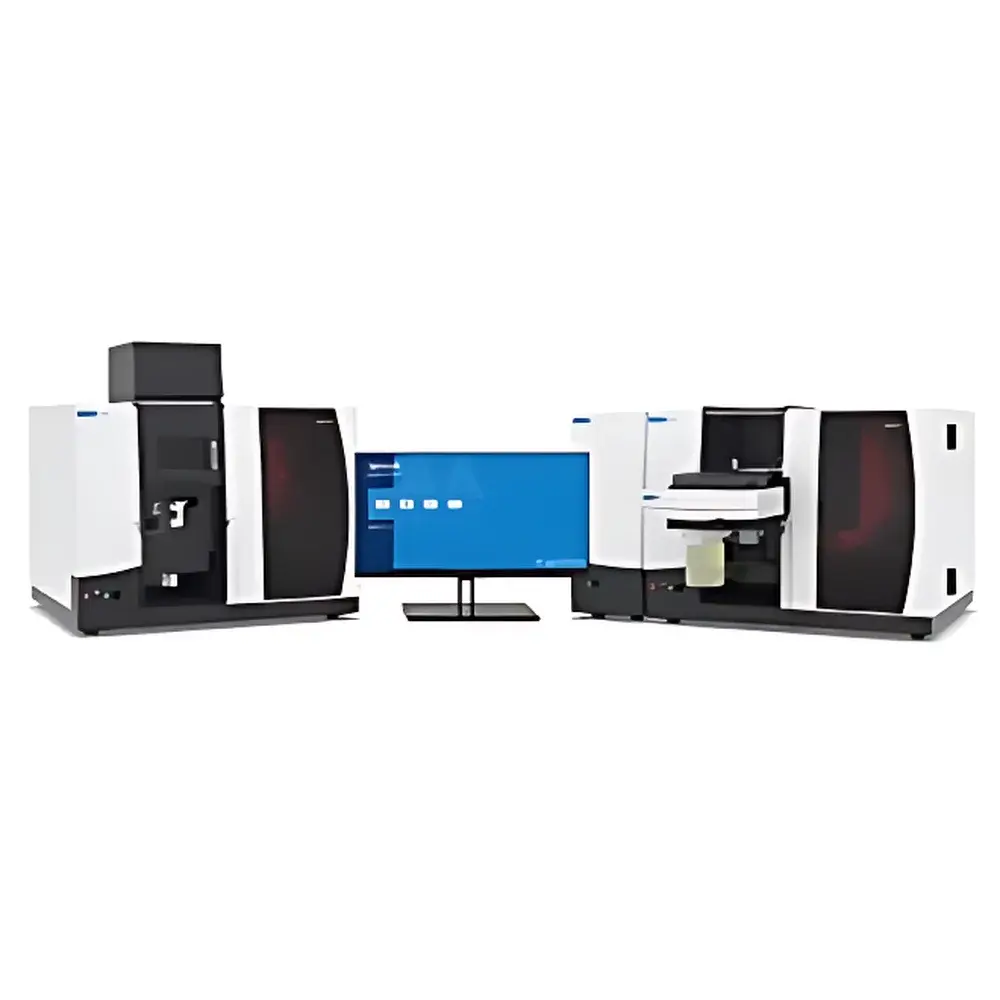
Agilent AA DUO Atomic Absorption Spectrometer
| Brand | Agilent Technologies |
|---|---|
| Origin | Malaysia |
| Manufacturer Type | Original Equipment Manufacturer (OEM) |
| Import Status | Imported |
| Model | AA DUO |
| Instrument Type | Flame and Graphite Furnace AAS |
| Optical System | Dual-Beam |
| Monochromator Type | Custom High-Resolution Echelle Grating |
| Detector | Photomultiplier Tube (PMT) |
| Background Correction | Deuterium Lamp + Zeeman Effect |
| Linear Dynamic Range | Sub-ppt to Percent-Level Concentrations |
| Automation | Fully Integrated Dual-Atomizer Control via Agilent Workstation Software |
| Compliance | Designed for GLP/GMP environments |
Overview
The Agilent AA DUO Atomic Absorption Spectrometer represents a paradigm shift in elemental quantification by integrating two fully independent, permanently installed atomization systems—flame and graphite furnace—within a single instrument platform. Unlike conventional sequential or hybrid AAS systems requiring manual reconfiguration, the AA DUO employs a true dual-atomizer architecture engineered for concurrent operation under synchronized control of a central workstation. This design leverages fundamental atomic absorption principles: free atoms generated in the flame (air-acetylene or nitrous oxide-acetylene) or electrothermally vaporized in the graphite tube absorb characteristic wavelengths from a hollow cathode lamp (HCL) or electrodeless discharge lamp (EDL). The dual-beam optical path compensates for source intensity drift and lamp aging, while the echelle grating monochromator delivers high spectral resolution and stray-light rejection essential for complex matrices. The system is optimized for trace-to-major-element analysis across environmental, clinical, pharmaceutical, and metallurgical laboratories where throughput, reproducibility, and regulatory compliance are non-negotiable.
Key Features
- True simultaneous operation of flame and graphite furnace atomizers—no mechanical switching, no recalibration delays between modes
- Dual independent optical paths with beam-splitting optics and matched photomultiplier detection channels
- Integrated background correction combining deuterium continuum lamp (for broad-band correction) and transverse magnetic field Zeeman effect (for structured background and high-precision correction at peak absorption)
- Sub-ppt detection limits for graphite furnace mode (e.g., Cd, Pb, As) and sub-ppb sensitivity in flame mode (e.g., Ca, Mg, Fe), supported by Agilent’s Fast Sequence technology for rapid multi-element flame analysis
- Modular atomizer configuration: optional hydride generation accessory compatible with graphite furnace for As, Se, Sb, Bi, Te, and Hg speciation-ready workflows
- Rugged, temperature-stabilized optical bench with sealed purged optics to minimize humidity- and ozone-induced drift
Sample Compatibility & Compliance
The AA DUO accommodates liquid samples ranging from ultrapure water (e.g., semiconductor-grade standards) to highly saline digests (e.g., EPA Method 200.8, ISO 11885), suspended solids (via ultrasonic nebulization or slurry introduction), and volatile hydride-forming elements. Its dual-atomizer architecture eliminates cross-contamination risks associated with shared sample introduction lines. The system meets international regulatory requirements for routine QC/QA: fully compliant with ASTM D1688 (copper in fuel oils), ISO 7027 (aluminum in drinking water), USP (elemental impurities in pharmaceuticals), and EN 14802 (heavy metals in soils). Audit trail functionality, user access levels, electronic signatures, and data integrity controls align with FDA 21 CFR Part 11 and EU Annex 11 for GxP environments.
Software & Data Management
Controlled exclusively via Agilent’s validated Workstation software, the AA DUO supports method development, instrument calibration, real-time diagnostics, and report generation in a single interface. The software includes built-in validation wizards for IQ/OQ/PQ protocols, customizable reporting templates compliant with LIMS export (ASTM E1467), and automated calibration verification using certified reference materials (CRMs). All raw spectra, integration parameters, and background correction logs are stored with time-stamped metadata. Data archiving follows ALCOA+ principles (Attributable, Legible, Contemporaneous, Original, Accurate, Complete, Consistent, Enduring, Available), ensuring full traceability during internal audits or regulatory inspections.
Applications
- Environmental labs: Simultaneous monitoring of Pb and Cd in wastewater (graphite furnace) alongside Na and K in surface water (flame) per EPA 7000B/7010
- Pharmaceutical QA: Quantification of catalyst residues (Pd, Pt, Ni) in APIs at sub-ppm levels (graphite furnace) and excipient metals (Ca, Mg) in tablet formulations (flame)
- Clinical toxicology: Rapid screening of blood lead (Pb-B) and urinary cadmium (Cd-U) without instrument downtime
- Food safety: Multi-analyte testing for As species (via hydride-AAS) and total Fe/Zn in fortified cereals within one analytical session
- Geochemical research: High-precision determination of REEs in acid-digested rock samples using matrix-matched calibration and Zeeman-corrected background subtraction
FAQ
Can the flame and graphite furnace operate truly simultaneously—or is it just rapid alternation?
Yes—the AA DUO uses physically separate atomization chambers, independent nebulizers, and dual optical detection paths, enabling genuine concurrent measurement without shared components or timing arbitration.
Does the system support hydride generation without external hardware?
Hydride generation is implemented as an integrated accessory module that interfaces directly with the graphite furnace autosampler and Workstation software; no third-party controllers or gas manifolds are required.
Is method transfer possible from legacy Agilent AAS instruments?
All flame and graphite furnace methods developed on Agilent 240FS, 280 series, or earlier AA platforms can be imported and executed with minimal parameter adjustment due to consistent spectral line selection, background correction logic, and calibration algorithms.
How is data integrity maintained during long unattended runs?
The Workstation enforces automatic data backup every 5 minutes, locks method files against unauthorized modification, and logs all user actions—including parameter changes, calibration events, and report exports—with digital signatures and timestamps.
What maintenance intervals are recommended for optimal performance?
Daily: Nebulizer cleaning, burner head inspection, graphite tube replacement tracking
Monthly: Optical alignment verification, PMT voltage calibration, gas flow validation per ISO 17025 checklist
Annually: Full system OQ with NIST-traceable CRMs and documented uncertainty budgeting.
Related Products






