
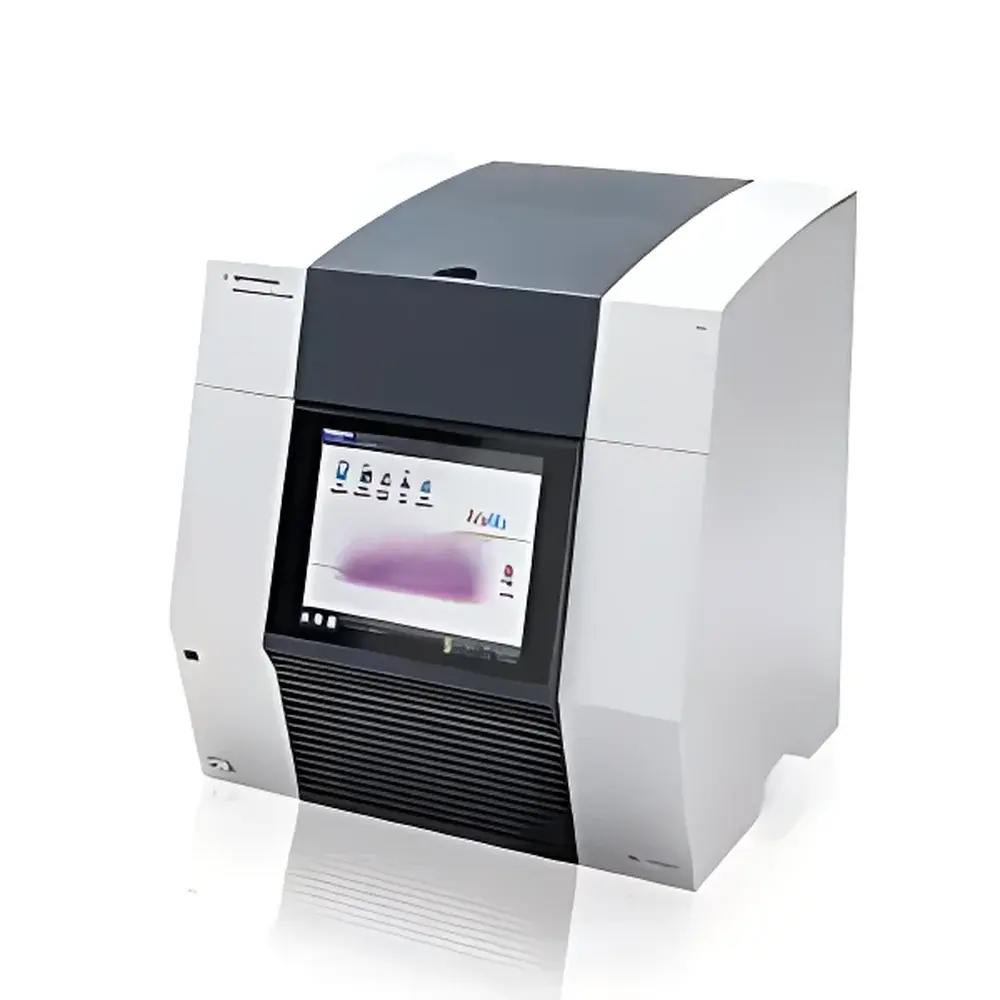
Agilent AriaMx Real-Time PCR System
| Brand | Agilent Technologies |
|---|---|
| Origin | Malaysia |
| Manufacturer Type | Original Equipment Manufacturer (OEM) |
| Origin Category | Imported |
| Model | AriaMx PCR |
| Instrument Type | Real-Time Quantitative PCR System |
| Thermal Uniformity | ±0.4 °C |
| Temperature Accuracy | ±0.2 °C |
| Temperature Range | 25.0–99.9 °C |
| Max Ramp Rate | 6 °C/sec |
| Reaction Volume | 10–30 µL |
| Well Format | 96-well |
| Optical Modules | Up to 6 interchangeable filter-based modules |
| Excitation Source | Dye-specific LEDs per module |
| Detection Source | 8-channel photodiode array per module |
| Fluorophores Supported | SYBR Green, EvaGreen, FAM, HEX, ROX, CY3, CY5, ATTO 425 |
| Multiplex Capacity | Up to 5 targets per well |
| Data Acquisition Time | <3 sec per cycle |
| Onboard Storage | 5 GB |
| Touchscreen Interface | Yes |
| Remote Monitoring | Yes |
| Software Included | ARIA Software with LIMS connectivity, melt curve analysis, and FDA 21 CFR Part 11–compliant audit trail options |
| Self-Installable Optics | Yes |
| Dimensions (W×D×H) | 50.0 × 46.0 × 42.0 cm (19.7 × 18.1 × 16.5 in) |
| Warranty | 1 year standard |
| Regulatory Status | For Research Use Only (RUO) |
Overview
The Agilent AriaMx Real-Time PCR System is an integrated, benchtop qPCR platform engineered for precision, reproducibility, and operational efficiency in molecular biology laboratories. It employs a Peltier-based thermal cycling architecture combined with a modular, LED-driven optical detection system to deliver high-fidelity amplification and quantitative fluorescence monitoring across up to five spectral channels per reaction well. Unlike legacy systems relying on broadband lamps or fixed-filter optics, the AriaMx utilizes discrete, dye-matched LEDs and user-swappable optical modules—each configured with dedicated bandpass filters and calibrated photodiode detection—to minimize spectral crosstalk and maximize signal-to-noise ratio. Its thermal control system maintains ±0.4 °C uniformity across all 96 wells and achieves ramp rates up to 6 °C/sec, enabling rapid cycling without compromising assay integrity. Designed for RUO applications only, the system complies with GLP-aligned data handling practices and supports 21 CFR Part 11–ready configurations via optional software modules.
Key Features
- Modular optical design: Six independently installable filter-based modules—supporting SYBR Green, FAM, HEX, ROX, CY3, CY5, and ATTO 425—allow flexible reconfiguration for evolving assay requirements.
- Dye-optimized excitation: Eight individual LEDs per optical module provide narrow-band, intensity-stabilized illumination matched precisely to common fluorophore absorption profiles.
- High-speed thermal cycling: Patented Peltier architecture delivers precise temperature transitions between 25.0 °C and 99.9 °C with ≤3-second data acquisition per cycle and validated thermal accuracy of ±0.2 °C.
- Intuitive touchscreen interface: Integrated 10.4-inch capacitive display enables protocol setup, real-time monitoring, and post-run analysis without external computing hardware.
- Open reagent compatibility: Fully validated with major chemistries including TaqMan probes, SYBR Green I, EvaGreen, and high-resolution melt (HRM) reagents—no proprietary consumables required.
- Onboard computational capability: 5 GB internal storage retains raw fluorescence traces, melt curves, and analysis metadata; remote monitoring enabled via secure HTTPS-based API.
Sample Compatibility & Compliance
The AriaMx accommodates standard 0.2 mL skirted or semi-skirted 96-well plates with reaction volumes ranging from 10 to 30 µL—optimized for low-volume assays while maintaining robust evaporation control. Its optical path length and detector gain are factory-calibrated against NIST-traceable fluorescence standards, ensuring inter-instrument comparability. The system has undergone extensive validation across >100,000 samples spanning 14 distinct assay types—including gene expression, SNP genotyping, microRNA quantification, and viral load determination—demonstrating consistent performance under ISO/IEC 17025–informed laboratory conditions. While designated RUO, its software architecture supports audit trail logging, electronic signatures, and LIMS integration per CLIA and CAP guidelines. Documentation packages include IQ/OQ protocols compliant with ASTM E2500 and ISO 13485 frameworks for instrument qualification in regulated environments.
Software & Data Management
Bundled ARIA Software provides end-to-end workflow management—from experimental design and plate setup to baseline correction, threshold determination, relative quantification (ΔΔCq), and high-resolution melt profiling. Algorithms employ adaptive noise filtering and multi-point normalization to mitigate well-to-well variation. Raw fluorescence data (.ard files) are stored in vendor-neutral HDF5 format, enabling third-party import into Python (via h5py), R (rhdf5), or MATLAB environments. Optional modules extend functionality to include FDA 21 CFR Part 11 compliance (role-based access control, electronic signatures, immutable audit logs), automated report generation in PDF/XLSX, and RESTful API endpoints for enterprise-scale data federation. All software updates are delivered free-of-charge via Agilent’s secure download portal.
Applications
- Gene expression profiling using reference gene normalization and efficiency-corrected quantification models.
- Allelic discrimination and copy number variation (CNV) analysis via probe-based duplex or triplex assays.
- MicroRNA detection leveraging stem-loop RT primers and optimized low-input cycling protocols.
- Viral/bacterial load quantification in clinical research specimens, including plasma, PBMCs, and FFPE-derived nucleic acids.
- High-resolution melt (HRM) analysis for methylation-sensitive PCR, splice variant detection, and amplicon sequencing QC.
- Validation of CRISPR editing efficiency through T7E1 or SURVEYOR nuclease-coupled qPCR workflows.
FAQ
Is the AriaMx compatible with third-party qPCR master mixes and probes?
Yes—the system is fully open-platform and validated with commercial reagents from Thermo Fisher, Bio-Rad, Takara, and IDT, as well as custom oligonucleotide probes.
Can optical modules be upgraded or replaced in the field?
Yes—optical modules are user-installable without tools or service dispatch; each module is serialized and auto-recognized upon insertion.
What data security and traceability features does the software support?
ARIA Software includes configurable audit trails, user-level permissions, electronic signature capture, and exportable metadata logs compliant with GLP/GMP documentation requirements.
Does Agilent provide application support for assay development?
Yes—Agilent offers technical notes, validated protocols, and remote consultation services through its Global Applications Support team.
Is remote instrument monitoring supported over institutional networks?
Yes—HTTPS-based web interface enables secure remote access for real-time run status, alert notifications, and historical data retrieval without VPN dependency.



