
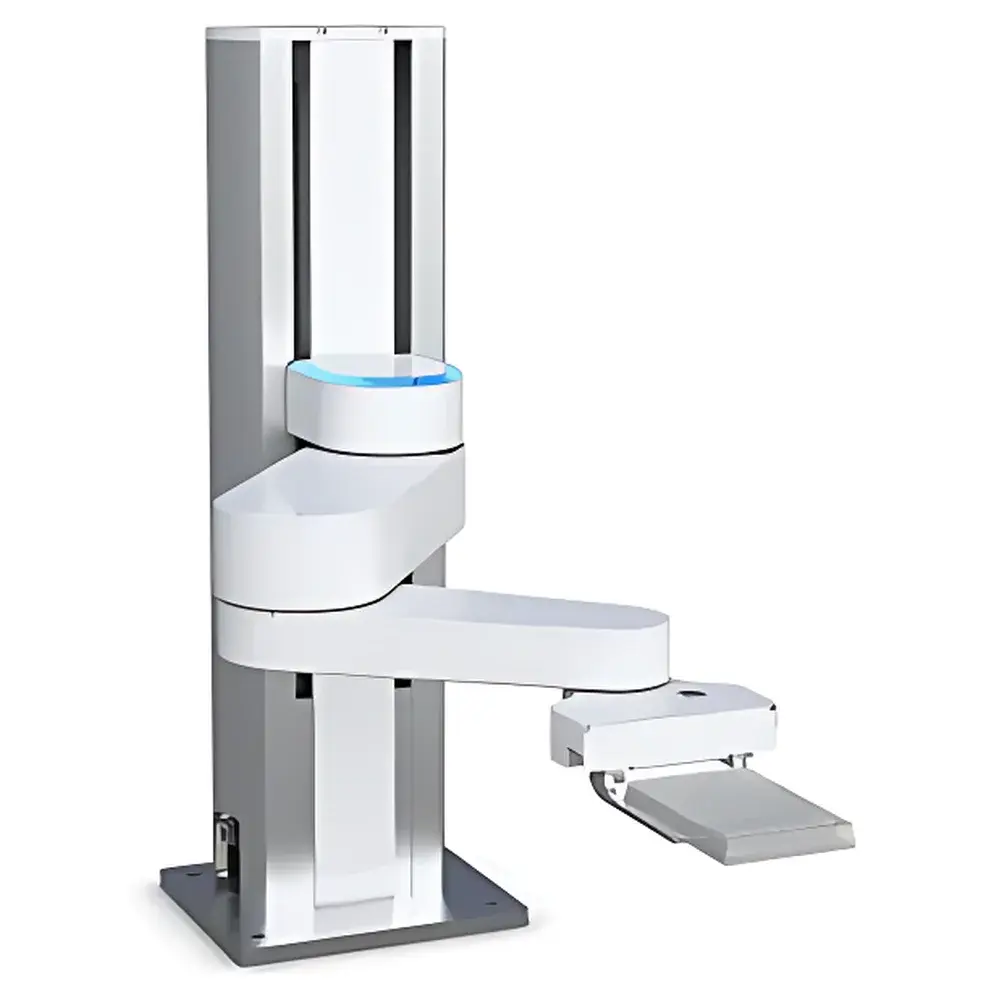
Agilent BenchBot Laboratory Automation Robot
| Brand | Agilent Technologies |
|---|---|
| Origin | Imported |
| Manufacturer Type | Original Equipment Manufacturer (OEM) |
| Model | BenchBot |
| Pricing | Available Upon Request |
Overview
The Agilent BenchBot is a compact, benchtop laboratory automation robot engineered for precise, repeatable microplate handling across diverse life science and analytical workflows. Operating on a Cartesian coordinate system with high-resolution stepper motor control, the BenchBot executes accurate X-Y-Z positioning of labware—including 96-well, 384-well, and 1536-well microplates, tube racks, tip boxes, and assay plates—enabling end-to-end automation of liquid handling, plate staging, and instrument interfacing. Unlike modular robotic arms requiring extensive integration engineering, the BenchBot features an integrated gantry architecture optimized for footprint-constrained environments such as core facilities, QC labs, and academic research spaces. Its design adheres to ISO/IEC 17025 principles for measurement traceability in automated systems and supports audit-ready operation under GLP and GMP frameworks when paired with compliant software.
Key Features
- Integrated Benchtop Architecture: Self-contained mechanical platform with rigid aluminum frame, precision linear rails, and calibrated homing sensors—requires no external mounting or structural reinforcement.
- One-Touch Positioning Calibration: Onboard optical encoder feedback and auto-homing routine enable rapid re-initialization (<60 seconds), minimizing setup time between protocol changes.
- Modular Payload Flexibility: Interchangeable end-effectors—including vacuum grippers, magnetic plate lifters, and barcode readers—allow seamless adaptation to varying labware geometries and identification requirements.
- Open Integration Protocol Support: Native compatibility with Agilent’s OpenLab CDS and MassHunter platforms via TCP/IP and RS-232; also supports third-party instrument control through standardized protocols including SLIM, HSL, and vendor-specific API wrappers (e.g., Hamilton VENUS, Tecan FluentControl).
- Enclosure-Ready Deployment: Designed to operate within Class II biosafety cabinets, laminar flow hoods, or custom ventilated enclosures without thermal or EMI interference.
Sample Compatibility & Compliance
The BenchBot accommodates standard ANSI/SBS-compliant microplates (SBS-123 format), deep-well plates, PCR strips, cryovial racks (up to 2 mL), and custom fixtures with dimensional tolerances ±0.2 mm. All motion profiles are validated for ≤0.1 mm positional repeatability (3σ) across full travel range (X: 320 mm, Y: 280 mm, Z: 120 mm). The system complies with IEC 61000-6-2 (immunity) and IEC 61000-6-4 (emission) standards for laboratory equipment. When configured with Agilent’s Audit Trail-enabled software module, it meets FDA 21 CFR Part 11 requirements for electronic records and signatures, including user authentication, change logging, and immutable data export.
Software & Data Management
BenchBot operates under Agilent’s BenchBot Control Software (v3.2+), a Windows-based application supporting drag-and-drop workflow sequencing, conditional logic branching (e.g., “if plate barcode matches template, proceed to centrifuge docking”), and real-time error recovery (e.g., collision detection, missed grip verification). Protocols are stored as XML-based .bbp files with embedded metadata (user, timestamp, instrument ID), enabling version-controlled deployment across multi-user environments. Raw position logs and execution timestamps are exported in CSV/TSV format compatible with LIMS integration (e.g., LabVantage, STARLIMS) and statistical process monitoring tools. Optional Python SDK allows advanced users to embed custom algorithms for adaptive scheduling or ML-driven anomaly detection during long-duration runs.
Applications
- Genomics sample prep: Automated normalization, fragmentation, adapter ligation, and library pooling for NGS workflows (Illumina, PacBio, Oxford Nanopore).
- Microarray processing: Plate staging, hybridization station loading, wash buffer dispensing coordination, and slide scanning queue management.
- Cell-based assays: Serial dilution series generation, co-culture plate setup, media exchange timing synchronization with incubators (e.g., Binder CB series).
- HPLC/GC autosampler staging: High-throughput vial tray loading, cap piercing sequence optimization, and injection order synchronization with chromatography data systems.
- Enzyme kinetics screening: Multi-point time-series plate transfers to plate readers (e.g., BioTek Synergy Neo2) with sub-second timing precision between wells.
FAQ
Does the BenchBot require dedicated IT infrastructure or network configuration?
No—BenchBot operates as a standalone node with optional Ethernet connectivity. Local USB control is fully functional; network features (e.g., remote monitoring, LIMS sync) use standard DHCP-assigned IPs and require no VLAN segmentation or firewall rule exceptions.
Can it handle non-standard or custom labware?
Yes—custom fixture mounts and user-defined coordinate offsets allow registration of proprietary plates, slide holders, or microfluidic cartridges via teach-mode calibration.
Is validation documentation available for regulated environments?
Agilent provides IQ/OQ documentation packages (per ASTM E2500-13) and URS templates aligned with EU Annex 11 and USP Analytical Instrument Qualification guidelines.
What maintenance intervals are recommended?
Linear rail lubrication and belt tension verification every 6 months; optical sensor cleaning quarterly; no scheduled replacement parts required within first 5 years of operation under typical lab usage (≤8 hrs/day, 5 days/week).



