
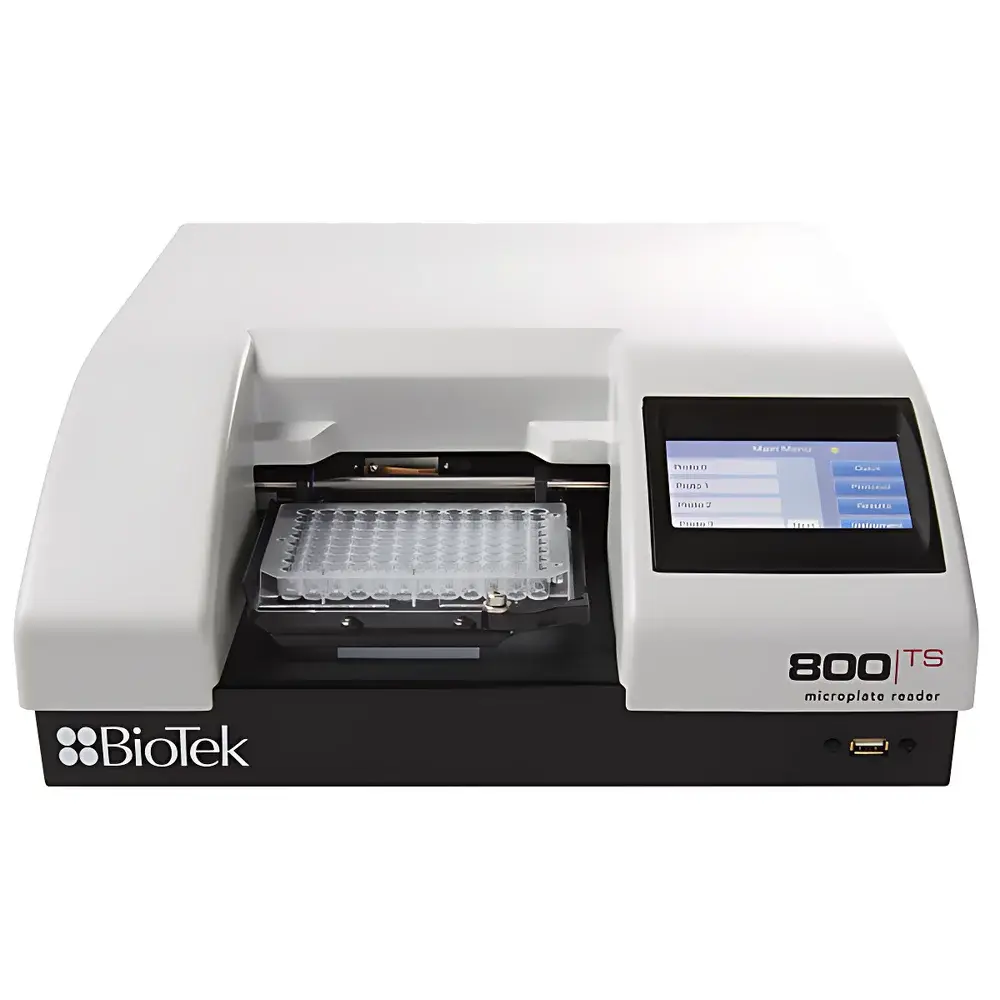
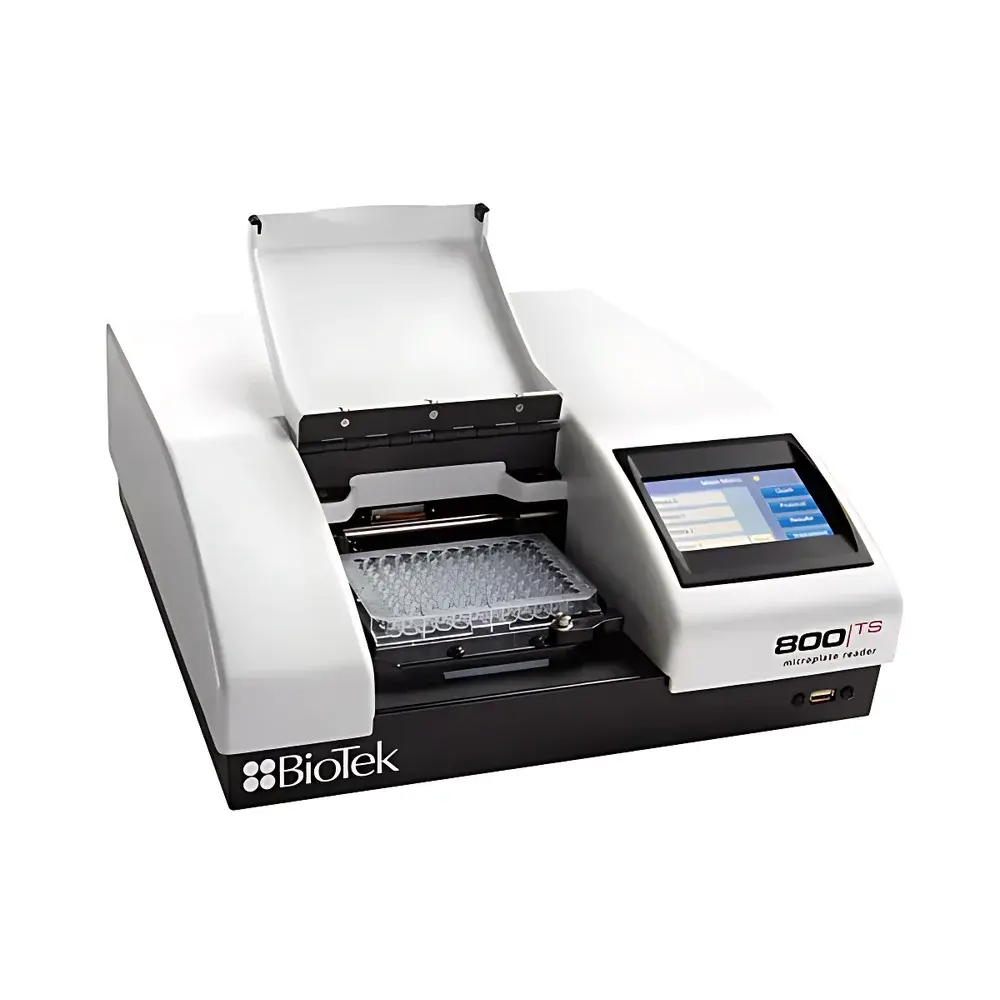
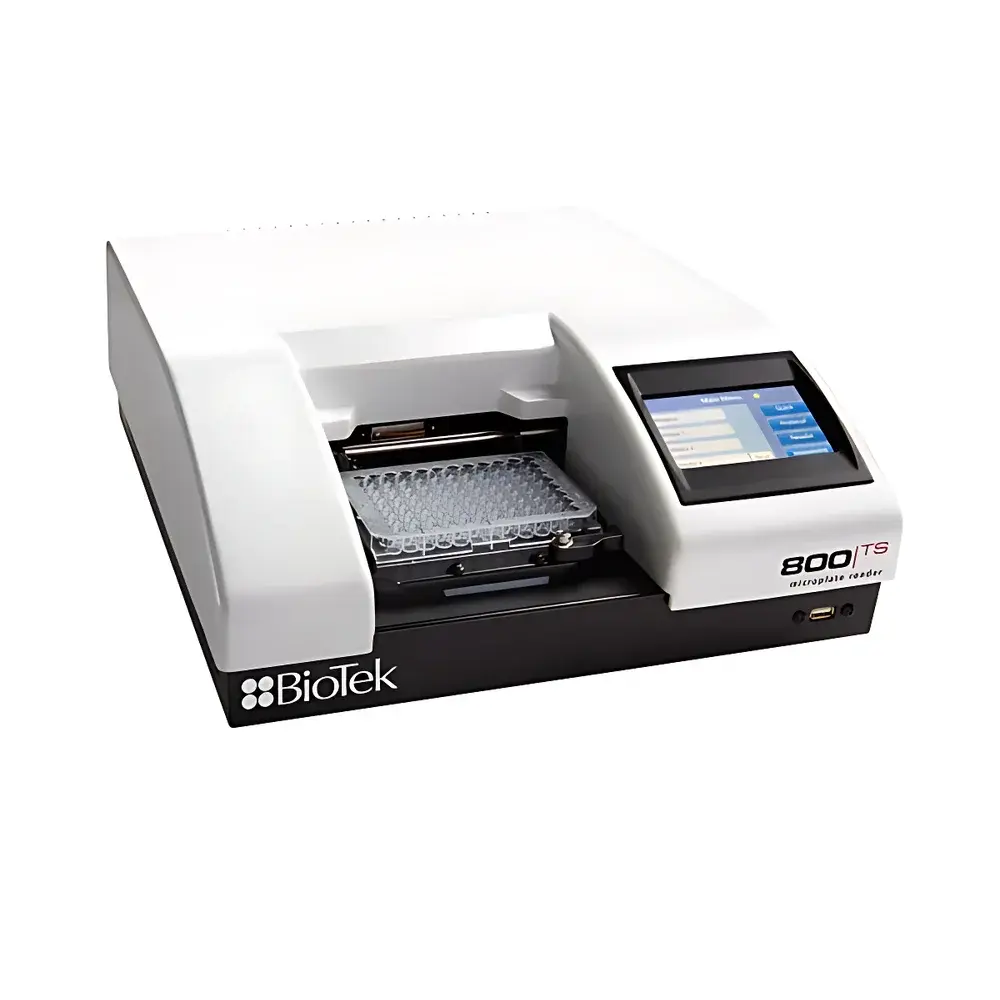
Agilent BioTek 800 TS Absorbance Microplate Reader
| Brand | Agilent Technologies |
|---|---|
| Origin | USA |
| Manufacturer | Agilent Technologies |
| Import Status | Imported |
| Model | 800 TS |
| Function Type | Absorbance-Only Microplate Reader |
| Automation Level | Fully Automated |
| Assay Modes | Endpoint, Kinetic, and Scanning |
| Curve Fitting Options | Multiple nonlinear regression models (e.g., 4PL, 5PL, linear, quadratic, log-log) |
| Detector Type | Photodiode-based UV-Vis spectrophotometric detector |
| Wavelength Range | 400–750 nm standard |
| Absorbance Range | 0–4.0 OD |
| Absorbance Linearity | ±1.0% ± 0.010 OD (0–2.0 OD at 405 nm) |
| Plate Read Time | 11 seconds per 96-well plate |
| Precision | ±1.0% ± 0.010 OD (0–2.0 OD at 405 nm) |
| Incubation Temperature | Up to 50 °C |
| Orbital Shaking | Linear and orbital modes |
| Supported Plate Formats | 6-, 12-, 24-, 48-, 96-, 384-well microplates |
| Filter Capacity | 5-position filter wheel |
| Onboard Storage | Internal memory + USB export capability |
| Software Platform | Integrated touchscreen interface + compatibility with Agilent BioTek Gen5 v3.11 or later |
Overview
The Agilent BioTek 800 TS Absorbance Microplate Reader is a dedicated, high-reliability photometric detection system engineered for precision endpoint, kinetic, and scanning absorbance assays in life science laboratories. Based on dual-beam photodiode optics with temperature-controlled sample compartment and integrated incubation, the instrument delivers reproducible optical density (OD) measurements across the visible spectrum (400–750 nm), with optional UV capability down to 340 nm. Its architecture follows standardized microplate reader design principles—employing fixed-pathlength detection geometry, calibrated reference beam compensation, and thermally stabilized optical train—to ensure compliance with fundamental performance criteria defined in CLSI EP10-A3 and ISO 15197:2013 for quantitative photometric instrumentation. Designed specifically for absorbance-based workflows—including ELISA, BCA/Lowry protein quantification, NAD(P)H-linked enzyme kinetics, and cell viability assays—the 800 TS provides traceable, GLP-ready data acquisition without fluorescence or luminescence modules, minimizing cross-platform interference and maintenance complexity.
Key Features
- Fully automated operation with intuitive 7-inch capacitive touchscreen interface—enabling rapid protocol setup, real-time parameter adjustment, and onboard result visualization without external PC dependency
- Integrated temperature-controlled incubation (ambient to 50 °C) with programmable ramping and hold profiles, supporting enzyme kinetics and cell-based assays requiring thermal stabilization
- Linear and orbital shaking modes with adjustable amplitude and duration, optimized for uniform reagent mixing in low-volume wells (e.g., 384-well formats)
- Five-position motorized filter wheel accommodating standard ANSI/SLAS-compliant filters; pre-aligned for minimal wavelength drift during sequential reads
- Onboard data storage with USB 2.0 export functionality—retaining assay metadata, raw OD values, curve-fit parameters, and QC logs in CSV and XML formats compliant with FDA 21 CFR Part 11 audit trail requirements when used with Gen5 software
- Factory-calibrated optical path using NIST-traceable absorbance standards; shipped with Performance Qualification (PQ) kit including certified calibration plate and documentation per ISO/IEC 17025 guidelines
Sample Compatibility & Compliance
The 800 TS supports all standard microplate formats from 6- to 384-well configurations, including ANSI/SLAS-compliant polystyrene, black/clear-bottom, and specialty plates (e.g., Terasaki). It accommodates opaque, transparent, and UV-transmissive substrates without hardware modification. The system meets IEC 61000-6-3 (EMC) and IEC 61010-1 (safety) standards for laboratory equipment. For regulated environments, its firmware and Gen5 software support user access control, electronic signatures, and audit-trail-enabled data handling aligned with GxP, USP , and ISO 13485 requirements. Routine verification follows Agilent’s PQ protocol, which includes wavelength accuracy (±2 nm), photometric linearity (per ASTM E275-21 Annex A1), and inter-plate repeatability (CV ≤ 1.5% at 1.0 OD).
Software & Data Management
The embedded operating system provides full assay control, real-time graphing, and basic statistical analysis (mean, SD, CV%, Z’, S/B). Raw data and processed results are exportable via USB to Agilent BioTek Gen5 v3.11+—a validated platform supporting advanced curve fitting (4PL, 5PL, sigmoidal), multi-plate normalization, kinetic modeling (Vmax, Km), and customizable report generation. Gen5 complies with 21 CFR Part 11 through role-based permissions, electronic signature workflows, and immutable audit trails. All data files include embedded metadata: timestamp, operator ID, plate map, instrument serial number, and environmental conditions (temperature, humidity if logged externally).
Applications
The 800 TS is routinely deployed in core facilities and QC labs for immunodiagnostics (ELISA), protein concentration determination (Bradford, BCA), enzymatic activity profiling (e.g., alkaline phosphatase, β-galactosidase), microbial growth monitoring (OD600), and cytotoxicity screening (MTT, XTT, resazurin). Its kinetic mode enables real-time monitoring of reaction progress over minutes to hours, while scanning mode facilitates well-to-well uniformity assessment or gradient-based assays. When paired with the Agilent BioTek 50 TS washer, it forms a compact, walk-away-ready ELISA workflow system meeting ISO 15189 pre-analytical validation benchmarks.
FAQ
Does the 800 TS support wavelength scanning across its full range?
Yes—it performs discrete-wavelength absorbance measurements at up to five user-defined wavelengths per read cycle, but does not offer continuous spectral scanning (i.e., no monochromator-based full-spectrum acquisition).
Can the instrument be integrated into LIMS or third-party automation systems?
Via Gen5’s COM/ActiveX and REST API interfaces, the 800 TS supports bidirectional communication with major LIMS platforms and robotic handlers compliant with SLAS-SDM and ANSI/SLAS standards.
Is UV-capable configuration factory-installed or field-upgradable?
UV extension (340 nm) requires factory installation of quartz optics and UV-optimized detector components; it is not a field-serviceable retrofit.
What validation documentation is provided with shipment?
Each unit ships with IQ/OQ documentation templates, PQ test report, NIST-traceable calibration certificate, and a complete set of SOPs for daily verification per CLSI EP17-A2.
How frequently must optical performance verification be performed?
Agilent recommends daily blank verification, weekly linearity checks using certified OD standards, and semiannual PQ testing—aligned with ISO/IEC 17025 internal audit cycles.
Related Products



