
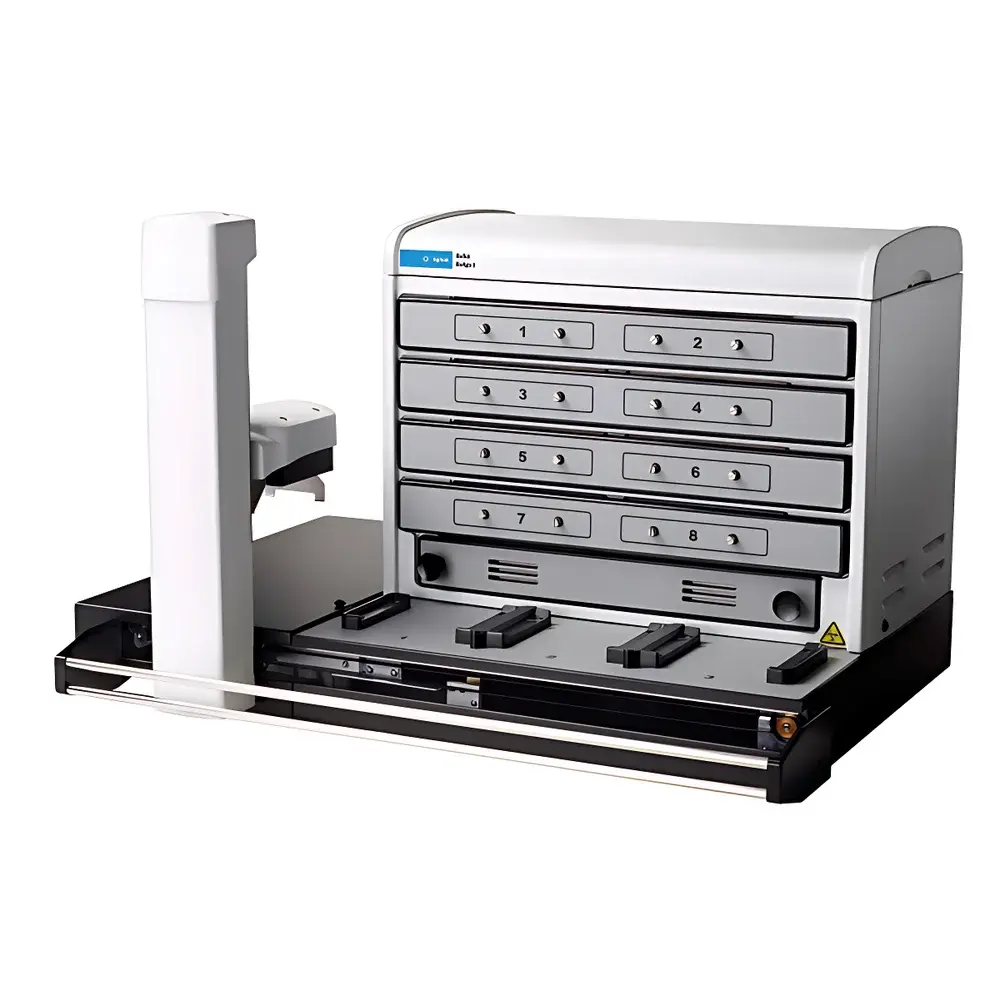
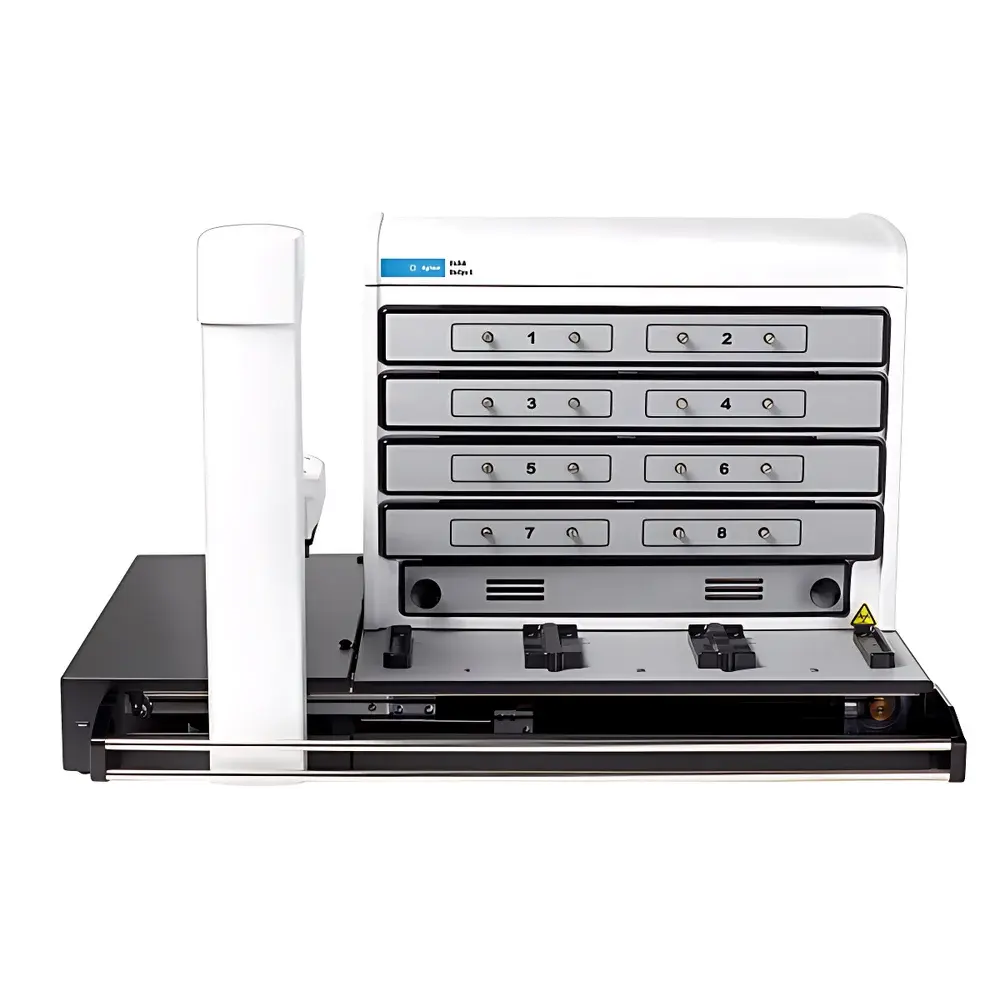
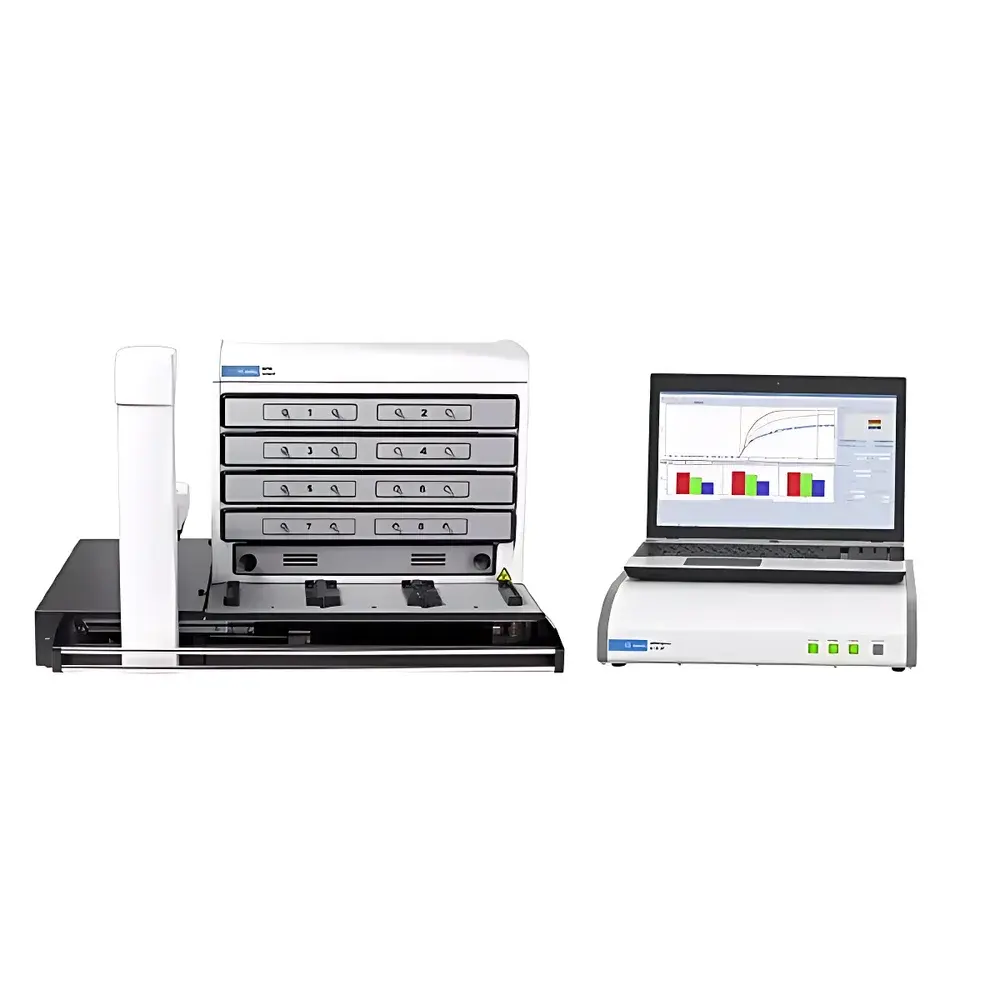
Agilent BioTek BioSpa 8 Automated Incubator for High-Content Cell Imaging Systems
| Brand | Agilent Technologies |
|---|---|
| Origin | USA |
| Manufacturer | Agilent Technologies |
| Import Status | Imported |
| Model | BioSpa 8 |
| Temperature Control | Up to 45 °C |
| Humidity Control | 80–95% RH |
| CO₂/O₂ Control | Yes |
| Microplate Capacity | 8 plates |
| Compatible Vessel Formats | 6–1536-well microplates, cell culture dishes |
Overview
The Agilent BioTek BioSpa 8 Automated Incubator is a precision-engineered environmental control module designed specifically for integration into high-content cell imaging and kinetic assay workflows. It operates on the principle of tightly regulated, real-time physiological parameter maintenance—enabling long-term, label-free or fluorescent live-cell assays under physiologically relevant conditions. Unlike conventional incubators, the BioSpa 8 functions as an intelligent node within a modular automation ecosystem, interfacing seamlessly with Agilent BioTek’s Cytation series imagers, Synergy multi-mode readers, ELx405 washers, and MultiFlo FX dispensers. Its core architecture supports end-to-end automation of complex protocols—including ELISA, proliferation assays, apoptosis kinetics, and phenotypic screening—without manual intervention across days or weeks. The system maintains sterility, thermal stability, gas composition fidelity, and humidity integrity throughout extended runs, directly addressing critical reproducibility challenges in primary cell and iPSC-based assays.
Key Features
- Integrated environmental control: Independent regulation of temperature (ambient to 45 °C), relative humidity (80–95% RH), CO₂ (0–20%), and O₂ (1–21%) with onboard sensors and closed-loop feedback.
- Eight-position plate handling: Accommodates up to eight standard microplates (6–1536-well) or cell culture dishes simultaneously, with programmable plate indexing and lid management (open/close/swap).
- OnDemand™ workflow flexibility: Enables dynamic insertion or removal of plates during active runs without halting incubation or compromising environmental stability—critical for staggered time-point acquisitions.
- Multi-user role-based access: Supports configurable user accounts with audit-trail–enabled permissions, experiment assignment, and real-time status visualization via web-enabled dashboard.
- Compact footprint (W × D × H: 45.7 × 61.0 × 40.6 cm): Designed for benchtop deployment or integration into Class II biological safety cabinets using optional mounting kits.
- Fail-safe monitoring: Continuous logging of all environmental parameters with timestamped data export (CSV, XML) and automatic alerting via email/SMS upon deviation from setpoints or hardware fault detection.
Sample Compatibility & Compliance
The BioSpa 8 supports a broad range of vessel formats essential for modern cell biology: ANSI/SLAS-compliant microplates (SBS footprint), Petri dishes (35–100 mm), chamber slides, and custom inserts compatible with Agilent BioTek’s Cytation imaging platforms. All internal surfaces are constructed from medical-grade stainless steel and antimicrobial-coated polymers, facilitating routine decontamination with 70% ethanol or hydrogen peroxide vapor. The system complies with ISO 13485 design controls for IVD-related instrumentation and meets electromagnetic compatibility (EMC) requirements per IEC 61326-1. Environmental data logging adheres to ALCOA+ principles (Attributable, Legible, Contemporaneous, Original, Accurate, Complete, Consistent, Enduring, Available), supporting GLP and GMP-aligned workflows where traceability of incubation history is required for regulatory submissions.
Software & Data Management
BioSpa software (v3.x and later) provides unified scheduling, environmental monitoring, and cross-device orchestration through native integration with Gen5 3.x and LHC (Live-Cell Histology Capture) software suites. Experimental timelines—including plate loading sequences, gas ramp profiles, humidity setpoint transitions, and imaging trigger points—are defined graphically or via script-based protocols. All system events—including door openings, sensor calibrations, and firmware updates—are recorded in an immutable audit trail compliant with FDA 21 CFR Part 11 requirements when configured with electronic signatures and role-based authentication. Raw environmental logs synchronize automatically with associated image or absorbance datasets, enabling correlation of phenotypic changes with precise incubation histories. Data exports support FAIR principles (Findable, Accessible, Interoperable, Reusable) via standardized metadata schemas.
Applications
- Long-term live-cell imaging: Sustained observation of migration, division, and morphological dynamics over 72+ hours with minimal phototoxicity and environmental drift.
- Functional cytotoxicity screening: Real-time assessment of membrane integrity, mitochondrial health, and caspase activation under controlled hypoxia or hypercapnia.
- 3D spheroid and organoid culture monitoring: Stable humidity and gas gradients enable reproducible growth and differentiation of complex co-cultures.
- Automated ELISA and immunoassay workflows: Integrated incubation, washing, and detection reduce hands-on time while improving inter-assay consistency.
- CRISPR/Cas9 editing validation: Time-resolved tracking of editing efficiency and clonal expansion under selective pressure conditions.
FAQ
Does the BioSpa 8 support independent O₂ control in hypoxic mode?
Yes—it delivers precise O₂ regulation between 1% and 21% with ±0.2% accuracy, using electrochemical sensors and proportional solenoid valves calibrated against NIST-traceable standards.
Can environmental data be exported in compliance with 21 CFR Part 11?
Yes—when deployed with validated BioSpa software v3.4+, full electronic signature capability, audit trail review tools, and secure user authentication meet Part 11 requirements for regulated environments.
Is the BioSpa 8 compatible with non-Agilent imaging systems?
It supports third-party devices via RS-232, USB HID, and TCP/IP interfaces using Agilent’s open API (RESTful JSON endpoints), though full automation sequencing requires Gen5 or LHC middleware.
What maintenance is required for sustained CO₂/O₂ sensor performance?
Sensors undergo automatic zero-point calibration daily; full recalibration is recommended every 6 months using certified gas mixtures, with logs retained in the system database.
How does OnDemand mode affect environmental recovery time after plate exchange?
Recovery to setpoint (±0.3 °C, ±2% RH, ±0.1% CO₂) occurs within ≤90 seconds post-door closure, verified by internal validation protocols per ISO 15197 Annex B.




