
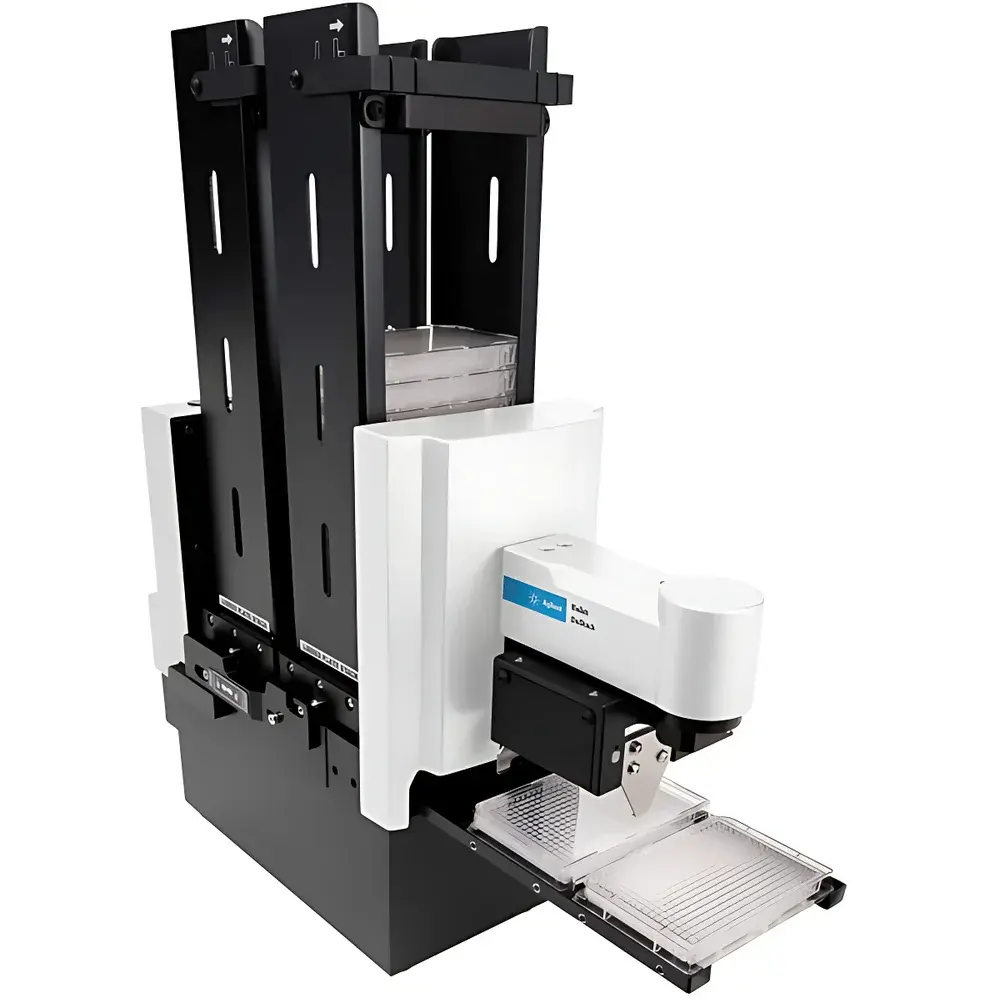
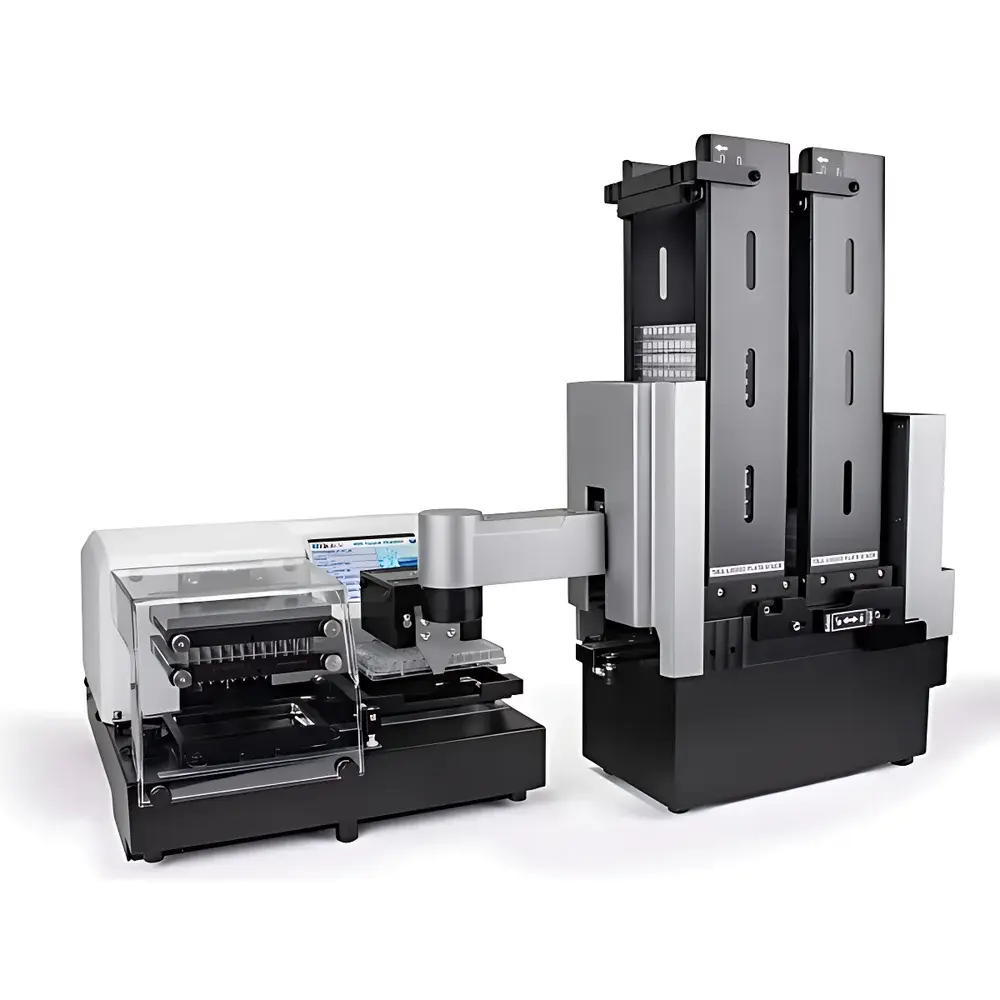
Agilent BioTek BioStack Microplate Stacker
| Brand | Agilent Technologies |
|---|---|
| Origin | USA |
| Manufacturer Type | Original Equipment Manufacturer (OEM) |
| Import Status | Imported |
| Model | BioStack |
| Instrument Category | Biopharmaceutical Applications |
| Plate Capacity Options | 10 / 30 / 50 microplates |
| Compatible Well Formats | 6–1536-well plates |
| Automation Level | Fully automated de-lidding and re-lidding |
| Integration Ready | Yes — with Agilent BioTek washers, dispensers, multimode readers, imagers, and Synergy Neo2 systems |
| Regulatory Compliance | Designed for GLP/GMP environments |
Overview
The Agilent BioTek BioStack Microplate Stacker is an engineered component of laboratory automation infrastructure, designed to enable unattended, high-integrity microplate handling in life science and biopharmaceutical workflows. Operating on a precision electromechanical transport architecture, the BioStack executes reliable plate staging, orientation correction, vertical stacking, and lid management—without manual intervention. Its core function is to serve as a bidirectional buffer between upstream sample preparation modules (e.g., liquid handlers or incubators) and downstream analytical instruments (e.g., multimode readers, high-content imagers, or plate washers). Unlike generic stackers, the BioStack integrates natively with Agilent BioTek’s instrument control ecosystem, ensuring deterministic timing, positional repeatability, and protocol-synchronized handoff across devices. It supports standard ANSI/SLAS-compliant microplates ranging from 6-well to 1536-well formats—including deep-well, skirted, and low-profile variants—and accommodates both lidded and lidless configurations via programmable de-lidding and re-lidding mechanisms. This capability is critical for cell-based assays requiring sterility maintenance, kinetic time-course studies spanning hours or days, and multiplexed screening where plate identity integrity must be preserved throughout transit.
Key Features
- Fully automated lid removal and reapplication using vacuum-assisted gripper modules—minimizing contamination risk and preserving assay integrity in sensitive cell culture workflows.
- Modular plate capacity: Interchangeable stacker trays support 10-, 30-, or 50-plate configurations, enabling scalability from benchtop validation to production-scale HTS operations.
- Compact footprint (≤ 30 cm depth) allows installation inside biosafety cabinets (BSCs) or under fume hoods—critical for aseptic cell handling and regulated bioprocessing environments.
- ANSI/SLAS-compliant plate registration ensures consistent X/Y/Z positioning across all supported well formats (6–1536-well), eliminating alignment drift during repeated robotic transfers.
- Real-time status monitoring via Ethernet/IP interface; integrated error detection for plate misalignment, lid jamming, or sensor timeout—enabling rapid fault isolation without interrupting adjacent instruments.
- Tool-free tray exchange and tool-less mounting brackets facilitate rapid reconfiguration during lab layout changes or platform upgrades.
Sample Compatibility & Compliance
The BioStack accepts all commercially available microplates conforming to ANSI/SLAS standards—including polypropylene, polystyrene, cyclo-olefin copolymer (COC), and glass-bottom plates. Optional slide adapters (sold separately) allow secure storage and retrieval of standard microscope slides for imaging-based assays. The system complies with IEC 61000-6-2 (electromagnetic immunity) and IEC 61000-6-4 (emission) standards. When deployed within Agilent BioTek’s Gen5 software environment under validated SOPs, it supports data integrity requirements aligned with FDA 21 CFR Part 11, EU Annex 11, and ISO/IEC 17025. Audit trails record all plate movements, lid operations, error events, and user-initiated commands—including timestamps, operator IDs, and instrument context.
Software & Data Management
BioStack operation is managed through Agilent BioTek’s Gen5 Data Analysis Software (v3.12+), which provides protocol-driven scheduling, event logging, and cross-instrument synchronization. Gen5 supports scripting via Python API extensions for custom workflow orchestration—including conditional branching based on reader output or environmental sensor input. All plate-handling actions generate timestamped metadata embedded in the raw data file (.g5d), ensuring full traceability from plate loading to final analysis. Electronic signatures, role-based access control, and encrypted local database storage are available for GxP-regulated deployments. Remote diagnostics and firmware updates are delivered via secure HTTPS channels with certificate pinning.
Applications
- Uninterrupted kinetic assays requiring >24-hour plate cycling (e.g., calcium flux, mitochondrial membrane potential, or viral cytopathic effect monitoring).
- High-content screening (HCS) workflows integrating BioStack with Cytation imagers for serial time-point acquisition across multi-plate experiments.
- Cell-based potency testing in biologics development, where sterile plate handling and lid integrity directly impact assay reproducibility.
- Automated ELISA and immunoassay pipelines combining BioStack with ELx405 washers and Synergy Neo2 readers under single-software control.
- Biobanking and compound library management—supporting barcoded plate tracking and inventory reconciliation via optional RFID integration.
FAQ
Can BioStack handle plates with adhesive seals or heat-sealed films?
Yes—BioStack 4 and Neo models support programmable seal puncture and peel routines using optional thermal or mechanical seal removal modules (requires configuration during ordering).
Is BioStack compatible with third-party liquid handlers or readers?
Native integration is optimized for Agilent BioTek instruments. Limited interoperability with non-BioTek platforms is possible via TTL or RS-232 hardware triggers, but full feature parity (e.g., lid management, error recovery) requires Gen5 software control.
What safety certifications does BioStack hold for use in BSCs?
It meets UL 61010-1 and CSA C22.2 No. 61010-1 for electrical safety and is rated for Class II A2 biosafety cabinet use when installed with approved airflow clearance (≥15 cm rear clearance recommended).
Does BioStack support barcode scanning for plate identification?
Yes—integrated 2D barcode readers (optional accessory) enable automatic plate ID capture at load/unload points, with metadata mapped to Gen5 experiment logs.
How is calibration maintained over long-term operation?
BioStack employs self-calibrating optical encoders and homing sensors; routine verification is performed via Gen5’s built-in diagnostic suite, which generates calibration reports compliant with ISO/IEC 17025 documentation requirements.





