
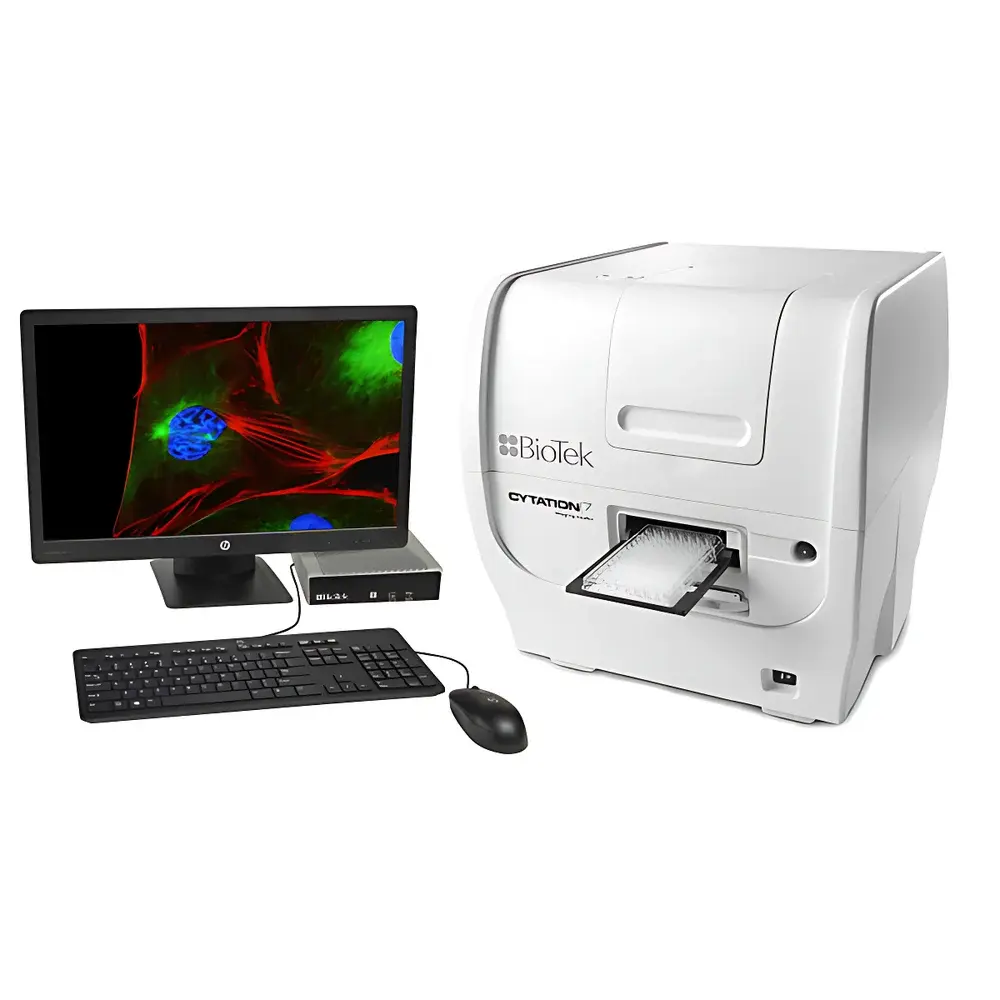
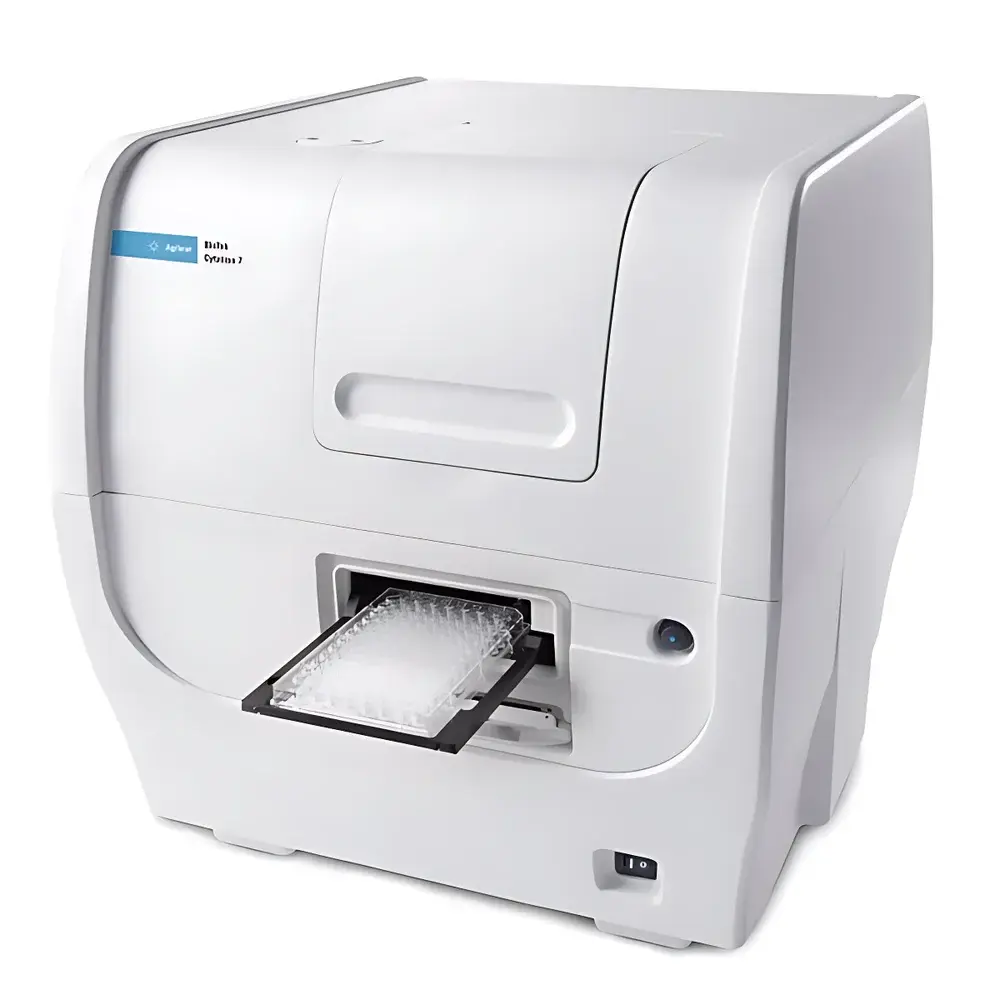
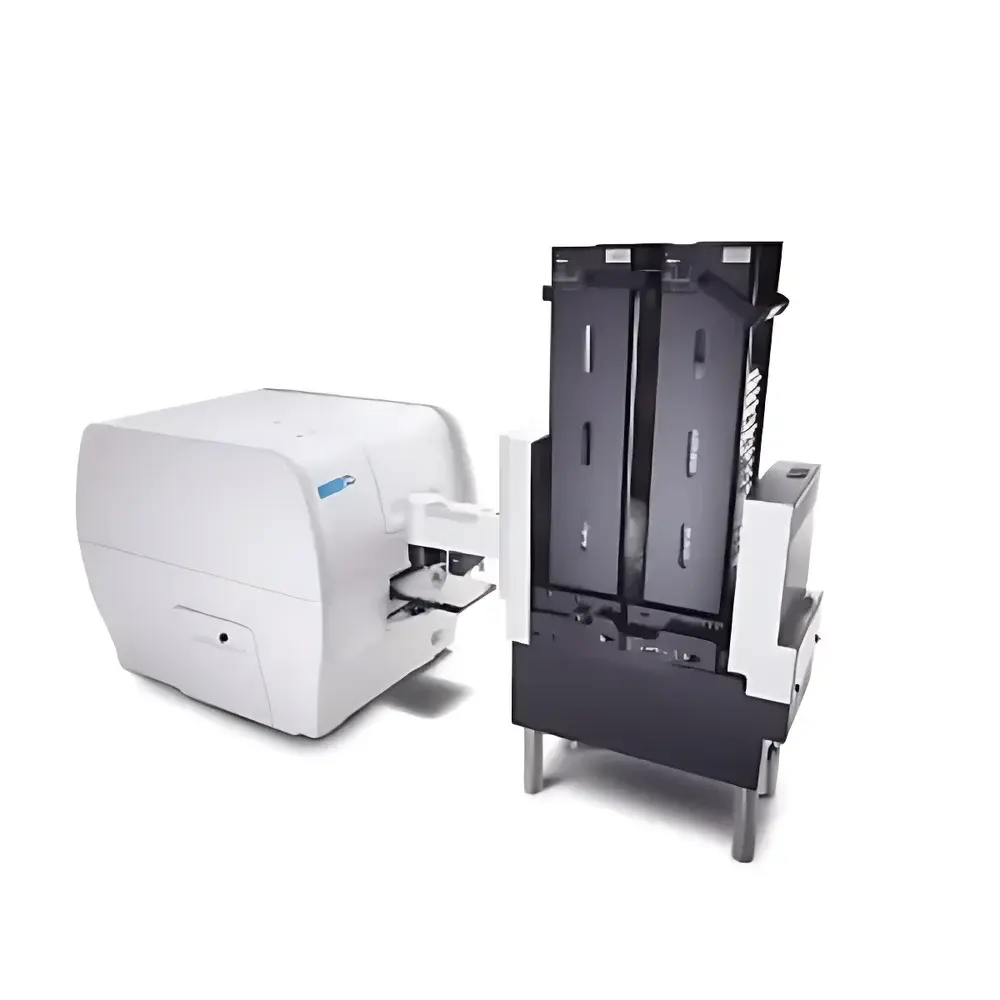
Agilent BioTek Cytation 7 Cell Imaging Multi-Mode Reader
| Brand | Agilent Technologies |
|---|---|
| Origin | USA |
| Manufacturer Type | Original Equipment Manufacturer (OEM) |
| Product Category | Imported Instrument |
| Model | Cytation 7 |
| Pricing | Available Upon Request |
Overview
The Agilent BioTek Cytation 7 is an integrated cell imaging multi-mode reader engineered for high-content, quantitative cellular analysis in microplate-based workflows. It uniquely combines automated upright and inverted widefield fluorescence microscopy with a full-featured monochromator-based microplate detection platform—enabling simultaneous acquisition of morphological, spatial, and biochemical data from the same sample. Its dual-microscope architecture operates on fundamental optical principles: inverted imaging leverages trans-illumination (fluorescence, brightfield, color brightfield) for live-cell and adherent culture analysis, while upright epifluorescence/reflectance imaging supports surface-sensitive assays such as ELISpot, colony enumeration, and slide-based tissue or material inspection. The system’s core detection modalities—including UV-Vis absorbance, tunable-bandwidth fluorescence intensity, luminescence, and digital imaging—are unified under a single hardware platform and controlled via Gen5 software, ensuring experimental reproducibility and regulatory traceability across GLP and GMP environments.
Key Features
- Dual-microscope architecture: Integrated inverted microscope (1.25×–60× air objectives) and upright reflectance microscope for complementary cellular and surface-level imaging
- Monochromator-based detection: Continuously adjustable excitation/emission bandwidths (1 nm increments) for optimized assay specificity and sensitivity across absorbance, fluorescence intensity, and luminescence modes
- Automated Z-stack, time-lapse, montage, and multi-color imaging: Supports quantitative subcellular localization, co-localization, and dynamic response profiling
- Four-zone independent temperature control (up to 45 °C) with Peltier-cooled condenser and configurable CO2/O2 regulation for long-term live-cell experiments
- High-resolution 16-bit monochrome CMOS camera (Sony sensor) with low-noise performance for precise pixel-intensity quantification
- Motorized XYZ stage with joystick control, auto-focus laser, and optional liquid handling integration (e.g., Agilent BioStack or third-party pipetting systems)
- Take3™ and Take3 Trio™ micro-volume platforms enabling parallel analysis of up to 48 samples per run without plate transfer
Sample Compatibility & Compliance
The Cytation 7 accommodates standard microplate formats from 6- to 1536-well, as well as non-traditional substrates including glass slides, chambered coverslips, Petri dishes, T25 flasks, hemocytometers, and custom-patterned surfaces. Its environmental control system meets ASTM E2927-22 requirements for incubation stability during extended imaging sessions. All instrument operations—including image acquisition parameters, ROI definitions, analysis algorithms, and result exports—are fully auditable within Gen5 software, supporting compliance with FDA 21 CFR Part 11, ISO/IEC 17025, and USP guidelines for analytical instrument qualification. Data integrity safeguards include electronic signatures, user-access tiers, and immutable audit trails for method development, validation, and routine QC/QA use.
Software & Data Management
Gen5 v3.12+ software serves as the central interface for instrument control, protocol design, image processing, and statistical reporting. It features batch-processing pipelines for automated ROI identification, object segmentation, intensity thresholding, and morphometric analysis (e.g., nuclear area, cytoplasmic texture, neurite length). The software enables hierarchical region-of-interest selection: initial low-magnification scanning identifies candidate wells or fields; users then define high-magnification ROIs for targeted imaging—reducing file size and storage overhead by >70% compared to full-plate high-res capture. Export options include TIFF (16-bit), CSV, and structured JSON for LIMS integration. Gen5 also supports macro scripting (VBScript), API connectivity for workflow orchestration, and secure cloud backup via Agilent’s enterprise deployment options.
Applications
- High-content screening (HCS): Quantitative analysis of cell viability, proliferation, apoptosis, and translocation events using multiplexed fluorescent probes
- ELISpot and FluoroSpot: Automated spot detection, sizing, and cytokine quantification via upright reflectance imaging
- 3D spheroid and organoid characterization: Z-stack reconstruction, volume measurement, and viability gradient mapping
- Microbial colony enumeration and phenotypic profiling on agar plates or membranes
- Cell migration and wound-healing assays monitored via time-lapse brightfield imaging
- Transfection efficiency optimization using GFP/RFP reporter expression coupled with automated well-scoring
- Co-culture interaction studies leveraging multi-channel fluorescence and spatial proximity metrics
FAQ
Does the Cytation 7 support live-cell imaging over extended durations?
Yes—its four-zone thermal control, humidified CO2/O2 regulation, and anti-condensation Peltier system enable stable imaging for up to 72 hours without media evaporation or focus drift.
Can Gen5 software perform machine learning–based segmentation?
Gen5 includes rule-based and threshold-driven segmentation; for deep-learning segmentation (e.g., U-Net), exported TIFF stacks are compatible with third-party tools like CellProfiler, ilastik, or Python-based PyTorch pipelines.
Is the upright imaging module field-serviceable as an upgrade?
Yes—the upright reflectance module is available as a factory-installed option or field-upgrade kit, with full calibration and validation documentation provided.
What plate types are supported for Z-stack acquisition?
All standard black, white, and clear-bottom microplates (including µClear® and TC-treated surfaces) are supported; optimal Z-resolution is achieved with plates having ≤1.2 mm bottom thickness and refractive index matching.
How does the system ensure assay reproducibility across operators?
Gen5 enforces method locking, parameter versioning, and electronic signature enforcement—ensuring identical acquisition and analysis settings across users, shifts, and sites.




