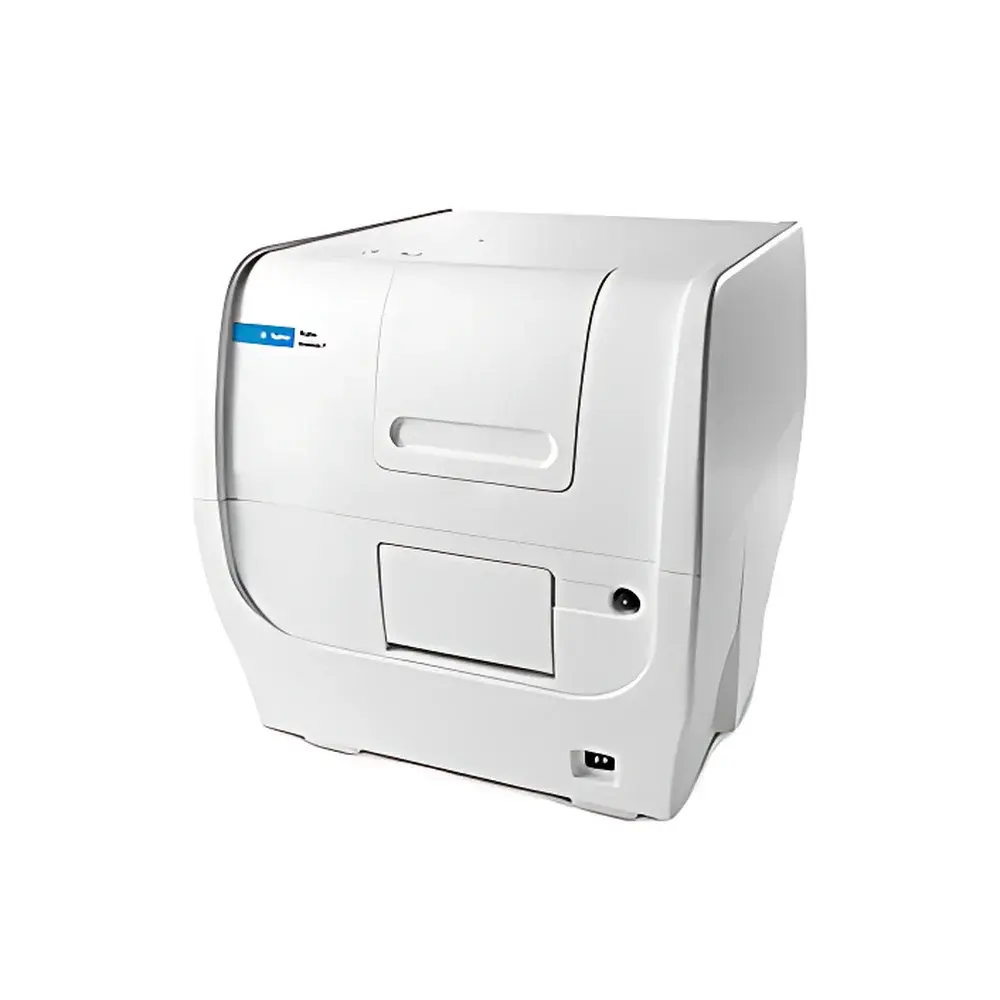
Agilent BioTek Cytation 7 High-Content Cell Imaging and Multi-Mode Detection System
| Brand | Agilent Technologies |
|---|---|
| Origin | USA |
| Manufacturer Type | Original Equipment Manufacturer (OEM) |
| Product Category | Imported Instrument |
| Model | Cytation 7 |
| Temperature Control Range | Up to 45 °C |
| Throughput | High-speed automated imaging and detection |
| Cooling Option | Optional Peltier-based cooling module |
| Environmental Control | Integrated gas control (CO₂/O₂) capability |
| Automation Interface | Compatible with robotic liquid handlers and stackers |
Overview
The Agilent BioTek Cytation 7 High-Content Cell Imaging and Multi-Mode Detection System is an integrated platform engineered for quantitative, label-free and fluorescence-based cellular phenotyping in microplate formats. It combines dual-path optical architecture—patented upright and inverted digital microscopy—with fourth-generation monochromator-based multimode detection (absorbance, fluorescence intensity, luminescence, time-resolved fluorescence, and fluorescence polarization). This hybrid design enables simultaneous or sequential acquisition of high-resolution morphological data and functional assay readouts from the same well, without requiring instrument reconfiguration. The system operates on the principle of widefield epifluorescence and brightfield microscopy, augmented by precision motorized Z-stack acquisition, autofocus algorithms, and adaptive illumination control. Its modular architecture supports live-cell kinetics under physiologically relevant conditions—including temperature regulation up to 45 °C, optional CO₂/O₂ gas control, and Peltier-assisted cooling—making it suitable for longitudinal studies across primary cells, iPSC-derived models, 3D spheroids, and co-culture systems.
Key Features
- Dual-path optical engine: Independent upright and inverted imaging modules enable optimal sample access—from adherent monolayers (inverted) to tissue sections, ELISpot membranes, or gel-based assays (upright).
- 4-Zone independent temperature control: Ensures uniform thermal stability across all 96-/384-well plate zones, minimizing edge effects and condensation during extended incubations.
- Fourth-generation monochromator system: Offers continuously adjustable excitation/emission bandwidths (1–50 nm), enabling precise spectral optimization for multiplexed fluorescent probes (e.g., FITC, TRITC, Cy5, Hoechst) while maintaining signal-to-noise integrity.
- Hit-pick functionality: Automates selection and re-plating of individual wells or sub-regions based on user-defined image or assay thresholds—critical for lead identification in phenotypic screening campaigns.
- Integrated environmental control: Optional gas module supports programmable CO₂ (0–20%) and O₂ (1–21%) regulation, validated for hypoxia modeling and stem cell maintenance.
- Robust automation readiness: Standard SLAS/ANSI-compliant footprint; compatible with third-party stackers, liquid handlers, and LIMS via RS-232, USB, and Ethernet interfaces.
Sample Compatibility & Compliance
The Cytation 7 accommodates standard microplate formats (6–1536-well), chambered coverslips, glass-bottom plates, and specialized assay substrates (e.g., collagen-coated, ultra-low attachment, or membrane inserts). It supports both fixed and live-cell applications—including immunocytochemistry, mitochondrial dynamics tracking, nuclear translocation assays, neurite outgrowth quantification, and colony formation analysis. All hardware and software components comply with ISO 13485:2016 (for IVD-related use cases), and Gen5 software meets FDA 21 CFR Part 11 requirements for electronic records and signatures when configured with audit trail, user authentication, and electronic signature modules. System validation documentation aligns with GLP and GMP laboratory practices for preclinical assay development.
Software & Data Management
Gen5 3.x software provides a unified interface for instrument control, acquisition protocol design, image segmentation, and quantitative analysis. Built-in algorithms support object-based morphometrics (cell count, area, circularity, intensity distribution), subcellular compartmentalization (nucleus/cytoplasm ratio), and kinetic trend modeling. Data export options include CSV, TIFF (16-bit), OME-TIFF, and HDF5—ensuring compatibility with downstream platforms such as ImageJ/Fiji, MATLAB, Python (scikit-image, napari), and commercial AI training environments. The software supports batch processing, template-driven workflows, and customizable report generation with embedded statistical summaries (mean ± SD, ANOVA, dose-response curve fitting).
Applications
- Phenotypic high-content screening (HCS) in oncology, neurodegeneration, and metabolic disease models
- 3D organoid and spheroid viability, size, and structural integrity assessment
- Cell migration and wound-healing assays with time-lapse Z-stack acquisition
- Immunomodulation profiling via cytokine secretion (ELISpot), phagocytosis, and T-cell activation
- Stem cell differentiation monitoring using lineage-specific marker expression and morphology metrics
- Toxicity evaluation including mitochondrial membrane potential (TMRM), lysosomal mass (LysoTracker), and DNA damage (γH2AX foci)
FAQ
Does the Cytation 7 support confocal imaging?
No—it utilizes high-sensitivity widefield fluorescence microscopy with computational deconvolution options; confocal capability requires external integration with compatible spinning-disk or laser-scanning systems.
Can Gen5 software be deployed in networked or virtualized environments?
Yes—Gen5 supports Windows Server deployments, remote desktop sessions, and Citrix Virtual Apps; concurrent licensing models are available for enterprise-scale rollouts.
Is calibration traceable to NIST standards?
Fluorescence intensity and absorbance modules include factory-calibrated reference standards; users may perform routine verification using Agilent’s certified QC plates (PN: 7270000-101) aligned to NIST-traceable photometric references.
What maintenance intervals are recommended for optical alignment?
No routine optical realignment is required; the system features solid-state optical mounts and factory-aligned light paths. Annual preventive maintenance includes lamp output verification, focus calibration, and temperature uniformity mapping per Agilent Service Bulletin SB-CYT7-2023-01.