
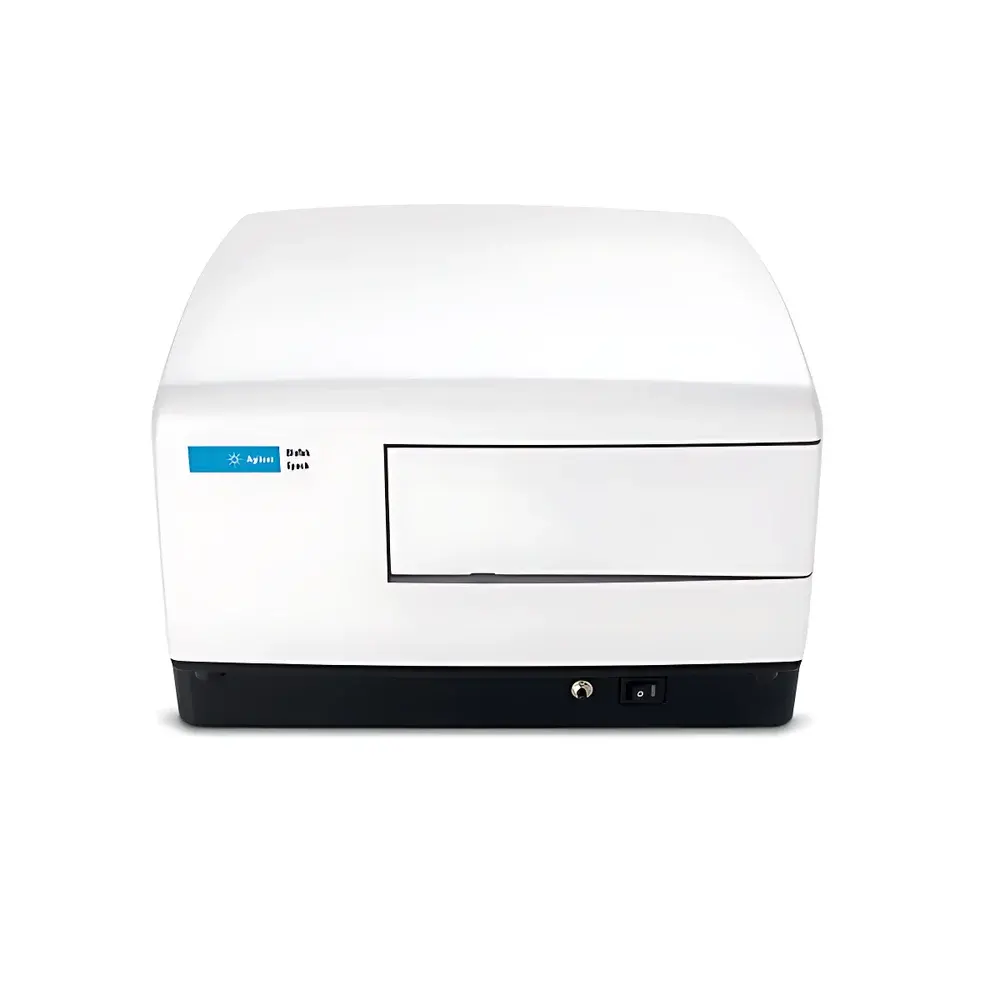
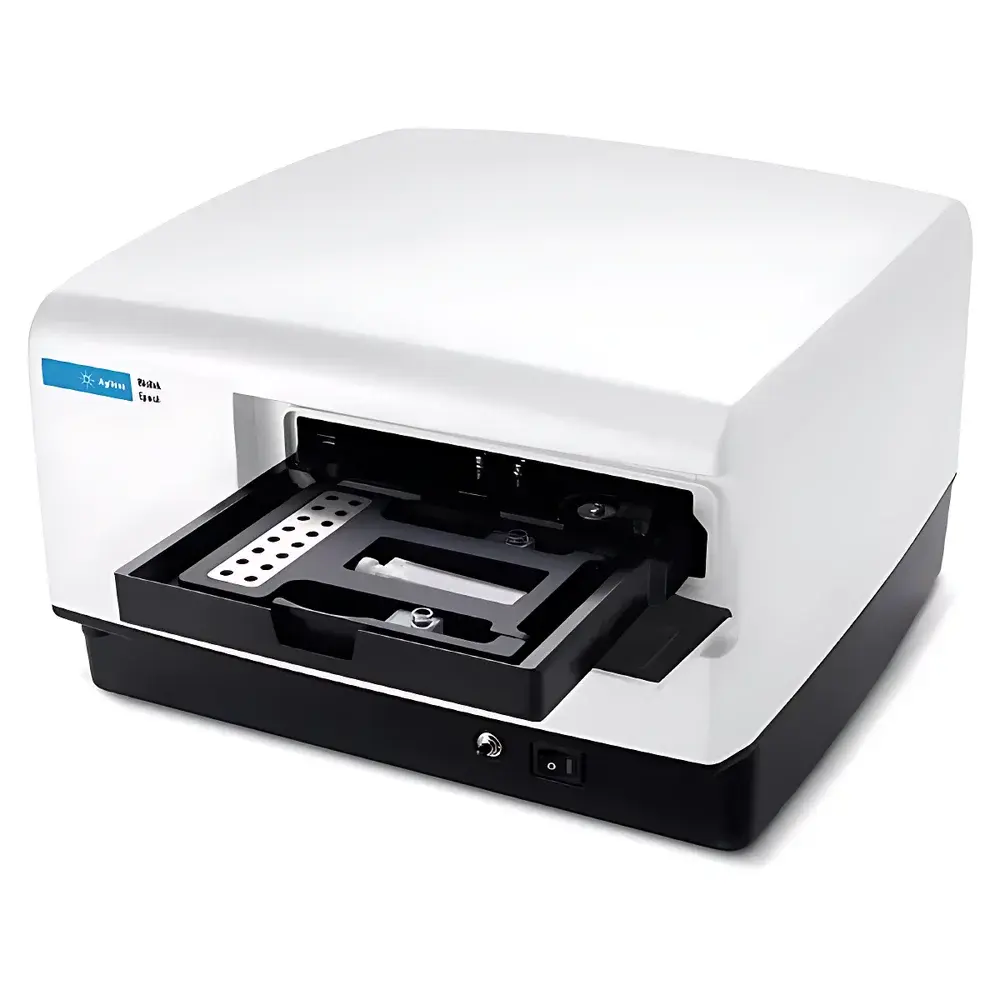
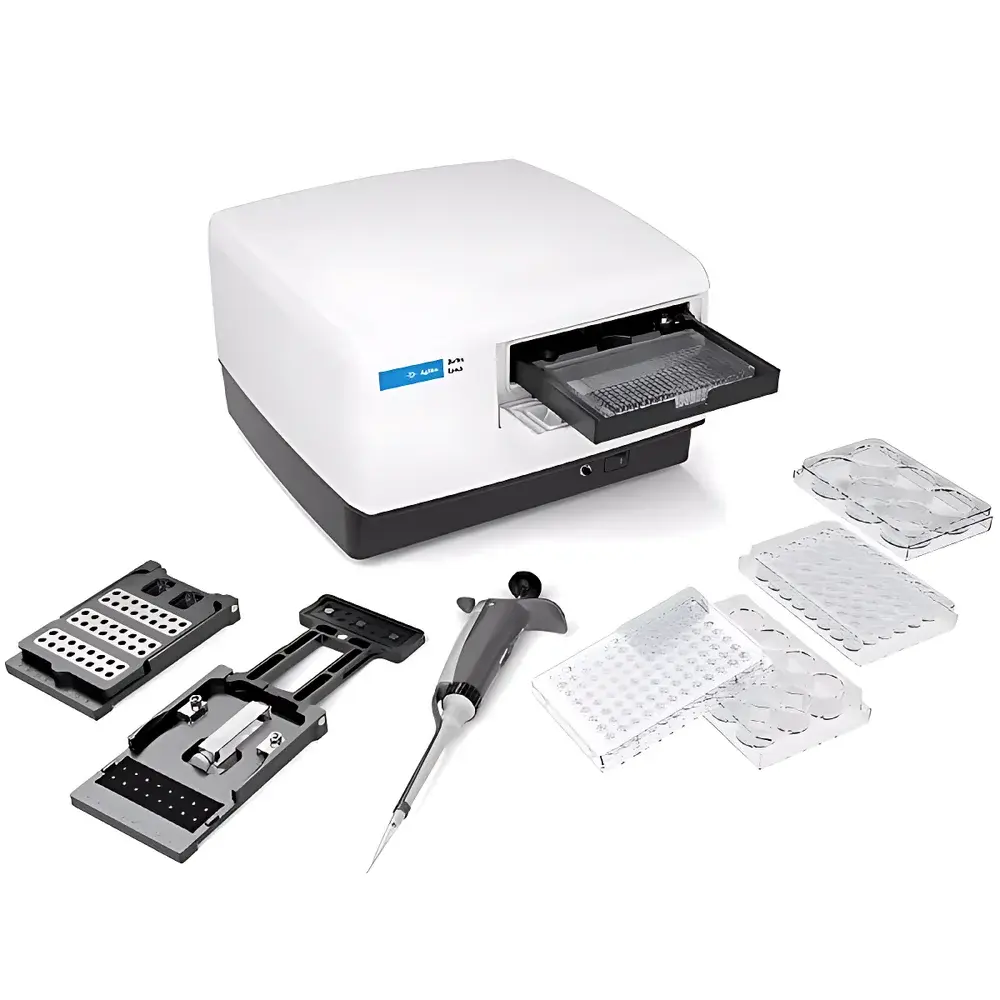
Agilent BioTek Epoch Microplate Spectrophotometer
| Brand | Agilent Technologies |
|---|---|
| Origin | USA |
| Manufacturer Type | Original Equipment Manufacturer (OEM) |
| Import Status | Imported |
| Model | Epoch |
| Function Type | Absorbance-Only Microplate Reader |
| Automation Level | Fully Automated |
| Detector Type | Photodiode Array (PDA) |
| Wavelength Range | 200–999 nm |
Overview
The Agilent BioTek Epoch Microplate Spectrophotometer is a dedicated absorbance-based microplate reader engineered for precision, reproducibility, and operational efficiency in life science laboratories. It employs a high-stability grating monochromator optical architecture—eliminating the need for interference filters—to deliver continuous, stepless wavelength selection across the full ultraviolet-to-visible spectrum (200–999 nm). This design ensures accurate spectral fidelity, minimal stray light, and long-term photometric stability without mechanical filter wheels or alignment drift. Unlike hybrid multimode readers, the Epoch is purpose-built for absorbance measurements only, enabling optimized optical path geometry, reduced thermal noise, and enhanced signal-to-noise ratio in endpoint, kinetic, and full-spectrum scan assays. Its robust mechanical platform and thermally stabilized optics support consistent performance under routine QC, academic research, and regulated bioprocessing environments.
Key Features
- Grating-based monochromator system with 200–999 nm continuous wavelength selection, providing true spectral flexibility without filter exchange or calibration recalibration
- High-sensitivity photodiode array (PDA) detector optimized for microplate absorbance quantification, delivering linear dynamic range up to 4.0 OD with <±0.003 OD accuracy at 0.5 OD
- Native compatibility with Agilent BioTek Take3 and Take3 Trio micro-volume platforms—enabling direct quantification of DNA, RNA, and proteins from as little as 2 µL sample volume per well
- Support for standard microplate formats including 6-, 12-, 24-, 48-, 96-, 384-, and 1536-well plates, with automatic plate recognition and onboard barcode scanning (optional)
- Fully automated operation via seamless integration with Agilent BioTek BioStack microplate stackers—configurable for 10-, 30-, or 50-plate capacity and compliant with ANSI/SLAS footprint standards
- Thermally managed optical bench and low-drift lamp source ensure <0.002 OD/h baseline stability over extended kinetic runs
Sample Compatibility & Compliance
The Epoch accommodates a broad range of biological and biochemical sample types—including nucleic acids, purified proteins, enzyme reaction mixtures, cell lysates, and colorimetric assay reagents—in both standard microplates and specialized micro-volume consumables. Its optical path length correction algorithms support accurate concentration calculation across variable well geometries and meniscus effects. From a regulatory standpoint, the system supports GLP- and GMP-aligned workflows through Gen5 software’s audit-trail-enabled user management, electronic signature capability, and instrument method locking. While the Epoch itself is not FDA 21 CFR Part 11–certified out-of-the-box, its Gen5 software (v3.11+) provides configurable features for Part 11 compliance—including role-based access control, change history logging, and secure data export—when deployed within validated laboratory IT infrastructure.
Software & Data Management
Controlled exclusively by Agilent BioTek Gen5 Microplate Reader Software, the Epoch leverages a modular, scriptable interface designed for both novice and advanced users. Gen5 supports protocol-driven assay setup, real-time kinetic visualization, multi-parameter curve fitting (e.g., Michaelis-Menten, sigmoidal dose-response), and integrated statistical analysis (ANOVA, t-test, Z’-factor). Raw absorbance data are stored in vendor-neutral .txt and .csv formats; proprietary .gen5 project files include full metadata (instrument settings, timestamps, user IDs, plate maps). Data export complies with MIAME and MIAPE reporting guidelines. Optional Gen5 Secure Edition enables 21 CFR Part 11–compliant deployment with electronic signatures, audit trails, and password-protected method libraries—suitable for quality control labs operating under ISO 17025 or pharmaceutical QA/QC frameworks.
Applications
The Epoch is routinely deployed in nucleic acid quantification (A260/A280 ratios, dsDNA/RNA concentration), protein assay validation (Bradford, BCA, Lowry), ELISA endpoint detection, enzyme kinetics (e.g., β-galactosidase, LDH, HRP), microbial growth monitoring (OD600), and small-molecule absorbance profiling. Its wide spectral range supports legacy and emerging colorimetric chemistries—including nitroblue tetrazolium (NBT), p-nitrophenyl phosphate (pNPP), and resazurin-based viability assays—without hardware modification. In academic core facilities, it serves as a high-throughput alternative to cuvette-based spectrophotometers for library screening and combinatorial assay development. Its deterministic optical response and low inter-run variability make it suitable for longitudinal studies requiring cross-experiment comparability.
FAQ
Does the Epoch support fluorescence or luminescence detection?
No. The Epoch is a dedicated absorbance-only microplate reader. For multimode capabilities, consider the Agilent BioTek Synergy series.
Can I use third-party microplates with the Epoch?
Yes—standard ANSI/SLAS-compliant plates from Corning, Greiner, Sarstedt, and others are fully supported. Non-standard plates require manual configuration of plate map and height offset.
Is Gen5 software included with the instrument?
Yes. Each Epoch ships with a perpetual license for Gen5 v3.x (including all minor updates). Major version upgrades may require separate maintenance agreement.
What maintenance is required beyond lamp replacement?
The xenon flash lamp has a rated lifetime of ≥1×10⁹ flashes. No routine optical alignment or detector recalibration is required; only periodic cleaning of the plate carrier and optical window is recommended.
How does the Epoch handle spectral scatter in turbid samples?
Gen5 includes optional pathlength correction algorithms (e.g., “Turbidity Correction” module) that apply dual-wavelength referencing (e.g., 750 nm background subtraction) to mitigate scattering artifacts in cell-based or particulate assays.





