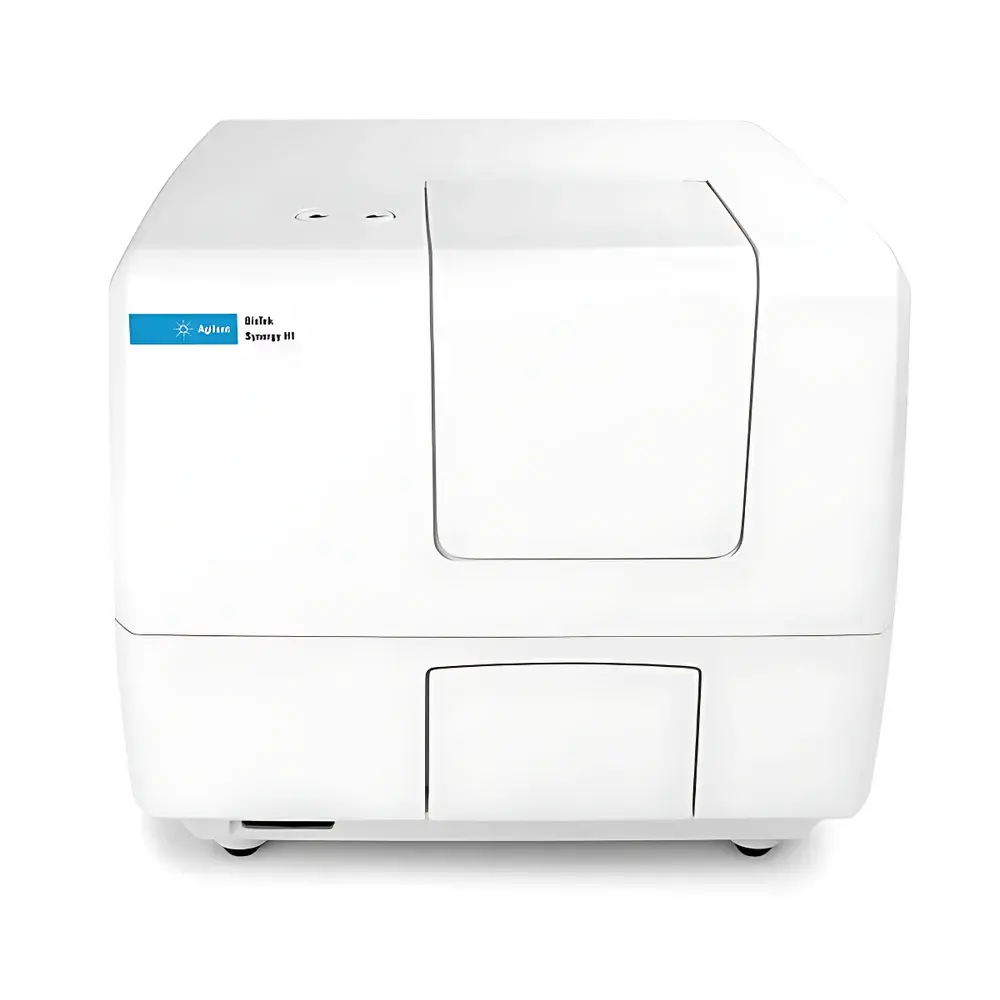
Agilent BioTek Synergy H1 Hybrid Multi-Mode Microplate Reader
| Brand | Agilent Technologies |
|---|---|
| Origin | Shanghai, China |
| Manufacturer Type | Original Equipment Manufacturer (OEM) |
| Regional Classification | Domestic (China-manufactured) |
| Model | Synergy H1 |
| Pricing | Upon Request |
| Functionality | Multi-Mode |
| Automation Level | Fully Automated |
| Assay Methods | Endpoint, Kinetic, Wavelength Scan, Well Area Scan |
| Curve Fitting Options | Linear, Logarithmic, Four-Parameter Logistic (4PL), Five-Parameter Logistic (5PL) |
| Detector Type | Photomultiplier Tube (PMT) / Photodiode (PD) |
| Wavelength Range | Filter-based: 200–700 nm |
| Monochromator-based | 250–900 nm |
| Absorbance Range | 0.0000–4.0000 OD |
| Absorbance Linearity | Not Specified |
| Read Speed | 96-well plate in 11 s |
| Accuracy | Not Specified |
Overview
The Agilent BioTek Synergy H1 Hybrid Multi-Mode Microplate Reader is an engineered platform for quantitative and kinetic analysis across life science research, drug discovery, and quality control laboratories. It integrates dual optical architectures—monochromator-based and filter-based detection—within a single instrument to deliver broad-spectrum versatility without compromising sensitivity or reproducibility. Its hybrid design enables simultaneous optimization of spectral resolution, signal-to-noise ratio, and assay throughput. The monochromator supports continuous wavelength selection from 250 to 900 nm with adjustable excitation/emission bandwidths (9–50 nm, 1-nm increments), facilitating precise spectral deconvolution in complex fluorescent assays. Complementary filter-based modules support high-efficiency detection modes including fluorescence polarization (FP), bioluminescence resonance energy transfer (BRET), time-resolved fluorescence (TRF), and TR-FRET—each optimized for low-background, high-specificity readouts. This architecture aligns with established microplate reader design principles defined in ASTM E2851 and ISO/IEC 17025-compliant validation frameworks.
Key Features
- Hybrid optical system combining monochromator and filter-based detection paths for maximum flexibility across absorbance, fluorescence intensity, luminescence, FP, TRF, and TR-FRET applications
- Variable bandwidth monochromator (9–50 nm, 1-nm step resolution) enabling empirical optimization of signal specificity and dynamic range
- Automated Z-axis focus adjustment for consistent focal plane positioning across all microplate formats (6–384-well), including low-volume wells and specialty plates (e.g., Take3/Take3 Trio)
- Extended dynamic signal range spanning seven orders of magnitude—enabling accurate quantification from picomolar to millimolar analyte concentrations without manual gain adjustment
- Dual independent syringe-based reagent injectors with interchangeable straight and angled needles: straight for vigorous mixing and rapid kinetics; angled for non-disruptive cell layer delivery in calcium flux or live-cell assays
- Integrated environmental control: four-zone temperature regulation up to 70 °C, condensation management, CO2/O2 gas modulation, and programmable linear or orbital shaking for physiologically relevant cell-based workflows
- Modular expandability supporting future upgrades—including additional detection modes, dual injector expansion, and integrated incubation accessories compatible with BioSpa and BioStack automation platforms
Sample Compatibility & Compliance
The Synergy H1 accommodates standard ANSI/SLAS-compliant microplates (6–384-well), as well as specialized formats such as Take3 and Take3 Trio microvolume plates for direct nucleic acid and protein quantification without dilution. Its optical path calibration adheres to CLSI EP10-A3 guidelines for instrument verification, while software audit trails and user-access controls support compliance with FDA 21 CFR Part 11 requirements when configured with secure authentication and electronic signature capabilities. Instrument validation documentation—including IQ/OQ protocols—is available for GxP-regulated environments, and routine performance checks can be aligned with ISO 15197:2013 and USP analytical instrument qualification standards.
Software & Data Management
Gen5 Microplate Reader Software provides intuitive assay setup, real-time data visualization, and robust statistical analysis—including automated curve fitting (linear, log-log, 4PL, 5PL), kinetic modeling, and multi-parameter normalization. Data export options include CSV, Excel, and XML formats compatible with LIMS integration. Audit trail functionality records all user actions, parameter changes, and data modifications with timestamps and operator IDs—meeting GLP/GMP traceability requirements. Remote instrument monitoring and scheduling are supported via networked deployment, and Gen5 is validated for use in regulated environments when installed on validated operating systems (Windows 10/11 LTSB editions).
Applications
The Synergy H1 supports a wide spectrum of life science applications requiring precision, adaptability, and environmental fidelity. These include enzyme kinetics (e.g., ELISA, phosphatase assays), receptor-ligand binding studies (TR-FRET, FP), cell viability and cytotoxicity screening (ATP-based luminescence, resazurin reduction), oxidative stress profiling (DCFDA fluorescence), mitochondrial membrane potential assessment (JC-1), and long-term live-cell imaging-compatible kinetic assays. Its environmental control module enables sustained monitoring of proliferation, apoptosis, and metabolic activity under controlled O2/CO2 conditions—critical for translational models in oncology, immunology, and regenerative medicine research.
FAQ
Does the Synergy H1 support FDA 21 CFR Part 11 compliance?
Yes—when deployed with Gen5 software configured for electronic signatures, role-based access control, and enabled audit trail logging, the system meets core technical requirements for Part 11 adherence.
Can the instrument perform simultaneous dual-wavelength absorbance measurements?
No—it acquires absorbance readings sequentially at user-defined wavelengths; however, its monochromator enables rapid wavelength switching (<100 ms) to approximate pseudo-simultaneous dual-wavelength acquisition.
Is the Z-axis focus calibration required before each plate type change?
No—automated Z-height optimization occurs per plate during initialization using onboard reference optics and plate-height detection algorithms.
What is the maximum incubation temperature for gas-controlled environments?
The system maintains stable temperature control up to 70 °C across four independently regulated zones, with optional humidification and CO2/O2 blending capability.
Are third-party microplates supported?
Yes—all ANSI/SLAS-standardized plates (including black, white, clear, and UV-transparent variants) are fully compatible; proprietary plate recognition is not required.