
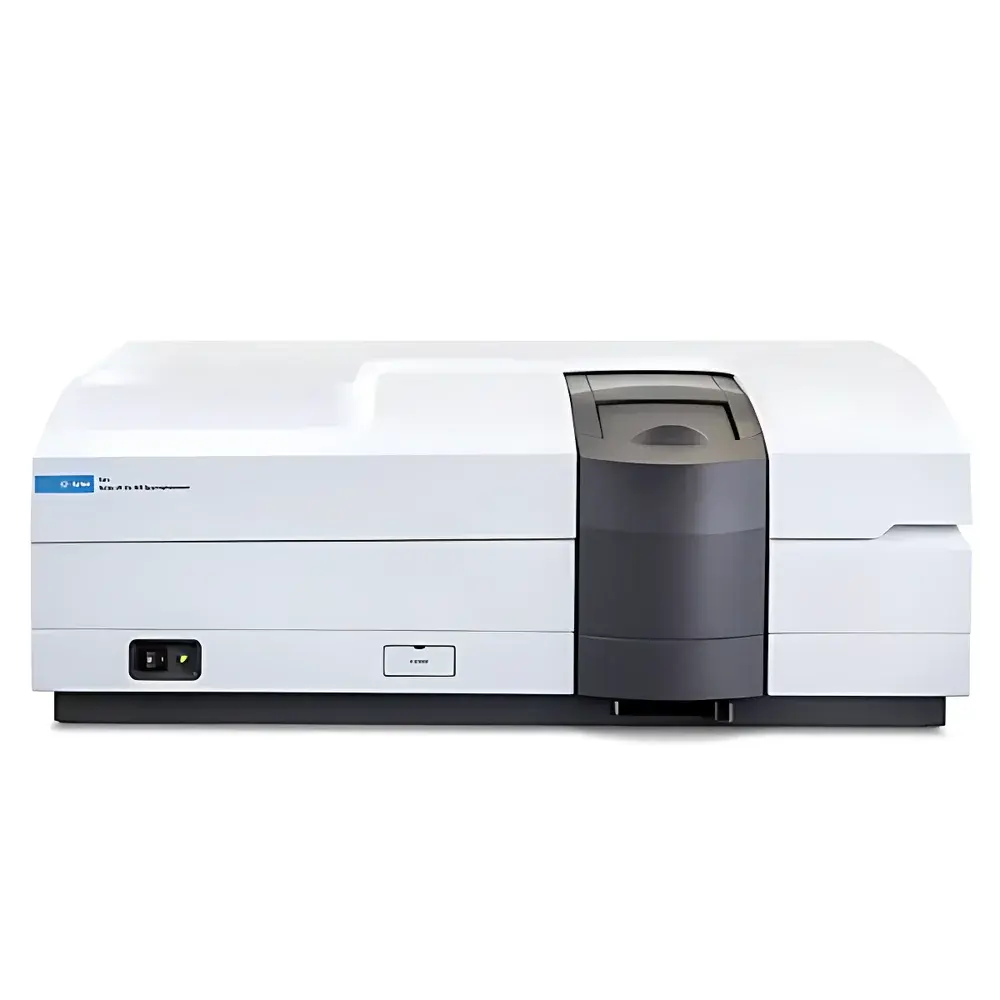
Agilent Cary 6000i UV-Vis-NIR Spectrophotometer
| Brand | Agilent Technologies |
|---|---|
| Origin | Malaysia |
| Manufacturer Type | Original Equipment Manufacturer (OEM) |
| Import Status | Imported |
| Model | Cary 6000i |
| Optical Design | Double-beam |
| Detector | Photomultiplier Tube (PMT) for UV-Vis |
| Wavelength Range | 175–1800 nm (UV-Vis-NIR) |
| Automation Level | Motorized wavelength scanning |
| Spectral Bandwidth | UV-Vis: 0.01–5.00 nm |
| NIR | 0.04–20 nm |
| Absorbance Range | Up to 8.0 Abs |
| Scan Speed | UV-Vis: 2000 nm/min |
| NIR | 8000 nm/min |
| Sample Compartment Z-height | 20 mm |
| Dimensions (W×D×H) | 1020 × 710 × 380 mm |
| Weight | 91 kg |
| Power Requirement | 100–240 VAC, 50/60 Hz |
| Purge Capability | Dual nitrogen purge (sample chamber & monochromator) |
Overview
The Agilent Cary 6000i UV-Vis-NIR Spectrophotometer is a high-performance double-beam optical instrument engineered for quantitative and qualitative spectral analysis across an extended wavelength range of 175–1800 nm. It integrates dual-monochromator architecture with Littrow configuration, optimized for minimal stray light and exceptional photometric stability. The system employs a deuterium arc lamp for the ultraviolet region (175–350 nm), a tungsten-halogen lamp for visible and near-infrared (350–1100 nm), and leverages a thermoelectrically cooled InGaAs detector array for high-sensitivity detection in the short-wave infrared (SWIR) region (800–1800 nm). A dedicated 600 lines/mm NIR diffraction grating—blazed at 1000 nm—concentrates optical dispersion within the SWIR band, maximizing photon utilization and signal-to-noise ratio where conventional silicon-based detectors exhibit diminishing quantum efficiency. This design enables accurate transmittance, reflectance, and absorbance measurements on optically dense, scattering, or highly absorbing materials—critical for advanced material characterization in R&D and quality control laboratories.
Key Features
- Extended spectral coverage from 175 nm (deep UV) to 1800 nm (SWIR), supporting comprehensive material fingerprinting beyond conventional UV-Vis instruments.
- Double-beam optical path with reference beam attenuation, enabling reliable absorbance measurements up to 8.0 Abs without signal saturation or baseline drift.
- Modular, LockDown mechanical interface for rapid, repeatable attachment of accessories—including integrating spheres (60 mm and 150 mm), specular reflectance modules, variable temperature cells, and fiber-optic probes—ensuring positional reproducibility within ±0.02 mm.
- Schwarzschild optical condenser system delivers high radiant flux to the sample, improving measurement accuracy at low transmittance (<1%) and enhancing signal fidelity in turbid or highly scattering media.
- Cast-aluminum vibration-isolation chassis and asymmetric Littrow monochromator design suppress mechanical and optical noise, achieving <0.0002 Abs RMS photometric noise at 546 nm (1 s integration).
- Motorized variable slit mechanism supports continuously adjustable spectral bandwidths: 0.01–5.00 nm (UV-Vis) and 0.04–20 nm (NIR), permitting resolution optimization per application—e.g., narrow bandwidth for high-resolution peak deconvolution or wider bandwidth for improved throughput in routine QC.
- Dual independent nitrogen purge paths—one for the sample compartment, another for the NIR monochromator chamber—eliminate O₂ and H₂O vapor absorption bands below 200 nm and above 1350 nm, ensuring spectral integrity in demanding UV and SWIR applications.
Sample Compatibility & Compliance
The Cary 6000i accommodates diverse sample formats: solid films, powders, liquids, gels, and optically anisotropic substrates. Its expanded sample compartment (Z-height: 20 mm) accepts large-diameter integrating spheres (up to 150 mm), automated mapping stages, and cryogenic or heating accessories compliant with ASTM E1421, ISO 105-C06, and USP . The instrument meets IEC 61010-1 safety requirements and supports GLP/GMP workflows through audit-trail-enabled software logging, electronic signatures, and secure user-role management. Optional 21 CFR Part 11 compliance packages include encrypted data storage, immutable acquisition logs, and full traceability of method parameters, calibration events, and operator actions.
Software & Data Management
Cary WinUV software provides a modular, Windows-based platform for instrument control, spectral acquisition, multivariate analysis, and report generation. It supports batch processing of up to 999 spectra per sequence, real-time derivative spectroscopy, kinetic time-scans, and multi-component quantitation using classical least-squares (CLS) or partial least-squares (PLS) algorithms. All raw data are stored in vendor-neutral .csv and .jdx formats, while proprietary .uv files retain full metadata—including slit width, scan speed, detector mode, and purge status—for complete experimental reproducibility. Integration with Agilent’s OpenLab CDS enables cross-platform chromatography–spectroscopy correlation for hyphenated techniques.
Applications
The Cary 6000i serves as a primary analytical tool in semiconductor metrology (thin-film thickness and refractive index determination), pharmaceutical solid-state characterization (polymorph identification, excipient compatibility), nanomaterial optical property mapping (plasmonic resonance, bandgap estimation), solar cell R&D (quantum efficiency, anti-reflective coating validation), and forensic pigment analysis. Its ability to resolve fine spectral features in the SWIR region makes it particularly valuable for cellulose crystallinity assessment (1420/1370 cm⁻¹ ratio), polymer degradation monitoring (C–H overtone bands), and moisture content quantification (1940 nm water absorption peak).
FAQ
What is the maximum absorbance measurable with the Cary 6000i?
The system achieves accurate photometric linearity up to 8.0 Abs using dynamic reference beam attenuation and dual-detector optimization.
Does the Cary 6000i support automated accessory switching?
Yes—the LockDown mechanical interface enables tool-free, positionally repeatable mounting of up to six accessories without recalibration.
Is nitrogen purge required for all measurements?
Nitrogen purging is recommended for measurements below 200 nm or above 1350 nm to eliminate atmospheric absorption artifacts; optional purge kits allow selective activation per optical path.
Can the Cary 6000i be integrated into automated lab workflows?
It supports RS-232, USB, and Ethernet connectivity, and is compatible with third-party LIMS and robotic sample handlers via Agilent’s IVI-COM drivers and SCPI command set.
How does the 600 l/mm NIR grating improve SWIR performance?
By concentrating optical dispersion between 800–1800 nm, it increases photon flux on the InGaAs detector, improving signal-to-noise ratio by up to 4× compared to standard 300 l/mm gratings in the same spectral region.





