
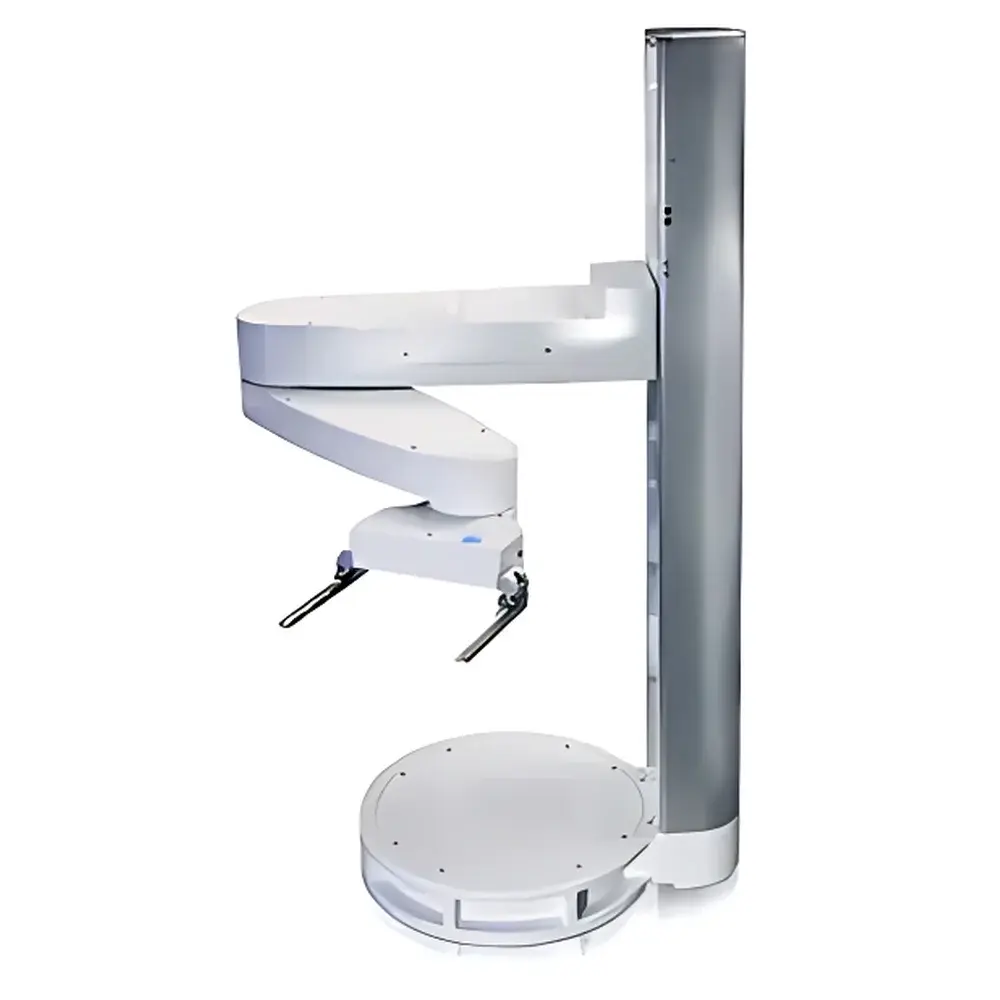
Agilent DDR Direct-Drive Robotic Arm
| Brand | Agilent Technologies |
|---|---|
| Origin | Singapore |
| Manufacturer Type | Original Equipment Manufacturer (OEM) |
| Origin Category | Imported |
| Model | DDR |
| Pricing | Available upon Request |
Overview
The Agilent DDR (Direct-Drive Robotic Arm) is a high-precision, four-axis laboratory automation component engineered for integration into modular life science and analytical workflows—particularly within the Agilent BioCel platform. Unlike conventional robotic arms employing gearboxes, belts, or harmonic drives, the DDR utilizes brushless direct-drive motor technology at each joint, eliminating mechanical transmission losses and backlash. This architecture enables sub-millimeter repeatability, smooth low-vibration motion profiles, and rapid acceleration/deceleration—critical for handling delicate labware (e.g., microplates, vials, pipette tips) in regulated environments. Designed explicitly for single-operator deployment, the DDR supports intuitive point-and-click positioning via touchscreen or software interface, minimizing configuration overhead while maintaining full compatibility with GLP/GMP-aligned system architectures.
Key Features
- Direct-Drive Joint Architecture: Four independently controlled axes (X, Y, Z, and rotational wrist) powered by integrated torque motors—no gears, belts, or couplings—reducing maintenance intervals and increasing mean time between failures (MTBF).
- High-Resolution Optical Encoders: Absolute-position optical encoders at each axis deliver ≤0.01° angular resolution and ≤5 µm linear positional accuracy, enabling reproducible tip alignment for liquid handling and plate indexing tasks.
- Integrated Contact Sensing: Proprietary force-sensing feedback loop detects unintended contact with obstacles or labware, triggering immediate deceleration or stop—meeting ISO 10218-1 safety requirements for collaborative robotics in shared lab spaces.
- Extended Z-Axis Travel: Optimized vertical stroke (≥220 mm) allows unobstructed access to stacked plate carriers, centrifuge buckets, and thermal cyclers without requiring system reconfiguration.
- Multi-Oriented Gripper Compatibility: Supports both horizontal and vertical end-effector mounting; compatible with Agilent-certified grippers for ANSI/SLAS-format microplates (96-, 384-, and 1536-well), tube racks, and custom fixtures.
- Standalone or Integrated Deployment: Operates as a self-contained robotic module with EtherCAT or RS-485 communication interface—or integrates natively into Agilent BioCel control architecture via standardized API protocols.
Sample Compatibility & Compliance
The DDR is validated for use with standard laboratory consumables compliant with ANSI/SLAS dimensional specifications. Its motion envelope and payload capacity (max. 1.2 kg at full extension) accommodate common assay formats including PCR plates, deep-well blocks, and cryovial racks. From a regulatory perspective, the DDR’s firmware includes audit-trail logging capabilities aligned with FDA 21 CFR Part 11 requirements when deployed in BioCel systems. Mechanical design adheres to IEC 61000-6-2 (immunity) and IEC 61000-6-4 (emissions) standards. Safety-rated emergency stop circuits and dual-channel position verification meet ISO 13849-1 PLd Cat.3 requirements.
Software & Data Management
The DDR is controlled through Agilent’s BioCel System Manager software (v5.2+), which provides graphical path programming, drag-and-drop sequence building, and real-time trajectory visualization. All motion parameters—including speed profiles, acceleration limits, and homing offsets—are stored in encrypted XML-based configuration files supporting version control and backup. Audit trails record timestamped operator actions, firmware updates, and error logs with user authentication. For third-party integration, Agilent provides a documented RESTful API and OPC UA server support, enabling interoperability with LIMS (e.g., LabVantage, Thermo Fisher SampleManager) and MES platforms under ISA-95 frameworks.
Applications
- Automated sample transfer between liquid handlers, readers, and storage modules in high-throughput screening (HTS) workflows.
- Plate staging and orientation adjustment prior to imaging or mass spectrometry analysis.
- Integration into cell culture automation suites for multi-step passaging, media exchange, and assay plate loading.
- Support of qPCR and NGS library prep workflows requiring precise plate-to-plate transfer across thermocyclers and normalization stations.
- Modular expansion of existing Agilent BioCel configurations—enabling reconfiguration without hardware redesign or vendor lock-in.
FAQ
Is the DDR compatible with non-Agilent liquid handlers or readers?
Yes—the DDR supports industry-standard communication protocols (EtherCAT, Modbus TCP) and can be configured for OEM integration with third-party instruments using Agilent’s published hardware abstraction layer (HAL) documentation.
What is the maximum payload capacity at extended reach?
The DDR maintains ≤1.2 kg payload capacity at full Z-extension (220 mm), with dynamic torque compensation active across all operational speeds.
Does the DDR require periodic calibration?
No routine recalibration is required; factory-calibrated optical encoders retain positional fidelity over time. A diagnostic self-test sequence is executed automatically at power-on and may be manually triggered via software.
Can the DDR operate in a Class II biosafety cabinet?
Yes—its IP20-rated enclosure and low-outgassing materials comply with ISO 14644-1 Class 5 cleanroom requirements; optional conformal coating is available for enhanced humidity resistance.
Is remote monitoring and troubleshooting supported?
Yes—integrated web server enables secure HTTPS-based remote diagnostics, firmware updates, and log export via TLS 1.2 encryption.



