
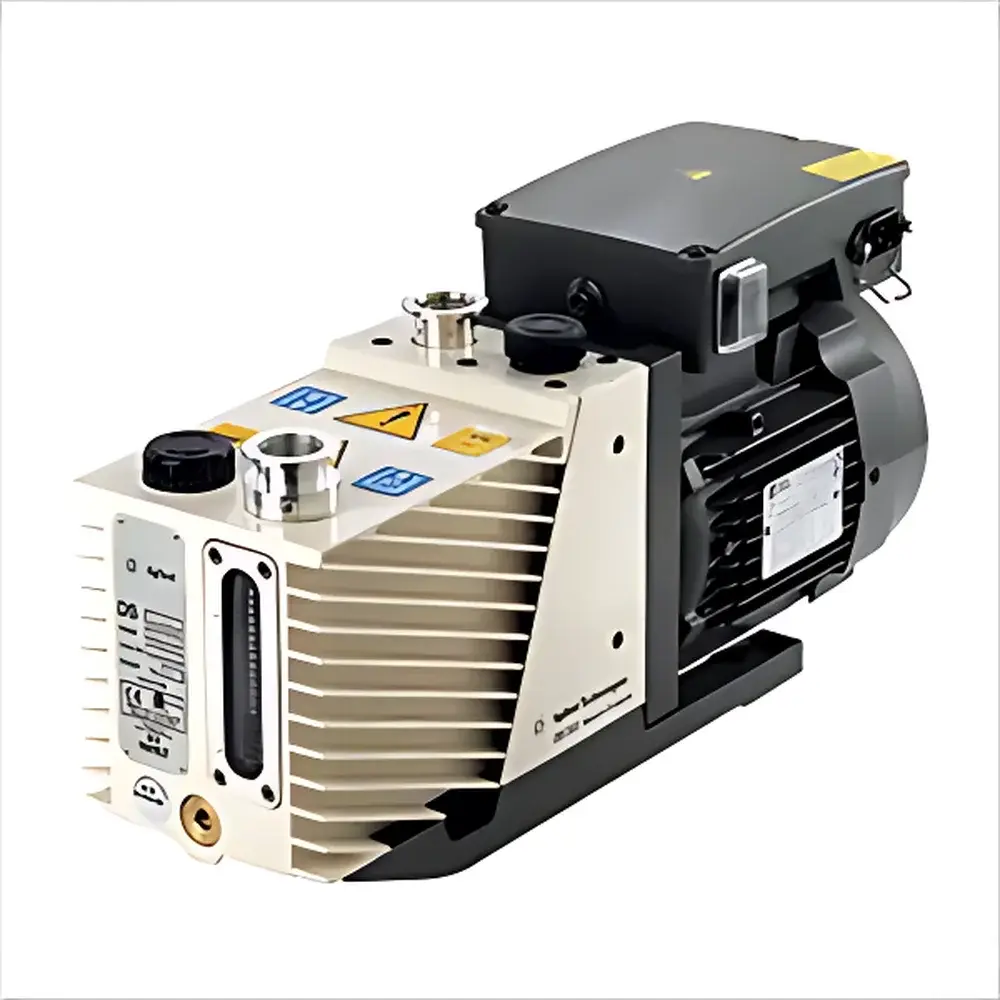
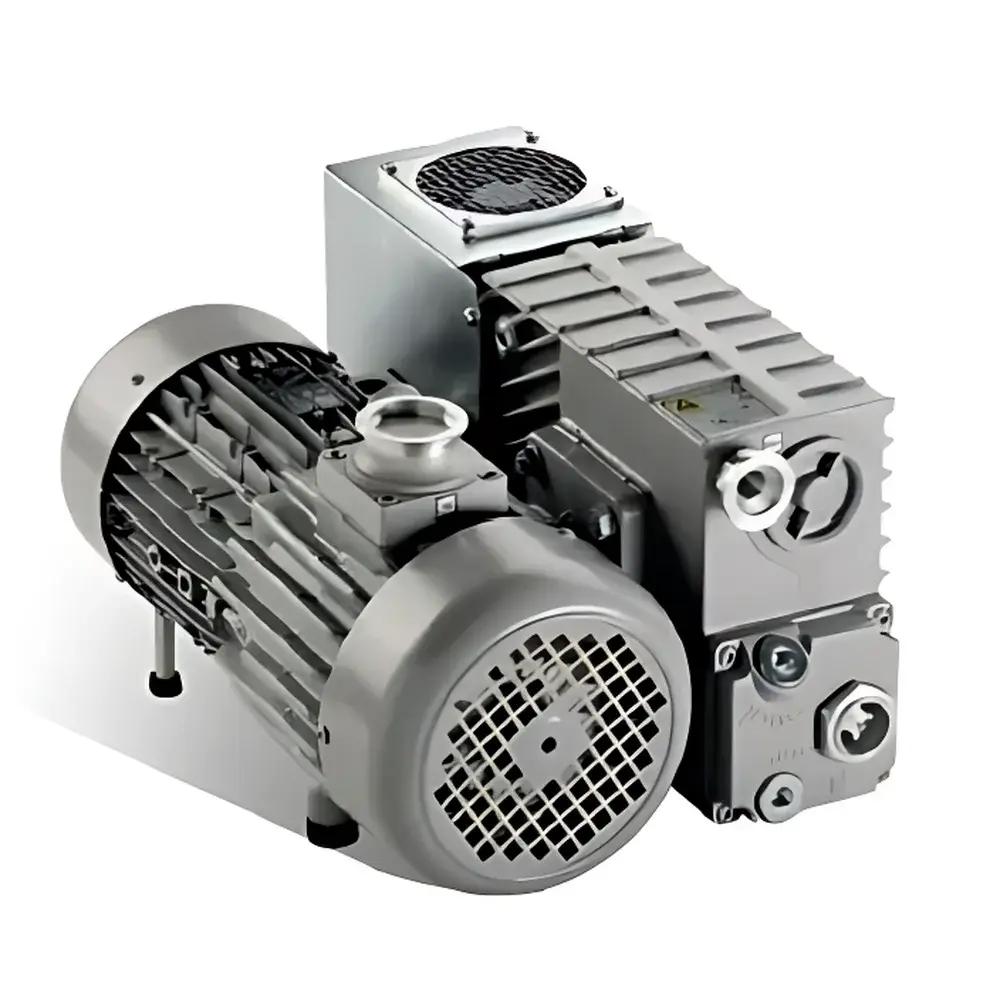
Agilent DS Series Rotary Vane Vacuum Pump
| Brand | Agilent Technologies |
|---|---|
| Origin | Italy |
| Manufacturer Type | Manufacturer |
| Origin Category | Imported |
| Model | DS |
| Instrument Type | Rotary Vane Pump |
| Product Type | Oil-Lubricated Pump |
| Pumping Speed | 25 m³/h |
| External Dimensions | 164 mm × 242 mm × 541 mm |
| Weight | 35 kg |
| Compliance | CE, RoHS, UL, CSA |
Overview
The Agilent DS Series Rotary Vane Vacuum Pump is an oil-lubricated, two-stage positive displacement pump engineered for stable, high-performance vacuum generation in demanding analytical and materials science laboratories. Based on the proven Couette-flow principle of rotary vane mechanics, the DS pump achieves continuous gas removal by rotating vanes within an eccentric stator chamber, compressing entrapped gas volumes toward the exhaust port. Its dual-stage configuration enables efficient compression across a broad pressure range—from atmospheric down to ultimate pressures of ≤1 × 10⁻³ mbar—while maintaining thermal stability and minimizing backstreaming of pump oil vapor. Designed and manufactured in Italy under Agilent’s stringent quality control systems, the DS series delivers consistent pumping speed (25 m³/h at 50 Hz), low operational noise (<62 dB(A)), and extended service intervals—making it suitable for integration into sensitive vacuum-dependent instrumentation where reliability, repeatability, and regulatory traceability are critical.
Key Features
- Two-stage rotary vane architecture for enhanced compression ratio and improved ultimate vacuum performance (≤1 × 10⁻³ mbar)
- Optimized thermal management enabling stable operation at reduced working temperatures, reducing oil degradation and vapor pressure effects
- Low oil backstreaming design minimizes hydrocarbon contamination in high-vacuum chambers—critical for surface-sensitive applications such as SEM and XPS
- Integrated gas ballast (air bleed) system ensures effective removal of condensable vapors (e.g., water, solvents) during rough vacuum stages, preserving oil integrity and extending maintenance cycles
- Robust cast-aluminum housing with vibration-damped mounting feet for quiet, stable operation in shared laboratory environments
- UL- and CSA-listed electrical components; CE-marked and RoHS-compliant per Directive 2011/65/EU
Sample Compatibility & Compliance
The DS pump is compatible with inert, non-corrosive, and mildly aggressive process gases typical in mass spectrometry, surface analysis, and thin-film deposition workflows. It is not intended for use with highly corrosive, polymerizing, or explosive gases without additional trapping or scrubbing. All units undergo factory calibration and full functional testing per Agilent’s ISO 9001-certified production protocol. Documentation includes Declaration of Conformity (DoC) for CE, UL/cUL certification reports, and RoHS compliance statements—all available upon request for GLP/GMP audit readiness. The pump meets applicable requirements of IEC 61000-6-3 (EMC emission) and IEC 61000-6-2 (immunity), supporting integration into regulated environments governed by FDA 21 CFR Part 11 and ISO/IEC 17025 frameworks.
Software & Data Management
While the DS series operates as a standalone mechanical vacuum source without embedded firmware or digital interfaces, its analog control compatibility supports integration with third-party vacuum monitoring systems via standard 0–10 V or 4–20 mA pressure feedback signals (when paired with optional Agilent or compatible Pirani/capacitance manometers). Agilent provides comprehensive technical documentation—including operation manuals, maintenance schedules, spare parts catalogs, and UL/CSA safety schematics—in English, accessible through the official Agilent Support Portal. Firmware-upgradable controllers (e.g., Agilent Vacuum Manager VM-200) may be deployed externally to log pump runtime, temperature, and fault events for preventive maintenance tracking aligned with ISO 55001 asset management practices.
Applications
- Gas chromatography–mass spectrometry (GC-MS) and liquid chromatography–mass spectrometry (LC-MS) systems requiring stable rough vacuum for ion source and detector operation
- Scanning electron microscopy (SEM) and focused ion beam (FIB) platforms where low backstreaming is essential to prevent sample contamination
- Isotope ratio mass spectrometry (IRMS) and inductively coupled plasma mass spectrometry (ICP-MS) vacuum manifolds
- BET surface area analyzers and porosimeters operating in the 10⁻³–10² mbar range
- Vacuum ovens, gloveboxes, and magnetron sputtering systems requiring clean, continuous roughing capability
FAQ
What is the ultimate vacuum level achievable with the DS pump?
The DS series achieves an ultimate pressure of ≤1 × 10⁻³ mbar under clean, dry conditions with proper gas ballast operation and recommended oil type.
Can the DS pump be used with corrosive process gases?
No—it is designed for non-corrosive and mildly aggressive gases only. For halogenated or acidic vapors, a cold trap or chemical scrubber must be installed upstream.
What oil type is specified for optimal performance?
Agilent recommends Agilent Vacuum Pump Oil 100 (ISO VG 100), a highly refined mineral oil meeting DIN 51506 VDL specifications for low vapor pressure and oxidation resistance.
Is remote monitoring or control supported natively?
The base DS pump has no built-in digital interface; however, it can be integrated with external vacuum controllers using analog pressure feedback signals.
How often should maintenance be performed?
Oil changes are recommended every 3,000 operating hours or annually—whichever occurs first—under normal laboratory conditions; full service intervals depend on duty cycle and process gas composition.



