
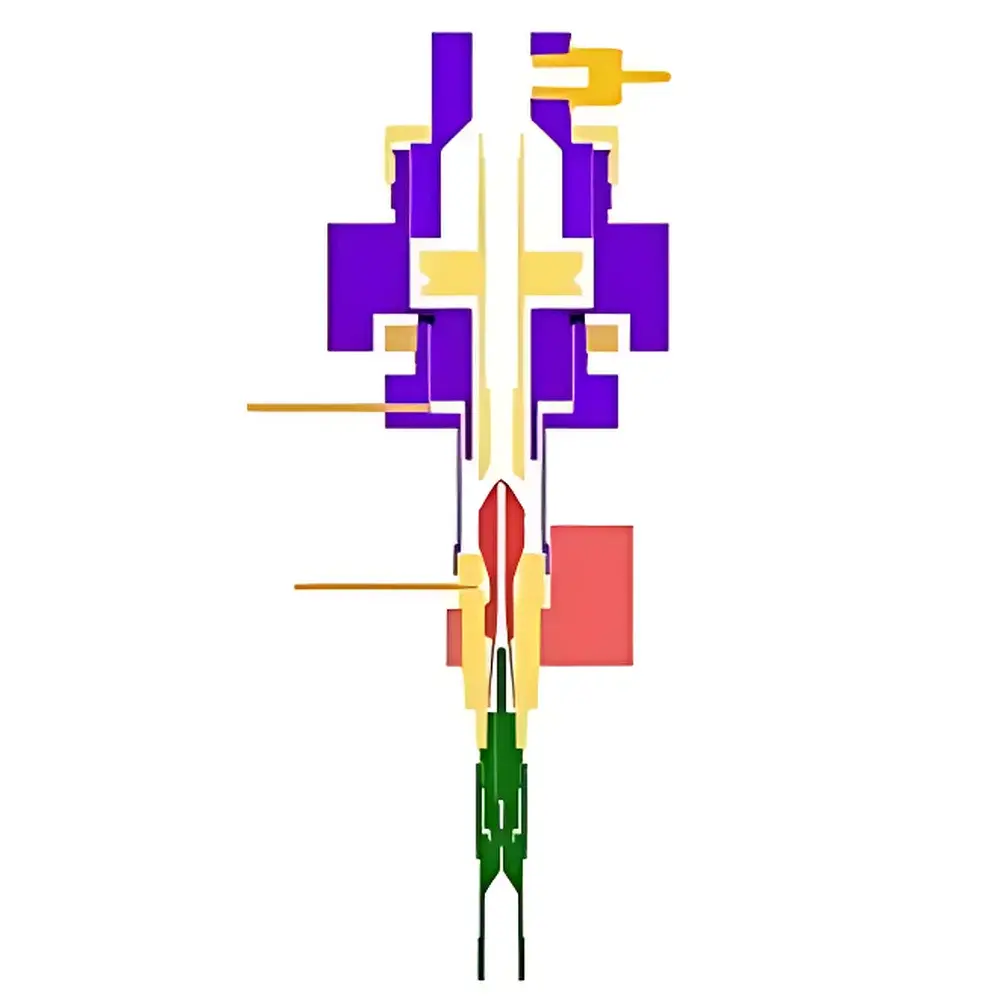
Agilent Flame Ionization Detector (FID) for GC Systems
| Brand | Agilent Technologies |
|---|---|
| Origin | Shanghai, China |
| Manufacturer Type | Original Equipment Manufacturer (OEM) |
| Product Category | Domestic |
| Model | Flame Ionization Detector |
| Compatible Instruments | Agilent Intuvo 9000, 8890, 8860, and 7890 Series Gas Chromatographs |
| Detection Limit (n-tridecane) | ≤1.2 pg C/s (8890 GC), ≤1.4 pg C/s (Intuvo 9000 & 7890B GC), ≤3 pg C/s (8860 GC) |
| Linear Dynamic Range | >10⁷ (±10%) |
| Data Acquisition Rate | Up to 1000 Hz (Intuvo 9000 & 8890 GC) |
| Maximum Operating Temperature | 450 °C (8890/7890B/Intuvo 9000), 425 °C (8860) |
| Column Compatibility | Capillary-optimized or universal (capillary & packed column) variants available |
| Mounting Flexibility | Optional third-detector position on 8890 GC left side |
| Ignition Control | Auto-ignition and flame-out detection with recovery |
Overview
The Agilent Flame Ionization Detector (FID) is a high-performance, benchtop-compatible chromatographic detector engineered for integration with Agilent’s flagship gas chromatography platforms—including the Intuvo 9000, 8890, 8860, and 7890 series. Operating on the principle of hydrocarbon-specific ionization in a hydrogen–air flame, the FID delivers exceptional sensitivity, wide linear dynamic range, and robust signal stability across diverse organic analytes. Its design adheres to fundamental requirements of quantitative trace analysis in regulated environments: low baseline noise (<0.2 pA RMS), rapid thermal equilibration, and consistent response factors for aliphatic, aromatic, and oxygenated compounds (excluding formic acid, formaldehyde, and permanently gaseous species such as CO, CO₂, NO, SO₂, and H₂O). The detector’s combustion chamber geometry, jet nozzle precision, and collector electrode alignment are optimized to minimize memory effects and maximize signal-to-noise ratio—critical for applications demanding reproducible calibration over extended run sequences.
Key Features
- Auto-ranging detection capability enabling simultaneous quantification of analytes spanning concentrations from sub-ppb to percent-level in a single injection—eliminating manual range switching and associated integration errors.
- Digital full-scale data output with 24-bit resolution ensures accurate peak area and height measurement across the entire 10⁷ linear dynamic range without saturation or truncation.
- High-speed data acquisition up to 1000 Hz supports ultra-fast GC methods, resolving peaks with base widths as narrow as 10 ms and half-widths down to 5 ms—essential for comprehensive two-dimensional GC (GC×GC) and high-throughput screening.
- Integrated flame monitoring circuitry provides real-time flame status feedback; automatic re-ignition occurs within <3 seconds following flame-out, minimizing downtime and preserving method integrity.
- Thermally isolated detector body with independent temperature control (up to 450 °C for 8890/7890B/Intuvo 9000; 425 °C for 8860) prevents condensation of high-boiling analytes and ensures stable baseline during temperature-programmed runs.
- Modular mounting architecture allows installation as a third detector on the 8890 GC’s left-side detector bay—enabling concurrent FID, TCD, and ECD or NPD operation for multi-detection strategies without hardware modification.
Sample Compatibility & Compliance
The Agilent FID exhibits near-universal response to carbon-containing organic compounds, with molar response factors typically within ±15% of propane across C₁–C₂₀ hydrocarbons, alcohols, ketones, esters, and halogenated organics. It is insensitive to permanent gases, water vapor, and inorganic oxides—making it ideal for environmental air monitoring (EPA Method 8260D), petrochemical hydrocarbon profiling (ASTM D3606, D5186), residual solvent analysis per ICH Q2(R2), and food safety testing (AOAC 2012.01). All variants comply with ISO/IEC 17025:2017 requirements for detector qualification, support GLP/GMP audit trails via OpenLab CDS, and meet FDA 21 CFR Part 11 electronic record and signature criteria when deployed with validated software configurations.
Software & Data Management
Native integration with Agilent OpenLab CDS 2.x enables automated detector configuration, real-time signal visualization, and seamless method transfer between instruments. Calibration curves are generated using weighted linear regression (1/x or 1/x²), with built-in validation tools for linearity assessment (r² ≥ 0.9999), accuracy (80–120% recovery), and precision (RSD ≤ 3% at LLOQ). Audit trail functionality logs all parameter changes, integration events, and user actions with timestamped, non-erasable entries. Raw data files (.D format) retain full digitized signal history—including pre-trigger and post-run baselines—for retrospective reprocessing and regulatory review.
Applications
- Environmental analysis: VOCs in ambient air, soil extracts, and drinking water per EPA TO-17 and Method 25A.
- Petrochemical QA/QC: Hydrocarbon type analysis (PIONA), gasoline sulfur content estimation, and refinery stream composition.
- Pharmaceutical impurity profiling: Residual solvents in APIs and drug products (ICH Q3C compliant).
- Food & flavor chemistry: Quantification of volatile aroma compounds, lipid oxidation markers (hexanal, pentanal), and ethanol in beverages.
- Forensic toxicology: Detection of drugs of abuse and metabolites in biological matrices following solvent extraction or headspace sampling.
FAQ
What is the minimum detectable mass for n-tridecane on the Agilent 8890 GC-FID?
The specified limit is ≤1.2 picograms of carbon per second (pg C/s) under standard test conditions (1 µL injection of 100 ng/µL n-tridecane, split ratio 50:1, H₂ flow 40 mL/min).
Can this FID be used with packed columns?
Yes—selectable versions include both capillary-optimized and universal configurations compatible with fused-silica capillary columns (0.1–0.53 mm ID) and stainless-steel or glass packed columns (2–4 mm ID).
Is the detector compatible with hydrogen carrier gas?
Hydrogen is fully supported as both fuel gas and optional carrier gas; however, optimal performance and safety compliance require use of Agilent-certified H₂ generators and pressure regulation modules meeting EN ISO 13849-1 PL e requirements.
How does the auto-ignition system function during unattended operation?
Flame status is continuously monitored via ion current sensing; upon loss of signal exceeding 100 ms, the system initiates controlled H₂/air purge, ignites the pilot flame, then engages main flame ignition—all without operator intervention or method interruption.
Does the FID support ASTM D1945 or D1946 hydrocarbon speciation workflows?
Yes—the detector’s linear response, fast acquisition rate, and compatibility with backflush-capable GC ovens enable full implementation of these natural gas analysis standards when paired with appropriate column sets and retention time locking (RTL) calibration protocols.



