
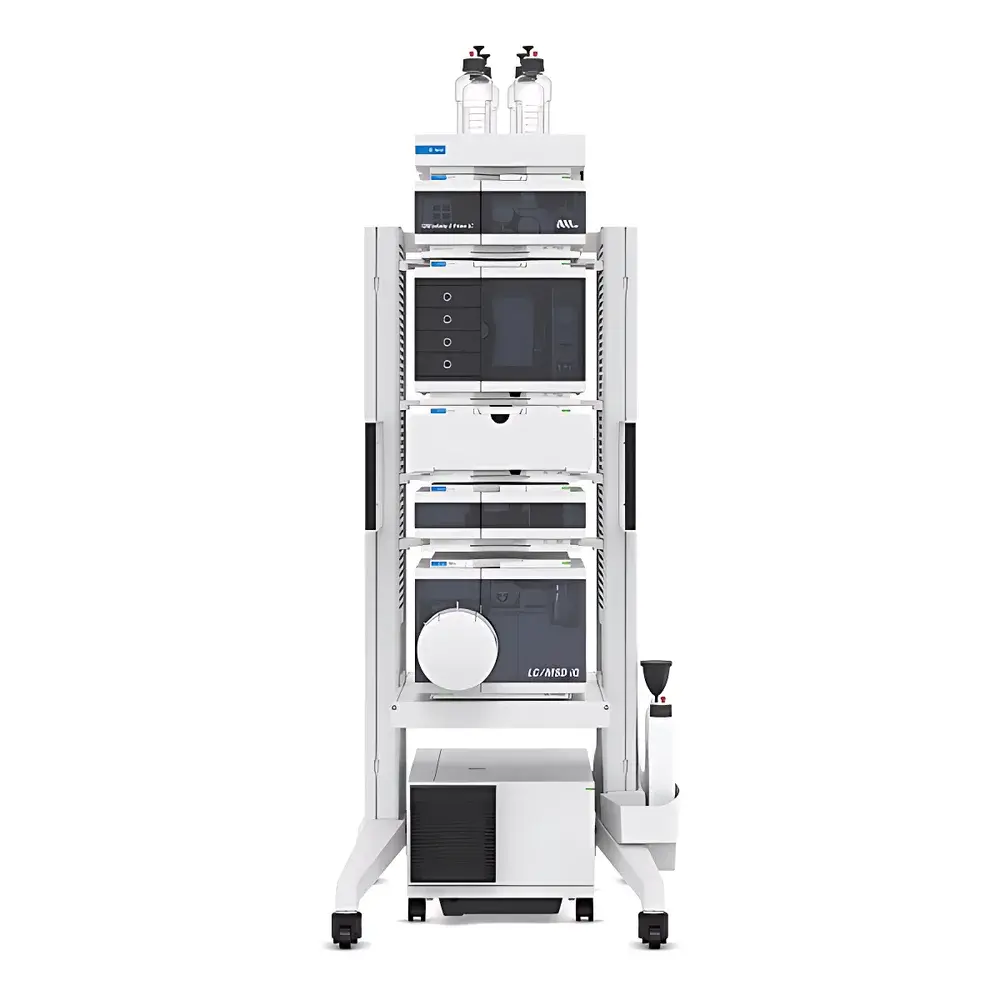
Agilent InfinityLab LC/MSD iQ Quadrupole-Time-of-Flight Liquid Chromatography Mass Spectrometer
| Brand | Agilent Technologies |
|---|---|
| Origin | Singapore |
| Manufacturer Type | Original Equipment Manufacturer (OEM) |
| Origin Category | Imported Instrument |
| Model | Agilent InfinityLab LC/MSD iQ |
| Instrument Type | Quadrupole-Time-of-Flight (Q-TOF) |
| Application Scope | General-Purpose LC/MS Analysis |
Overview
The Agilent InfinityLab LC/MSD iQ is a benchtop quadrupole-time-of-flight (Q-TOF) liquid chromatography mass spectrometry system engineered for robustness, operational simplicity, and high-fidelity molecular characterization in routine and exploratory analytical laboratories. Unlike traditional single-quadrupole or triple-quadrupole platforms, the LC/MSD iQ integrates a hybrid Q-TOF architecture—featuring a high-transmission quadrupole mass filter coupled to an orthogonal acceleration time-of-flight analyzer—to deliver accurate mass measurement ( 30,000 FWHM at m/z 556), and sub-ppb sensitivity in both full-scan and targeted acquisition modes. Its design prioritizes analytical continuity: the system maintains stable vacuum conditions during routine maintenance via VacShield vacuum shielding technology, minimizing downtime between sample batches. The instrument operates under standard 100–240 V AC power without requiring specialized infrastructure—enabling seamless integration into existing HPLC workflows and modular lab environments.
Key Features
- Self-aware diagnostics engine with predictive maintenance alerts—automatically monitors capillary condition, pump oil degradation, detector gain stability, and ion source contamination levels to recommend service intervals before performance drift occurs.
- VacShield vacuum isolation architecture—allows rapid re-establishment of operating vacuum (< 5 minutes) after ion source cleaning or column replacement, eliminating extended pump-down delays.
- Modular InfinityLab Flex Bench MS mobile platform—designed to ISO 9001-compliant ergonomic standards, supporting adjustable height, integrated cable management, and lockable casters for safe relocation between lab zones without recalibration.
- Intuitive OneScreen™ user interface—built on Agilent’s OpenLab CDS software framework, featuring guided method setup wizards, context-sensitive help, and real-time spectral preview to reduce operator training time by up to 60% compared to legacy LC/MS systems.
- Compliance-ready architecture—supports audit trails, electronic signatures, and 21 CFR Part 11–compliant data handling when deployed with OpenLab ECM (Enterprise Content Management) and validated instrument control modules.
Sample Compatibility & Compliance
The LC/MSD iQ accommodates a broad range of sample matrices—including pharmaceutical formulations, environmental extracts, food adulterants, and biological fluids—when coupled with standard reversed-phase, HILIC, or ion-pairing LC methods. It supports electrospray ionization (ESI) and atmospheric pressure chemical ionization (APCI) sources, both configurable for positive/negative switching within a single run. All hardware components comply with IEC 61010-1 (safety) and IEC 61326-1 (EMC) standards. System validation documentation—including Installation Qualification (IQ), Operational Qualification (OQ), and Performance Qualification (PQ) protocols—is available per ASTM E2500 and ISO/IEC 17025 guidelines. Routine operation meets GLP and GMP requirements when implemented with appropriate procedural controls and metadata logging.
Software & Data Management
Data acquisition and processing are managed through Agilent MassHunter Workstation Software (version B.08.00 or later), which provides comprehensive tools for deconvolution, formula prediction (with ChemStation-compatible elemental composition algorithms), and library searching against NIST, Wiley, and custom MS/MS spectral databases. Raw data files (.d format) are natively compatible with third-party platforms including Compound Discoverer (Thermo Fisher), SIMCA (Sartorius), and R-based open-source metabolomics pipelines (XCMS, MZmine). Audit trail functionality records all parameter modifications, calibration events, and report generation actions with timestamped user IDs—fully traceable for regulatory submissions to FDA, EMA, or PMDA.
Applications
The LC/MSD iQ serves as a primary platform for untargeted screening, impurity profiling, and structural elucidation across regulated and research settings. Typical use cases include: identification of unknown extractables/leachables in packaging materials (per USP ); quantitation of genotoxic impurities at ≤ 1 ppm levels (ICH M7-compliant workflows); characterization of biotransformation products in ADME studies; detection of pesticide residues in agricultural commodities (EU SANTE/11312/2021); and verification of oligonucleotide integrity in mRNA vaccine development. Its ability to acquire high-resolution, high-mass-accuracy spectra in data-dependent (DDA) and data-independent (DIA) modes ensures reproducible peak detection across multi-batch studies.
FAQ
What mass accuracy can be achieved with external calibration?
Typical mass accuracy is ≤ 3 ppm RMS error over a mass range of m/z 50–2000 when calibrated with Agilent ESI-L Tuning Mix.
Is the system compliant with 21 CFR Part 11 out of the box?
Yes—when configured with OpenLab ECM and validated MassHunter modules, full electronic signature support, audit trail generation, and role-based access control are enabled.
Can the LC/MSD iQ be relocated between laboratories without recalibration?
Yes—the Flex Bench MS mobile platform maintains mechanical alignment and vacuum integrity; only a quick vacuum leak check and tuning verification are required post-move.
What maintenance tasks trigger automated service notifications?
Capillary fouling estimation, pump oil viscosity decay modeling, detector gain drift tracking, and ion source electrode wear prediction—all derived from continuous telemetry streams.
Does the system support scheduled batch analysis with auto-reinjection?
Yes—OpenLab CDS enables unattended sequence execution with intelligent injection volume adjustment based on real-time signal intensity feedback.
Related Products





