
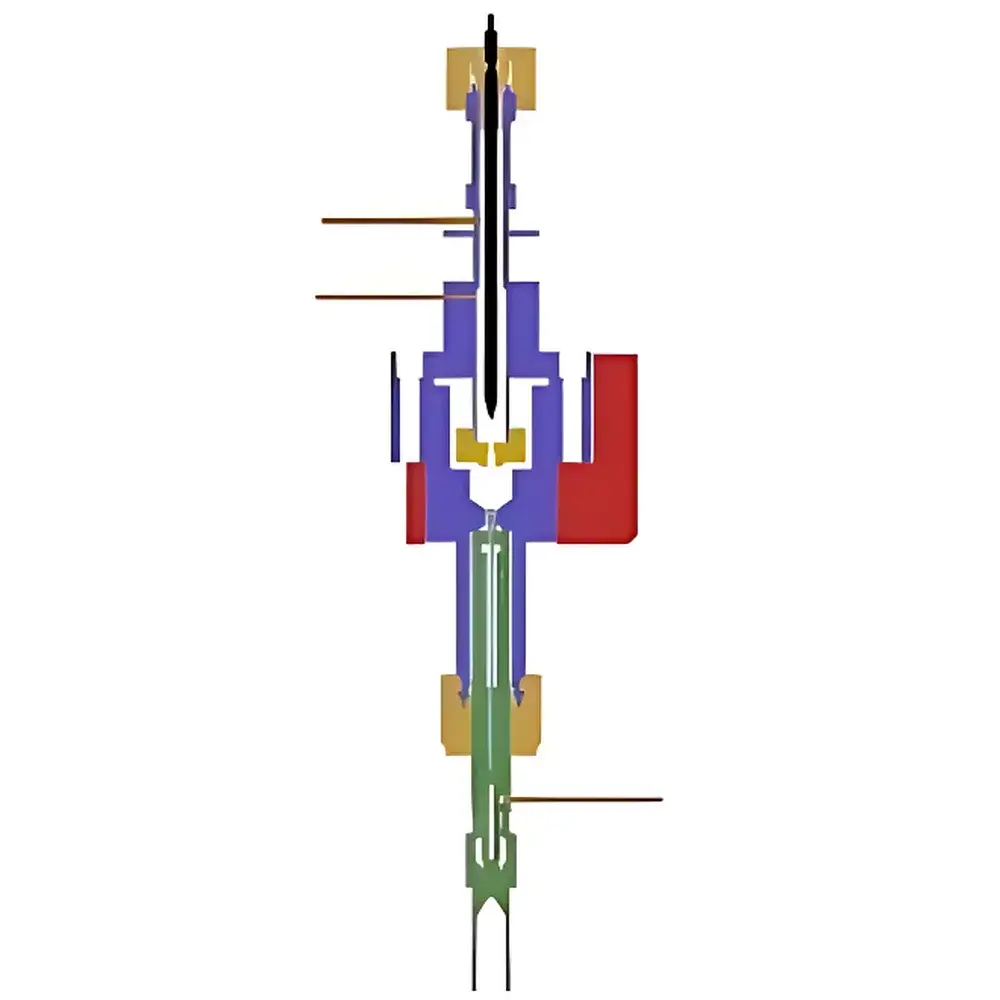
Agilent micro-ECD Micro Electron Capture Detector
| Brand | Agilent Technologies |
|---|---|
| Origin | USA |
| Manufacturer Type | Original Equipment Manufacturer (OEM) |
| Origin Category | Imported |
| Model | micro-ECD |
| Compatible Instrument | Gas Chromatograph (GC) |
| Detector Type | Electron Capture Detector (ECD) |
| Detection Principle | Radioisotope-based electron capture |
| Minimum Detectable Level (MDL) for Lindane | 3.8 fg/mL |
| Linear Dynamic Range | 5 × 10⁴ (fg/mL to ng/mL) |
| Sampling Rate | 5–500 Hz |
| Compliance | U.S. EPA Contract Laboratory Program (CLP) Method 8081B/8270 for pesticide analysis |
Overview
The Agilent micro-ECD (Micro Electron Capture Detector) is a high-performance, radioisotope-based detection module engineered exclusively for integration with Agilent gas chromatography systems—including the 8890 and 8860 GC platforms. Operating on the principle of electron capture by electronegative analytes in a beta-radiation ionization environment, the micro-ECD delivers exceptional sensitivity for trace-level detection of halogenated organic compounds—particularly organochlorine pesticides (e.g., lindane, DDT, heptachlor), polychlorinated biphenyls (PCBs), and aromatic nitro- or sulfonyl-containing contaminants. Its compact detection cell design minimizes dead volume while maximizing electron capture efficiency, resulting in sub-femtogram per milliliter detection limits without compromising baseline stability or reproducibility across extended run times.
Key Features
- Miniaturized detection cell: Reduced internal volume enhances mass transfer kinetics and signal-to-noise ratio, achieving an experimentally verified MDL of 3.8 fg/mL for lindane under standard EPA conditions.
- Extended linear dynamic range: Covers five orders of magnitude (fg/mL to ng/mL), enabling accurate quantitation of unknown samples without manual dilution or detector range switching—fully compliant with U.S. EPA CLP requirements for pesticide calibration (1–500 pg/µL).
- Optimized flow dynamics: Supports higher carrier gas linear velocities through the detector chamber, reducing analyte residence time and minimizing carbonaceous buildup on critical surfaces.
- Passivated anode architecture: Features a recessed, chemically inert anode configuration that significantly lowers susceptibility to contamination from non-volatile residues or column bleed products.
- Tuned electrostatic field geometry: Engineered electrode spacing and voltage gradient suppress secondary electron emission and ion recombination, thereby improving long-term signal fidelity and reducing maintenance frequency.
- High-speed data acquisition: Adjustable sampling rate from 5 Hz to 500 Hz supports both conventional and ultra-fast GC methods—including backflush and heart-cutting multidimensional configurations.
Sample Compatibility & Compliance
The micro-ECD is validated for routine use in environmental, food safety, and regulatory testing laboratories performing analyses per U.S. EPA Methods 8081B (organochlorine pesticides), 8082A (PCBs), and 8270 (semivolatile organics). It meets instrumental performance criteria outlined in ASTM D5845–22 for electron capture detection and is fully compatible with GLP- and GMP-regulated workflows when operated within Agilent’s OpenLab CDS software environment. The detector requires no external power supply beyond standard GC oven and electronics modules, and operates using a sealed ⁶³Ni foil source with certified activity and decay profile documentation supplied with each unit.
Software & Data Management
Controlled via Agilent OpenLab CDS (ChemStation Edition or EZChrom Edition), the micro-ECD integrates natively into sequence-driven acquisition protocols with real-time baseline correction, peak deconvolution, and automated gain adjustment. Audit trail functionality complies with FDA 21 CFR Part 11 requirements when configured with electronic signatures and secure user access levels. All raw detector signals are stored as vendor-neutral .D format files, supporting post-run reprocessing, spectral alignment, and export to LIMS via ASTM E1381-compliant interfaces. Calibration curves adhere to ISO/IEC 17025:2017 validation guidelines, including linearity assessment (r² ≥ 0.999), repeatability (RSD ≤ 3.5% at MDL), and intermediate precision across multi-day studies.
Applications
- Trace quantification of legacy pesticides in soil, sediment, and wastewater matrices
- Residue monitoring of chlorinated flame retardants (e.g., PBDEs, HBCDD) in food packaging and biological tissues
- Verification of PCB congener profiles in transformer oil and dielectric fluids
- Screening of nitroaromatic explosives (e.g., TNT, RDX) in forensic and environmental forensics applications
- Method development for fast-GC analysis of volatile halocarbons in ambient air canister samples
FAQ
What radioactive source is used in the Agilent micro-ECD?
The detector employs a sealed ⁶³Ni (nickel-63) foil source with nominal activity of 12 mCi, encapsulated in stainless steel and certified per IAEA SSG-24 guidelines for safe handling and disposal.
Is the micro-ECD compatible with hydrogen carrier gas?
No—hydrogen is incompatible due to quenching effects and safety risks; only nitrogen or argon/methane (95:5) make-up gases are permitted per Agilent specification.
How often does the ⁶³Ni source require replacement?
The half-life of ⁶³Ni is 102 years; source replacement is not required during normal instrument lifetime—only detector cell cleaning or electrode refurbishment may be needed after ~5,000 injections of dirty matrices.
Can the micro-ECD be retrofitted to older Agilent GC models?
Yes—it supports direct mechanical and electrical integration with 6890N, 7890A/B, and 8890 GC systems via standard GC detector interface modules and firmware version G1701EA Rev.E or later.
Does the micro-ECD support split/splitless and PTV injection modes?
Yes—full compatibility with all Agilent inlet types, including cool-on-column, with optimized temperature ramping and pressure control algorithms to prevent source overload during large-volume injections.






