
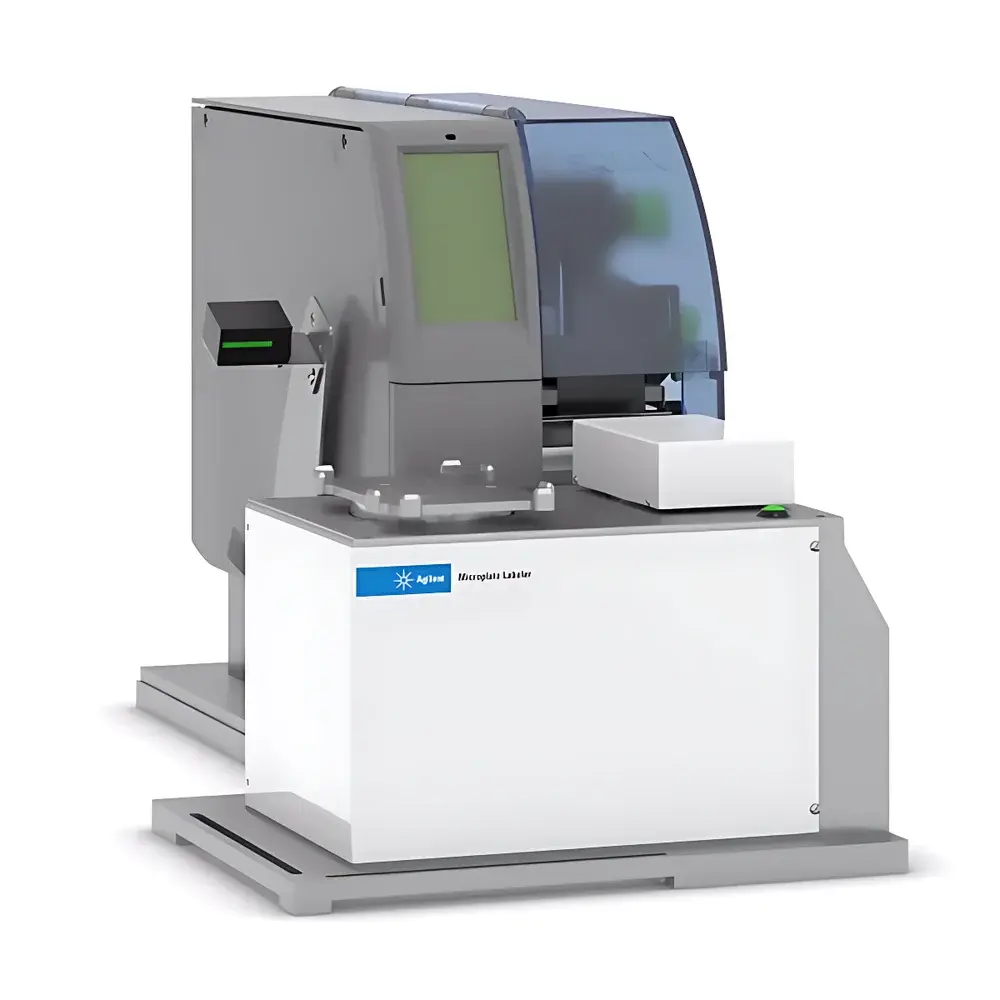
Agilent Microplate Barcode Labeler
| Brand | Agilent Technologies |
|---|---|
| Origin | Singapore |
| Manufacturer | Agilent Technologies |
| Origin Category | Imported |
| Model | Microplate Labeler |
| Pricing | Upon Request |
Overview
The Agilent Microplate Barcode Labeler is an engineered solution for high-precision, high-throughput labeling of standard and custom microplates used across life science laboratories, clinical diagnostics, and pharmaceutical R&D environments. Designed around a modular, benchtop architecture, the system employs thermal-transfer or direct thermal print technology—depending on configuration—to apply machine-readable barcodes (1D linear and 2D matrix) onto up to four vertical sidewalls of SBS-compliant microplates (96-, 384-, and 1536-well formats). Its core functionality supports traceability-driven workflows by enabling consistent label placement, repeatable adhesion performance, and seamless integration with LIMS, ELN, and robotic liquid handling platforms. The device operates on a closed-loop motion control system with optical position feedback, ensuring sub-millimeter registration accuracy across label application cycles.
Key Features
- Four-sided labeling capability: Simultaneous or sequential label application on all four lateral surfaces of microplates, supporting orientation-agnostic plate loading.
- High-speed throughput: Consistent label printing and application at ≤4 seconds per label under nominal operating conditions—scalable to multi-plate batches via programmable queuing.
- Flexible symbology support: Native rendering of Code 128, Code 39, Interleaved 2 of 5, QR Code, Data Matrix, and Aztec Code; configurable font sizing, magnification ratios (0.5×–2.0×), and quiet zone margins per ISO/IEC 15415 and 15416 standards.
- Multi-source data ingestion: Accepts input from CSV files, database queries (ODBC/JDBC), RESTful API endpoints, and real-time serial/USB streams—enabling dynamic label content generation tied to assay metadata or sample IDs.
- Integrated verification option: Optional integrated barcode verifier (ISO/IEC 15415-compliant) enables post-application grade assessment (A–F), automatic re-labeling upon decode failure, and label duplication from existing plates via camera-based optical recognition.
- Automation-ready interface: Equipped with RS-232, Ethernet (TCP/IP), and digital I/O ports; supports standard communication protocols including Modbus TCP and Agilent’s proprietary PlateLink™ handshake for synchronized operation with third-party robotics.
Sample Compatibility & Compliance
The labeler accommodates microplates conforming to ANSI/SBS standards (height: 14.35 ± 0.1 mm, footprint: 127.76 × 85.48 mm), including polypropylene, polystyrene, and cyclic olefin copolymer (COC) plates—whether skirted, semi-skirted, or unskirted. Adhesive-backed label stock (0.076–0.15 mm thickness, 12–50 mm width) must meet UL 969 and GHS-compliant chemical resistance specifications for solvent exposure in lab environments. The system complies with IEC 61000-6-2 (immunity) and IEC 61000-6-4 (emissions), carries CE marking, and meets FDA 21 CFR Part 11 requirements when deployed with audit-trail-enabled software configurations. It supports GLP/GMP documentation workflows through timestamped log export (CSV/JSON) and user-access-controlled role permissions.
Software & Data Management
Agilent’s PlateLabel Suite v3.x provides a Windows-based GUI for template design, batch job scheduling, and real-time status monitoring. Templates support dynamic fields (e.g., date/time stamps, incrementing lot numbers, hash-based UUIDs), conditional logic, and embedded calibration metadata. All print jobs generate immutable audit trails—including operator ID, timestamp, plate barcode, label content hash, and hardware sensor logs—retained for ≥18 months per configurable retention policy. The software integrates natively with Agilent OpenLab ECM and third-party systems via HL7, ASTM E1384, or custom XML schema mapping. Remote diagnostics and firmware updates are performed over HTTPS with TLS 1.2+ encryption.
Applications
- Biobanking and sample repository management: Ensuring unambiguous identification across cryogenic storage, thawing, and aliquoting workflows.
- High-content screening (HCS) and HTS assay setup: Synchronizing plate-level identifiers with imaging acquisition metadata and dose-response matrices.
- Regulated QC/QA testing in pharmaceutical manufacturing: Enabling full chain-of-identity for stability studies, release testing, and deviation investigations.
- NGS library preparation tracking: Associating index sequences, adapter ligation batches, and sequencing run assignments at the plate level.
- Automated biorepository curation: Coordinating with robotic arms, stackers, and environmental monitors in walk-in cold rooms or automated storage systems.
FAQ
Does the labeler support non-standard microplate geometries (e.g., deep-well or PCR plates)?
Yes—custom tooling fixtures and adjustable Z-axis height calibration allow adaptation to plates up to 45 mm tall, provided base dimensions remain within ANSI/SBS tolerances.
Can label data be pulled directly from a Laboratory Information Management System (LIMS)?
Yes—via ODBC connectivity or REST API integration, with field mapping configurable in PlateLabel Suite without code modification.
Is offline operation supported for secure environments with no network access?
Yes—batch jobs can be preloaded via USB drive; all label rendering and motion control execute locally without cloud dependency.
What maintenance intervals are recommended for the print head and peeling mechanism?
Agilent recommends print head cleaning every 5,000 labels and mechanical inspection every 6 months or 10,000 cycles—documented in the preventive maintenance log module.
How is label adhesion validated for low-surface-energy plates (e.g., COC)?
Agilent provides application notes with peel-force test protocols (ASTM D3330) and certified label-stock pairings tested across temperature/humidity gradients (20–40 °C, 30–70% RH).



