
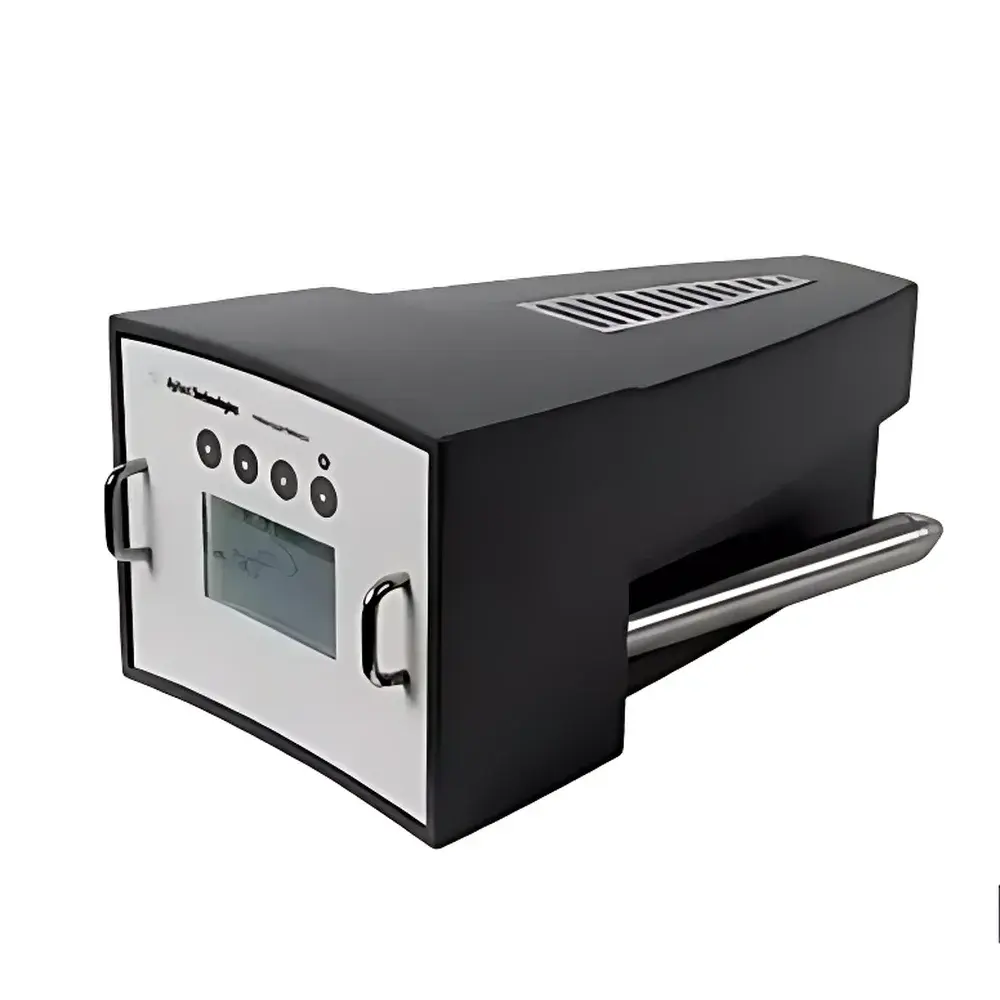
Agilent PHD-4 Portable Helium Mass Spectrometer Leak Detector
| Brand | Agilent Technologies |
|---|---|
| Origin | Italy |
| Manufacturer Type | Original Equipment Manufacturer (OEM) |
| Origin Category | Imported |
| Model | PHD-4 |
| Price Range | USD 13,500 – 40,500 |
Overview
The Agilent PHD-4 Portable Helium Mass Spectrometer Leak Detector is a compact, field-deployable instrument engineered for high-sensitivity quantitative leak detection in industrial, pharmaceutical, and vacuum-system maintenance environments. It operates on the principle of quadrupole mass spectrometry, selectively ionizing and detecting helium atoms (mass-to-charge ratio m/z = 4) within a background gas matrix. Unlike pressure decay or bubble testing—methods limited by resolution, environmental interference, and operator dependency—the PHD-4 delivers trace-level sensitivity grounded in fundamental mass spectral discrimination. Its patented Selective Ion Pump Detection (SIPD) technology enhances signal-to-noise ratio by integrating a miniature ion pump with optimized ion optics, enabling stable baseline performance even under variable ambient conditions. Designed for real-time, on-site diagnostics, the PHD-4 detects helium concentrations as low as 2 ppm—corresponding to a minimum detectable leak rate of 5 × 10⁻⁶ atm·cm³/s (standard cubic centimeters per second at standard temperature and pressure)—without requiring vacuum chamber evacuation or system isolation beyond standard operational protocols.
Key Features
- Ultra-portable design: Total unit weight—including integrated rechargeable lithium-ion battery—is 2.6 kg (5.7 lbs), enabling one-handed operation and extended field use without external power.
- Patented SIPD architecture: Combines a miniaturized ion pump with dynamic ion focusing to suppress background nitrogen/oxygen interference, ensuring helium-specific response with >99.8% selectivity.
- Fully automated startup sequence: Microprocessor-controlled auto-tuning, zero calibration, and filament activation complete within ≤3 minutes from cold start.
- Adaptive helium sensitivity adjustment: User-selectable sensitivity modes (1×, 10×, 100× gain) allow optimization of detection threshold versus helium consumption—critical for cost-sensitive or resource-constrained applications.
- Dual-power operation: Operates continuously on battery (≥4.5 hours typical runtime) or AC mains (100–240 V, 50/60 Hz) with automatic switchover and battery recharging.
- Intuitive interface: Backlit LCD display with context-sensitive soft keys; no specialized training required for routine leak survey or rate quantification.
Sample Compatibility & Compliance
The PHD-4 is compatible with all standard helium spray probes, sniffer probes, and vacuum-line adapters used across semiconductor fab tool maintenance, HVAC commissioning, pharmaceutical isolator validation, and cryogenic system integrity verification. It meets IEC 61010-1:2010 safety requirements for portable electrical equipment and complies with EN 61326-1:2013 electromagnetic compatibility (EMC) standards. While not certified for intrinsic safety (e.g., ATEX/IECEx), its low-power architecture and absence of high-voltage external components make it suitable for non-hazardous area deployment. Data logging outputs conform to ASTM E1776-21 guidelines for leak test documentation, supporting GLP/GMP audit readiness when paired with optional timestamped CSV export via USB-C interface.
Software & Data Management
The PHD-4 embeds firmware v3.2+ with embedded data logging (up to 10,000 timestamped events), including leak rate, helium concentration, probe position tag (via optional Bluetooth geotagging module), and environmental temperature/pressure metadata. Export is supported via USB-C to standard CSV or XML formats compatible with LIMS integration (e.g., Thermo Fisher SampleManager, LabVantage). No proprietary software installation is required—raw files open natively in Excel or Python pandas. Audit trail functionality includes user ID stamping (with optional password-protected access levels), firmware version logging, and tamper-evident calibration history—all compliant with FDA 21 CFR Part 11 Annex 11 requirements for electronic records and signatures when deployed in regulated manufacturing environments.
Applications
- On-site leak localization in high-purity gas distribution systems (e.g., bulk argon, nitrogen, or specialty process gases in semiconductor fabs).
- Quantitative leak rate verification of ASME B31.3-compliant piping welds prior to hydrostatic testing.
- Validation of vacuum integrity in lyophilizer chambers, gloveboxes, and inert-atmosphere reactors per USP guidance.
- Routine preventive maintenance of HVAC refrigerant circuits where R-134a or R-410A replacement mandates helium-trace leak verification.
- Field troubleshooting of cryostat seals, superconducting magnet housings, and particle accelerator beamline flanges.
FAQ
What is the minimum detectable leak rate under standard operating conditions?
The PHD-4 achieves a verified minimum detectable leak rate of 5 × 10⁻⁶ atm·cm³/s when using a calibrated helium sniffer probe at 25 °C ambient temperature and atmospheric pressure.
Does the PHD-4 require periodic recalibration by an authorized service center?
No—built-in reference leak verification and auto-zero routines enable user-performed functional checks per ISO 10857:2022 Annex B. Full calibration is recommended annually or after 500 operational hours, optionally performed on-site by Agilent Field Service Engineers.
Can the PHD-4 be used in pressurized or vacuum-integrated configurations?
Yes—it supports both sniffer-mode (positive-pressure test object) and vacuum-mode (test object connected to inlet port) per ASTM E499-20 Section 6.2, with configurable response delay and averaging windows.
Is helium consumption monitored or reported during testing?
Helium flow rate is not measured directly, but sensitivity mode selection (1×/10×/100×) correlates to approximate consumption profiles documented in the Operator’s Manual Section 4.3, enabling predictive gas budgeting.
How does SIPD technology differ from conventional hot-cathode mass spectrometer detectors?
SIPD replaces thermionic emission filaments with a cold-cathode ion pump that simultaneously evacuates residual gases and generates helium-specific ion current—eliminating filament burnout risk and improving long-term stability in variable humidity or particulate environments.
Related Products





