
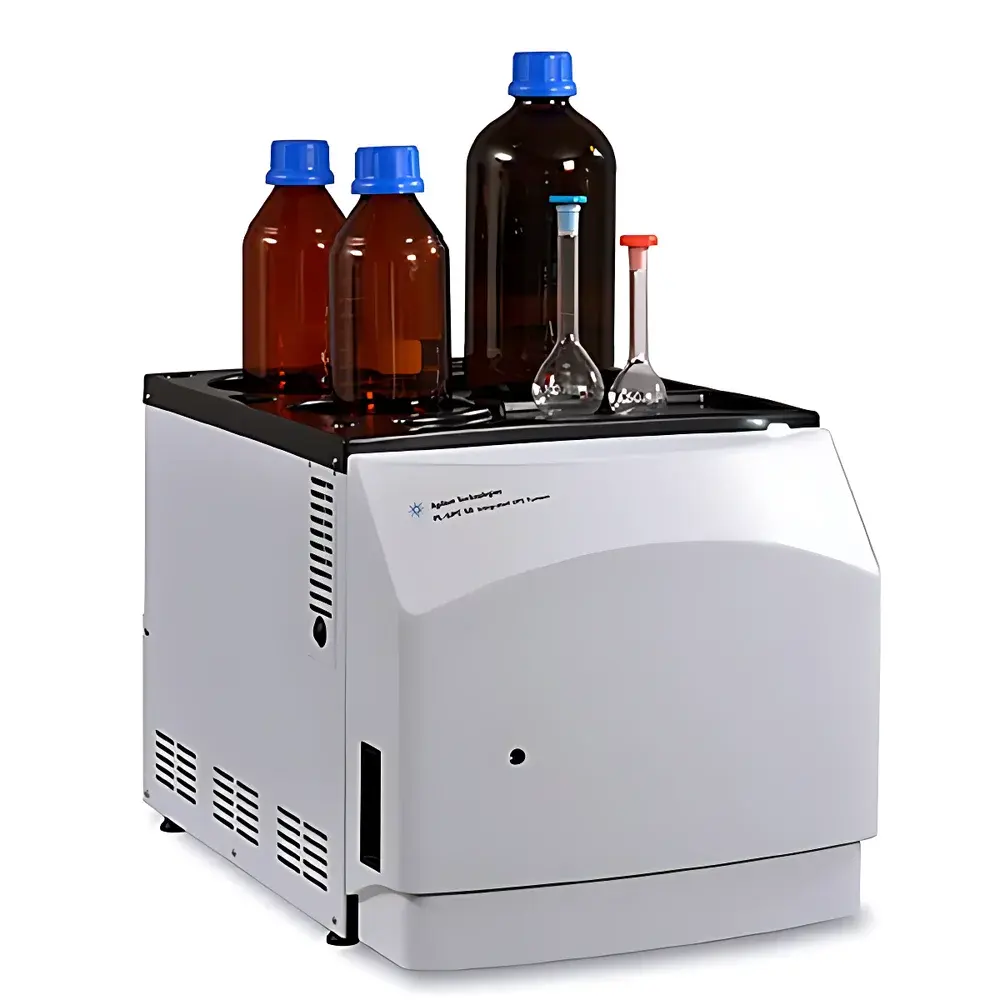
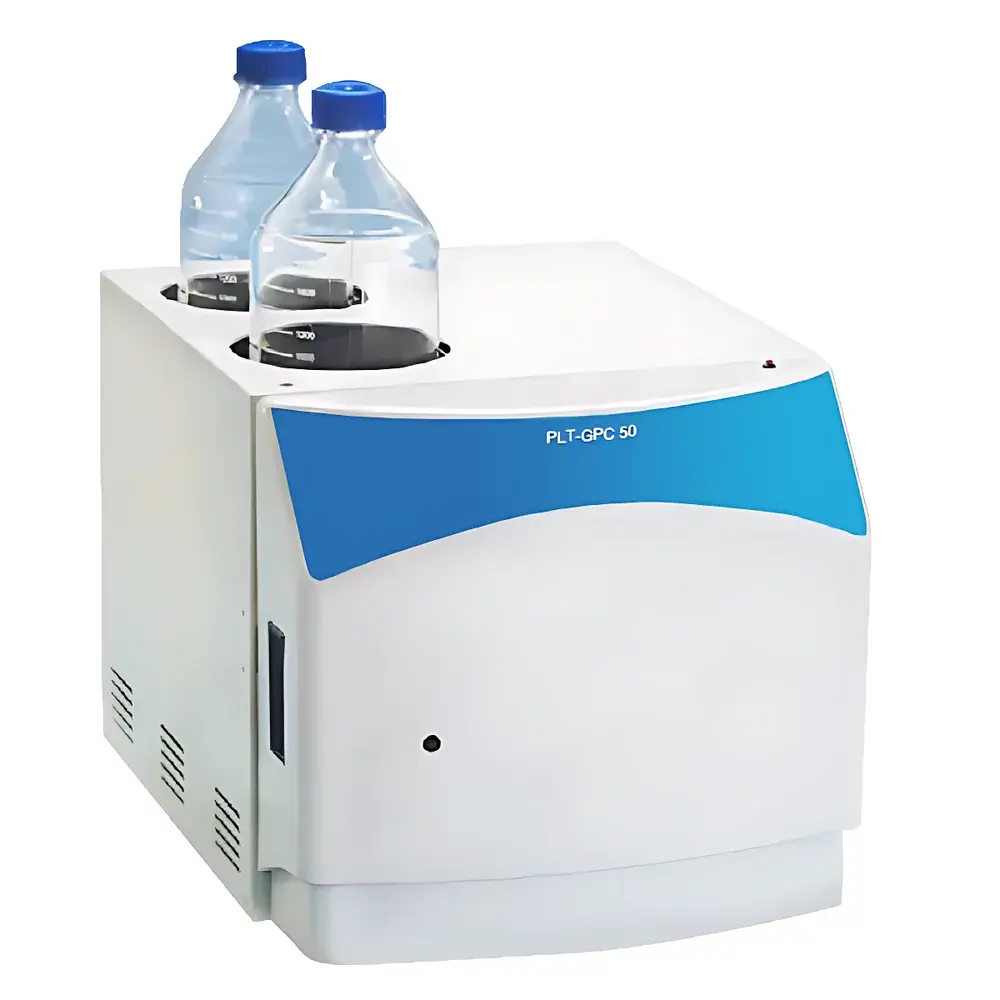
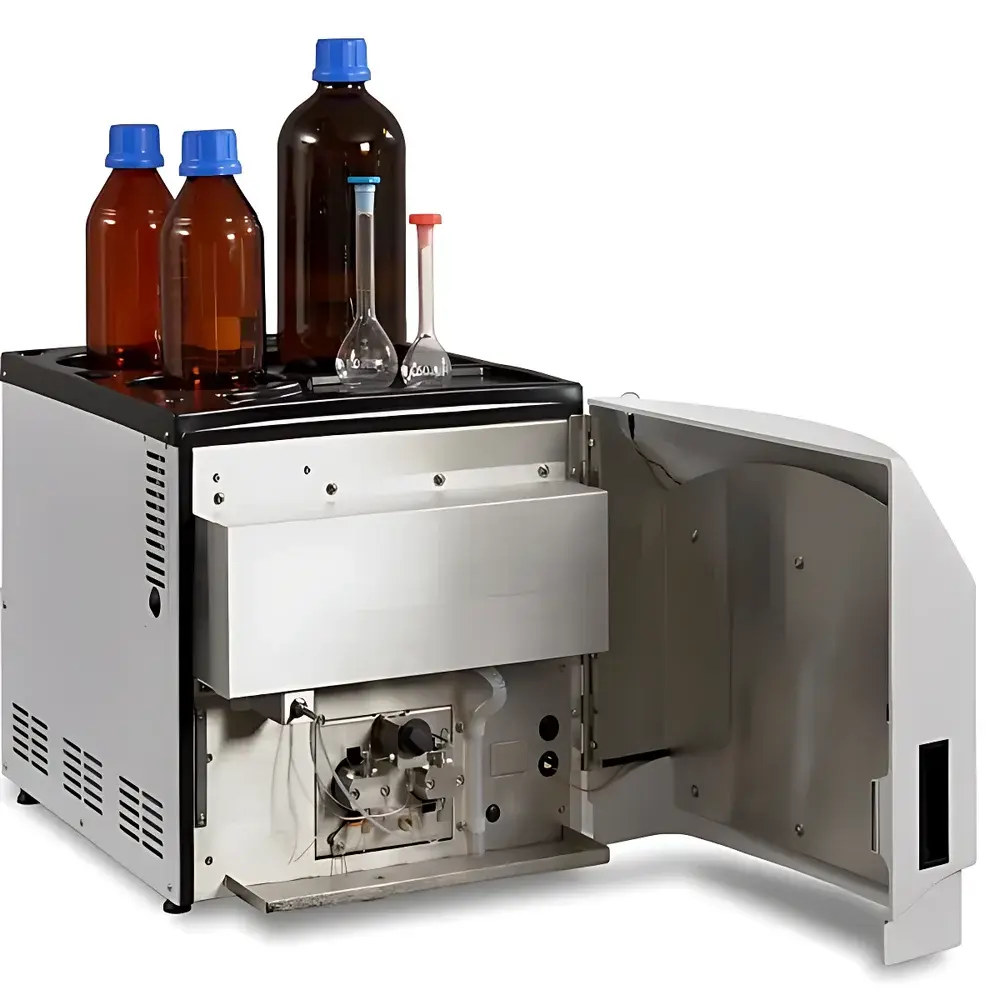
Agilent PL-GPC 50 Ambient-Temperature Gel Permeation Chromatograph
| Brand | Agilent Technologies |
|---|---|
| Origin | United Kingdom |
| Model | PL-GPC 50 |
| Operating Temperature Range | Ambient to 50 °C |
| Detector Options | UV, PL-RI (Refractive Index), PL-BV400RT (Viscometer), Multi-Angle Light Scattering (MALS) |
| Solvent Delivery System | High-Precision Isocratic Pump |
| Autosampler | Integrated Six-Position Valve-Based Injector |
| Compliance | Designed for ISO 16014, ASTM D5296, and USP <621> SEC/GPC Method Requirements |
Overview
The Agilent PL-GPC 50 is a purpose-engineered ambient-temperature gel permeation chromatography (GPC) / size exclusion chromatography (SEC) system optimized for routine polymer molecular weight distribution (MWD) analysis under isothermal conditions ranging from ambient temperature up to 50 °C. Unlike high-temperature GPC platforms, the PL-GPC 50 eliminates the need for elevated column oven operation—reducing thermal stress on thermally labile polymers, minimizing solvent degradation, and lowering operational energy consumption. Its monolithic design integrates the solvent delivery module, autosampling valve, column compartment, and detector flow path within a single thermally stabilized zone. This architecture ensures minimal thermal gradient-induced band broadening and refractive index drift—critical for reproducible retention time alignment and accurate calibration across multiple injections. The system leverages Polymer Laboratories’ (PL) legacy in SEC column chemistry, supporting industry-standard PLgel Mixed-D or Mixed-E columns with pore sizes calibrated against narrow polystyrene standards traceable to NIST SRM 1475a.
Key Features
- Thermally unified flow path: All critical components—including pump outlet, injection valve, column oven, and detector cell—are housed in a shared temperature-controlled environment (±0.1 °C stability), eliminating inter-component thermal lag and improving baseline stability for RI detection.
- Modular detector compatibility: Supports simultaneous dual- or triple-detection configurations—standard PL-RI detector included; optional UV-Vis (254 nm), PL-BV400RT capillary viscometer, and MALS detectors enable universal calibration and intrinsic viscosity determination.
- High-precision isocratic solvent delivery: Dual-piston reciprocating pump delivering flow rates from 0.1 to 2.0 mL/min with ≤0.1% RSD over 24 h—engineered for long-term baseline integrity during extended runs.
- Column oven with active air circulation: Maintains uniform axial and radial temperature distribution across stacked 300 × 7.8 mm columns, ensuring consistent elution kinetics and minimizing peak skewing.
- Intuitive software-integrated hardware control: Front-panel interface with real-time pressure monitoring, flow verification, and error logging—designed for GLP-compliant instrument qualification (IQ/OQ).
Sample Compatibility & Compliance
The PL-GPC 50 accommodates a broad range of synthetic and natural polymers soluble in common SEC solvents—including tetrahydrofuran (THF), chloroform, dimethylformamide (DMF), and dichlorobenzene—without requiring high-temperature dissolution or aggressive stabilization protocols. It meets key regulatory and methodological benchmarks: ISO 16014-1–4 (determination of average molecular weights and MWD), ASTM D5296 (standard test method for molecular weight distributions of polystyrene by SEC), and USP chromatography general chapter requirements for resolution, tailing factor, and system suitability. Data acquisition and processing comply with ALCOA+ principles; audit trails, electronic signatures, and user-access controls are configurable to meet FDA 21 CFR Part 11 and EU Annex 11 expectations when paired with Agilent OpenLab CDS.
Software & Data Management
Data acquisition and post-run analysis are performed using Agilent’s OpenLab GPC/SEC Software—a validated platform supporting automated calibration curve generation (linear, cubic spline, or universal calibration), batch processing of 100+ samples, and export of standardized reports compliant with LIMS integration (ASTM E2500, ISO/IEC 17025). The software includes built-in tools for baseline correction, peak deconvolution, branching ratio estimation (via universal calibration), and Mark–Houwink parameter derivation. All raw chromatograms, method files, and audit logs are stored in encrypted .agilent binary format with SHA-256 checksum validation. Raw data export supports CSV, ASCII, and AIA (.cdf) formats for third-party statistical analysis (e.g., JMP, MATLAB, Python pandas).
Applications
- Routine QC of polyolefins, acrylics, polyesters, and polyethers in manufacturing environments where thermal degradation must be avoided.
- Academic research on biodegradable polymers (e.g., PLA, PHA) and hydrogels sensitive to elevated temperatures.
- Regulatory submission support for pharmaceutical excipients (e.g., PEG, polysorbates) per ICH Q5E guidelines on polymer characterization.
- Method development and transfer between labs due to its robust isocratic performance and low inter-laboratory variability (<2% RSD in Mw across five independent sites).
- Stability-indicating assays tracking molecular weight shifts during accelerated aging studies (e.g., oxidation-induced chain scission).
FAQ
What solvents are compatible with the PL-GPC 50 system?
THF, chloroform, DMF, and o-dichlorobenzene are fully supported; solvent compatibility is verified per ASTM D5296 Annex A1 and PL column specifications.
Can the system perform universal calibration without polystyrene standards?
Yes—when equipped with both RI and viscometer detectors, the system calculates intrinsic viscosity and enables universal calibration using Mark–Houwink parameters for non-PS polymers.
Is the PL-GPC 50 suitable for GMP-regulated environments?
It supports 21 CFR Part 11 compliance when deployed with OpenLab CDS v2.5 or later, including role-based access, electronic signatures, and immutable audit trails.
What is the typical run time for a standard polymer sample?
A full MWD analysis using a 3-column PLgel Mixed-D set at 1.0 mL/min in THF requires approximately 25–30 minutes, including equilibration and post-run flush.
Does the system include column protection or guard column options?
Yes—PL offers dedicated guard columns (e.g., PLgel Guard 50 × 7.8 mm) and in-line solvent filters (0.2 µm PTFE) to extend analytical column lifetime and maintain backpressure stability.




