
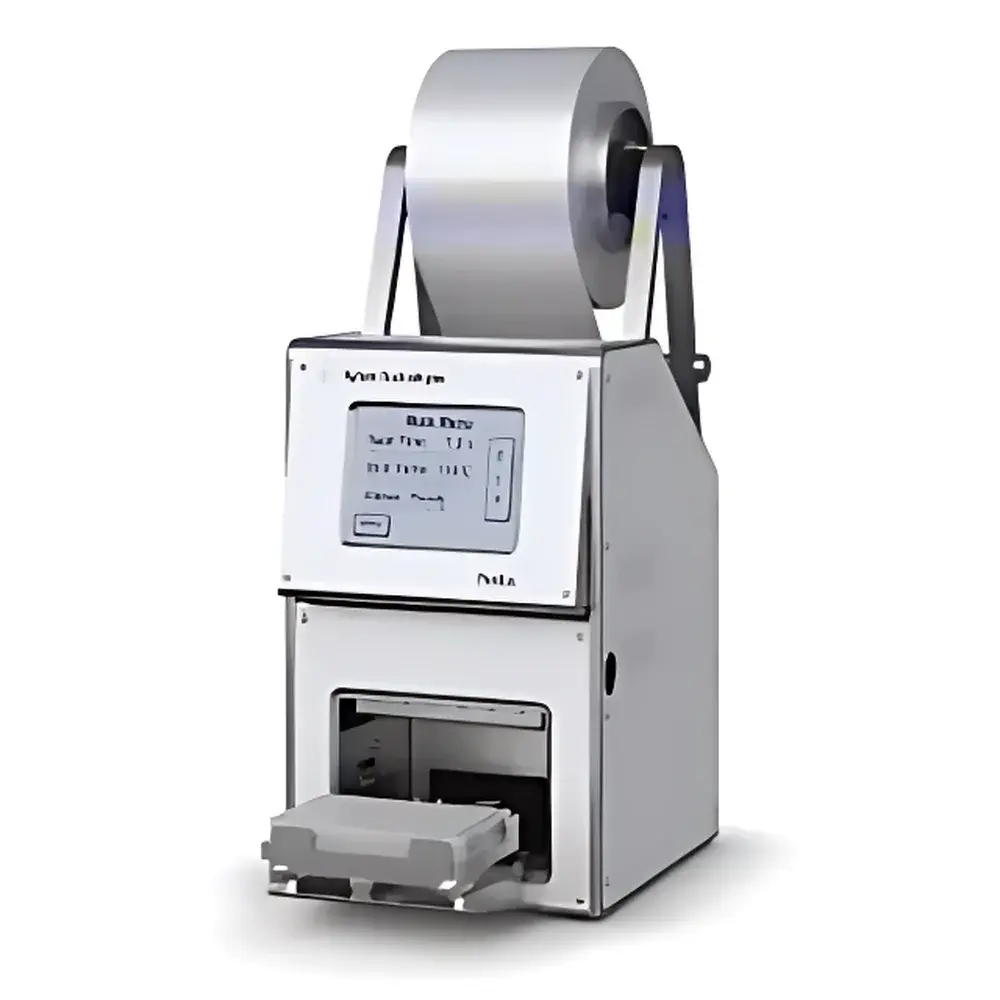
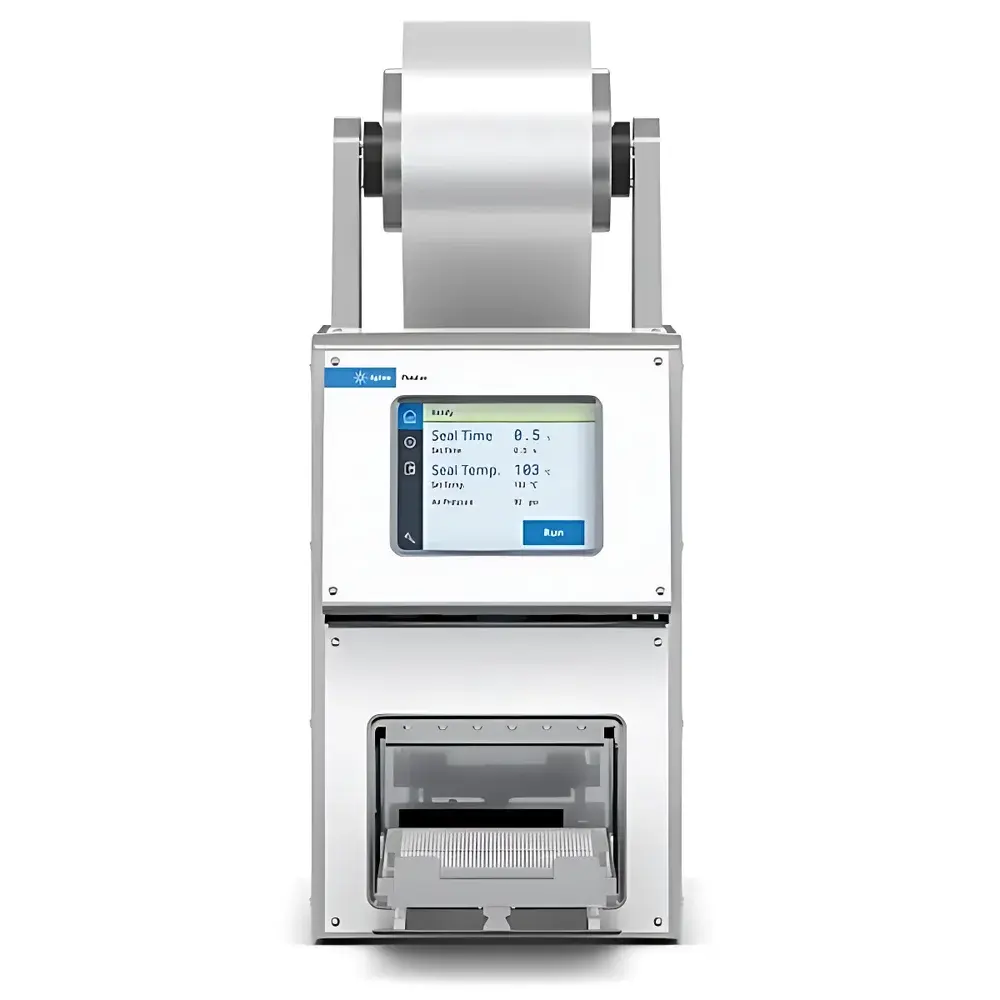
Agilent PlateLoc Automated Microplate Sealer
| Brand | Agilent Technologies |
|---|---|
| Origin | Singapore |
| Manufacturer | Agilent Technologies |
| Country of Origin | Imported |
| Model | PlateLoc |
| Pricing | Upon Request |
Overview
The Agilent PlateLoc Automated Microplate Sealer is a benchtop, fully automated thermal sealing system engineered for precision, reproducibility, and seamless integration in high-throughput laboratory environments. It operates on resistive heating and controlled dwell-time thermosealing principles—applying uniform thermal energy across the entire sealing surface to fuse heat-sensitive films (e.g., polypropylene, aluminum, foil-polymer laminates) onto standard and non-standard microplates. Designed for compatibility with ANSI/SLAS-format plates—including 96-, 384-, and 1536-well formats—the PlateLoc delivers consistent, bubble-free seals critical for downstream applications such as PCR, compound storage, enzymatic assays, and long-term sample archiving. Its compact footprint (24.5 × 30.5 × 27.5 cm), robust stainless-steel and reinforced polymer chassis, and factory-calibrated thermal architecture ensure operational stability across continuous shifts and multi-user facilities.
Key Features
- Intuitive 7-inch color touchscreen interface with context-sensitive prompts and real-time status feedback—no external PC required for standalone operation.
- Auto-height adjustment mechanism accommodates plate heights from 14.0 mm to 50.0 mm, supporting deep-well storage plates, low-profile PCR plates, assay-ready analytical plates, and custom-format compound management plates.
- Included universal platform inserts: four interchangeable silicone-coated垫片 kits pre-configured for 96-well, 384-well, 1536-well, and irregular-height plates—enabling rapid mechanical adaptation without tools or recalibration.
- No-cool-down sealing cycle: achieves full seal integrity in ≤8 seconds per plate (typical for polypropylene film on 96-well plates), eliminating mandatory post-seal cooling delays and maximizing throughput.
- Energy-efficient sleep mode: automatically powers down the heating plate and display after user-defined idle time (1–60 minutes), reducing standby power consumption by >70% versus continuous operation.
- Pre-programmable sealing profiles: up to 10 user-defined configurations stored onboard—each defining temperature setpoint (range: 100–220 °C), dwell time (0.5–15.0 s), and pressure profile (fixed pneumatic actuation)—for rapid recall across diverse film types and plate chemistries.
Sample Compatibility & Compliance
The PlateLoc supports all commercially available thermal sealing films compliant with ISO 20776-1 (clinical microbiology), ASTM D882 (tensile properties of thin plastic sheeting), and USP (plastic packaging systems for pharmaceuticals). It accommodates plates manufactured to ANSI SLAS-1–2019 dimensional standards, including skirted, semi-skirted, and unskirted formats. Seal integrity is validated via dye penetration testing (per ISO 11607-2 Annex B) and peel strength measurement (ASTM F88). The device meets IEC 61010-1:2010 safety requirements for laboratory equipment and carries CE marking for EMC and LVD compliance. For regulated environments, audit trails and configuration logs may be exported via RS-232 for GLP/GMP documentation; ActiveX control enables integration with LIMS and robotic workcell orchestration software under 21 CFR Part 11-compliant architectures.
Software & Data Management
While fully functional as a stand-alone instrument, the PlateLoc provides native RS-232 serial communication (9600 baud, N-8-1) for bidirectional command-and-control integration. Agilent-supplied ActiveX controls allow direct embedding into custom C#, LabVIEW, or Python-based automation frameworks—supporting plate ID pass-through, real-time temperature reporting, cycle completion signaling, and error-code logging. All 10 programmable profiles are stored in non-volatile memory with write-protection options. Firmware updates are performed via USB flash drive using Agilent-signed binaries, ensuring traceability and version control in validated settings.
Applications
- High-throughput PCR setup in molecular diagnostics labs requiring hermetic, nuclease-free sealing prior to thermal cycling.
- Compound library management in drug discovery—sealing DMSO-containing samples in 1536-well plates with low-permeability aluminum-laminate films.
- Biobanking and clinical specimen storage—achieving leak-tight seals on cryogenic storage plates used in -80 °C or liquid nitrogen environments.
- ELISA and cell-based assay preparation where evaporation control and contamination prevention are critical during extended incubation periods.
- Automated liquid handling workflows integrated with Hamilton STAR, Tecan Fluent, or PerkinElmer JANUS platforms via standardized command protocols.
FAQ
Does the PlateLoc support barcode-triggered sealing profiles?
Yes—when integrated via RS-232 or ActiveX, external barcode readers can initiate predefined sealing protocols based on scanned plate IDs.
Can it seal plates containing volatile solvents like DMSO or acetonitrile?
Yes—provided compatible solvent-resistant films (e.g., Agilent’s 5188-5350 aluminum laminate) are used and sealing parameters are optimized per solvent vapor pressure and film adhesion kinetics.
Is calibration required before first use or after routine maintenance?
No—factory calibration is permanent and traceable to NIST standards; only periodic verification using Agilent’s optional thermal validation kit (p/n 5190-1425) is recommended annually or per internal SOP.
What film thicknesses are supported?
Standard range: 25–125 µm; maximum recommended thickness is 150 µm for reliable thermal transfer and bond formation across all plate geometries.
How is thermal uniformity across the sealing surface verified?
Each unit undergoes IR thermographic mapping at 100+ points during final QA; uniformity is guaranteed to ±2.5 °C across the active sealing zone (127 × 86 mm) at setpoints between 120–200 °C.



