
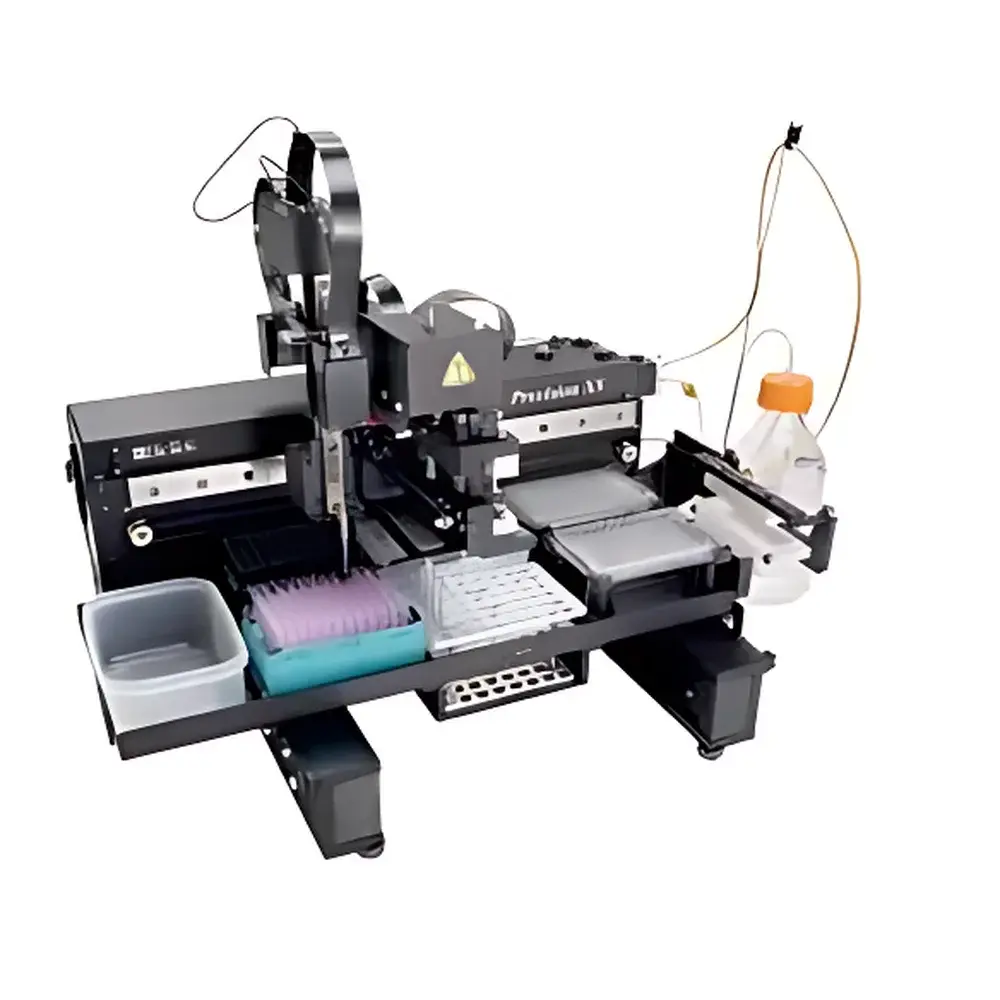
Agilent Precision Automated Liquid Handling Workstation
| Brand | Agilent Technologies |
|---|---|
| Origin | USA |
| Manufacturer Type | Original Equipment Manufacturer (OEM) |
| Import Status | Imported |
| Model | Precision |
| Pricing | Available Upon Request |
Overview
The Agilent Precision Automated Liquid Handling Workstation is a benchtop-integrated, programmable liquid handling platform engineered for precision, reproducibility, and workflow flexibility in modern life science and pharmaceutical laboratories. Built upon positive-displacement and air-displacement pipetting principles—depending on configuration—the system delivers calibrated volumetric transfer across a broad dynamic range (1 µL to 1,000 µL), supporting critical applications including assay setup, sample normalization, serial dilution, plate replication, and reagent dispensing. Unlike modular robotic systems requiring dedicated infrastructure, the Precision workstation operates as a self-contained unit with minimal footprint (41 × 64 × 51 cm), enabling seamless integration into ISO Class 5–7 clean benches, QC labs, and GLP-compliant environments without facility retrofitting.
Key Features
- Modular pipetting architecture supporting interchangeable single-, 8-channel, and 12-channel heads—enabling method-specific optimization for microplate (96- and 384-well), tube (≤100 mm height), vial, and reservoir-based workflows.
- Adjustable deck layout with configurable mounting positions for accessories including tip racks, wash stations, and barcode readers—allowing user-defined deck maps without firmware modification.
- Calibrated accuracy of ±1% at 100 µL and precision of <1.5% CV at 100 µL—validated per ISO 8655-6 and ASTM E2758 standards using gravimetric verification protocols.
- Robust mechanical design featuring stepper-motor-driven Z-axis control, low-dead-volume fluid paths, and anti-drip valve technology to minimize carryover and cross-contamination.
- Compliance-ready architecture supporting audit trails, electronic signatures, and protocol versioning when paired with optional Precision Power™ PC software configured for 21 CFR Part 11 compliance.
Sample Compatibility & Compliance
The Precision workstation accommodates standard ANSI/SLAS-format microplates (96- and 384-well), conical and round-bottom tubes (up to 15 mL), and commercial reagent bottles (e.g., Thermo Fisher Nunc, Corning, Greiner). It accepts universal pipette tips meeting ISO 8655-2 dimensional tolerances—eliminating vendor lock-in and reducing consumables cost. The system supports routine calibration verification using certified reference weights and traceable water standards, aligning with ISO/IEC 17025 requirements for accredited testing laboratories. All hardware and firmware revisions are documented per ICH Q7 Annex 11 guidance for computerized system validation in GMP manufacturing environments.
Software & Data Management
Precision Power™ PC software provides a Windows-based graphical interface for protocol creation, execution monitoring, and log export. Users define liquid classes (e.g., aqueous, viscous, volatile), aspiration/dispense parameters (speed, delay, touch-off), and multi-step workflows via drag-and-drop sequencing—not scripting. Raw execution logs include timestamped event records (tip pickup, aspirate volume, dispense location), error codes, and environmental metadata (ambient temperature, humidity if sensor-equipped). Export formats include CSV and XML for LIMS integration; optional database logging enables long-term trend analysis of pipetting performance metrics across shifts and operators.
Applications
- High-throughput screening (HTS) assay plate setup for oncology and neuropharmacology target validation.
- QC release testing of biologics—including buffer exchange, dilution series for potency assays, and sample aliquoting for stability studies.
- NGS library preparation workflows involving enzymatic reaction setup, bead-based cleanup, and index addition across multiple sample batches.
- Regulatory submission support: generation of auditable liquid handling records compliant with FDA BLA/MAA dossier requirements.
- Educational and core facility deployment where ease of training, method portability, and serviceability are prioritized over ultra-high-speed throughput.
FAQ
Is the Precision system compatible with third-party tip brands?
Yes. The system is validated for use with any ISO 8655-2–compliant pipette tips, including those from Rainin, Gilson, and VWR.
Can the Precision workstation be integrated with external plate handlers such as BioStack™ or Twister II?
Yes—via standardized RS-232 or Ethernet TCP/IP communication protocols. Agilent provides documented API command sets and integration test reports for interoperability validation.
What validation documentation is provided with the system?
Each unit ships with Factory Acceptance Test (FAT) reports, IQ/OQ templates aligned with ASTM E2500, and a Certificate of Conformance referencing NIST-traceable calibration standards.
Does the system support variable tip ejection or tip reuse protocols?
Tip ejection is programmable per step; however, tip reuse is not supported under GxP conditions due to risk of carryover—consistent with USP and EP 2.6.14 recommendations.
Is remote monitoring or cloud-based data backup available?
Local network logging is standard; cloud connectivity requires on-premise IT review and firewall configuration per institutional cybersecurity policy—no direct public cloud upload is enabled by default.
Related Products



