
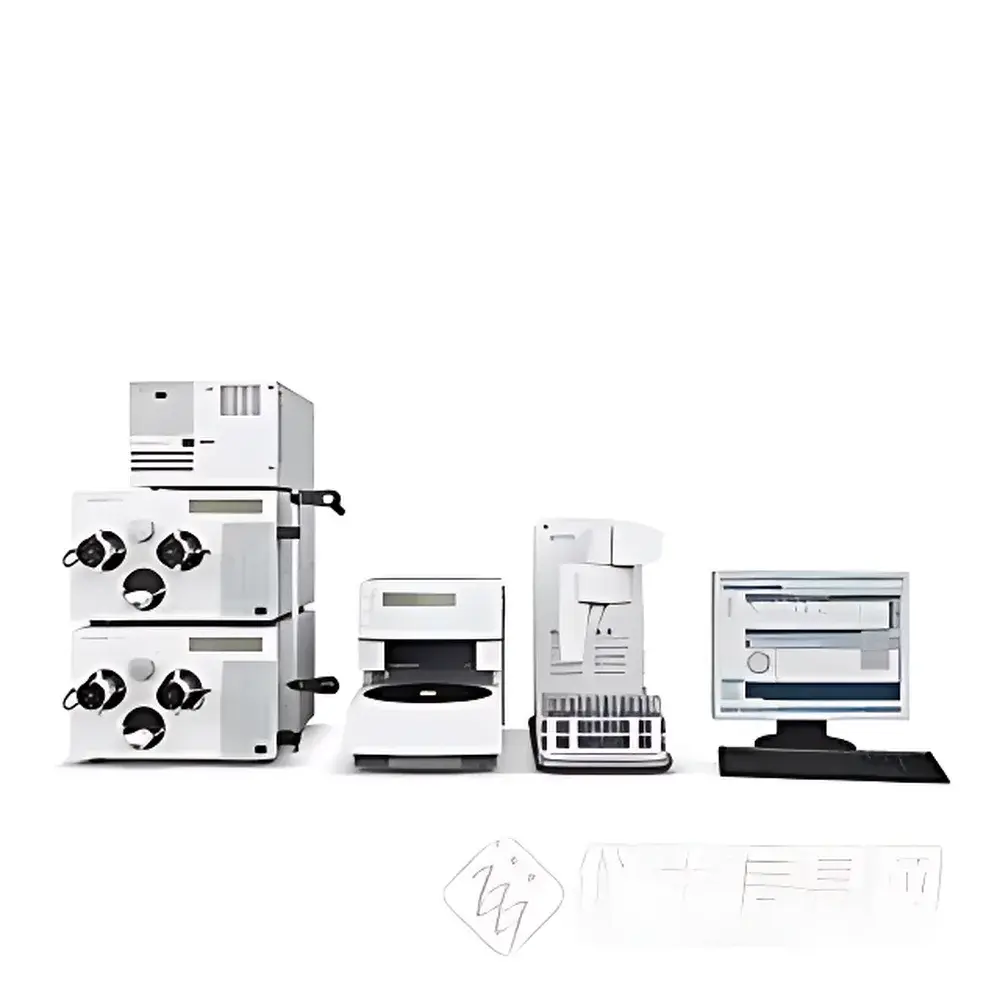
Agilent SD-1 Preparative Purification System
| Brand | Agilent Technologies |
|---|---|
| Origin | Germany |
| Manufacturer Type | Original Equipment Manufacturer (OEM) |
| Import Status | Imported |
| Model | SD-1 |
| Instrument Type | Ultra-High Performance Liquid Chromatography–Online Solid-Phase Extraction (UHPLC–Online SPE) Coupled Purification System |
| Flow Rate Range | 1–200 mL/min (upgradable to 500 mL/min or 800 mL/min) |
| Maximum Pressure Rating | 400 bar |
| Sample Injection Volume | 0.1–10 mL (via manual loop or Agilent 410 Autosampler) |
| Temperature Control Range | Ambient to 80 °C (column oven optional) |
| Wavelength Range | 190–800 nm (Agilent 325 UV-Vis Detector) |
| Data Acquisition Rate | Up to 100 Hz |
Overview
The Agilent SD-1 Preparative Purification System is an integrated, scalable liquid chromatography platform engineered for method development, analytical-to-preparative transfer, and gram-scale compound isolation. Built upon Agilent’s proven UHPLC architecture and coupled with online solid-phase extraction (SPE), the SD-1 enables seamless transition from screening to purification without method re-optimization. Its core design implements high-pressure gradient pumping with dual-piston solvent delivery, ensuring exceptional gradient accuracy (<0.2% RSD) and retention time reproducibility (<0.1% RSD) across flow rates from 1 mL/min to 200 mL/min — extendable to 500 mL/min or 800 mL/min via pump head upgrades. The system operates under ISO/IEC 17025-aligned instrumentation principles and supports compliance-critical workflows in pharmaceutical process development, natural product isolation, and synthetic chemistry support labs.
Key Features
- Modular UHPLC-based architecture with Agilent SD-1 Solvent Delivery Module, supporting precise binary or quaternary gradient formation at pressures up to 400 bar
- Agilent 410 Autosampler with 10 mL maximum injection volume, compatible with standard 10–100 µL loops and large-volume quantitative loops (up to 10 mL) for preparative loading
- Agilent 325 UV-Vis Dual-Wavelength Detector featuring a dual-pathlength flow cell (1 mm and 10 mm), delivering 40× wider linear dynamic range (0.0001–5.0 AU) versus conventional single-path detectors
- Agilent 440 Fraction Collector with open-bed tray design, enabling real-time peak-triggered collection based on UV signal thresholds or time windows, with fraction precision of ±0.2 s
- Pump heads configurable for 200 mL/min (standard), 500 mL/min (high-flow), or 800 mL/min (ultra-high-flow) operation — optimized for Agilent Load & Lock prep columns and custom-packed cartridges
- Integrated column oven (optional) maintaining temperature stability within ±0.5 °C across ambient–80 °C, critical for retention time control in method transfer
Sample Compatibility & Compliance
The SD-1 accommodates a broad spectrum of sample matrices, including crude reaction mixtures, natural extract fractions, peptide digests, and small-molecule APIs. It supports reversed-phase, normal-phase, HILIC, and ion-exchange purification chemistries using columns from 4.6 mm to 50 mm i.d., with particle sizes ranging from 5 µm to 25 µm. All hardware components meet CE marking requirements and conform to IEC 61010-1 safety standards. When operated with Agilent OpenLab CDS ChemStation software configured for audit trail, electronic signatures, and secure user roles, the system satisfies FDA 21 CFR Part 11, EU Annex 11, and GLP/GMP data integrity expectations for regulated environments.
Software & Data Management
Control, acquisition, and reporting are unified within Agilent OpenLab CDS ChemStation — the same software environment used for analytical HPLC and UHPLC systems. This ensures consistent method translation and eliminates software learning curves during scale-up. The platform provides full method validation support (including system suitability testing templates), automated calibration curve generation, and customizable report exports compliant with LIMS integration protocols (ASTM E1467, ASTM E2500). Raw data files (.D directories) are stored in vendor-neutral formats, and all acquisition parameters, detector signals, and fraction triggers are time-stamped with microsecond resolution and logged in tamper-evident audit trails.
Applications
- Parallel purification of hit compounds from high-throughput synthesis libraries
- Isolation of metabolites and degradation products for structural elucidation (NMR, MS)
- Removal of catalyst residues and unreacted starting materials in API intermediate purification
- Preparative chiral separation using polysaccharide-based columns (e.g., Chiralpak AD-H, AS-H)
- Online SPE–LC coupling for automated cleanup and concentration of environmental water samples prior to LC–MS analysis
- Process analytical technology (PAT) integration via analog/digital I/O for real-time feedback control in continuous manufacturing setups
FAQ
Can the SD-1 be validated for GMP-compliant purification workflows?
Yes — when deployed with OpenLab CDS ChemStation in 21 CFR Part 11 mode, including enabled audit trail, electronic signatures, and role-based access control, the SD-1 meets documentation and traceability requirements for Phase I–III pharmaceutical development.
What column formats are supported at 500 mL/min flow rate?
Standard 30 × 100 mm and 50 × 150 mm prep columns with 10–25 µm particles; Agilent recommends Load & Lock columns with reinforced frits and low-backpressure end fittings for sustained operation above 300 mL/min.
Is offline fraction analysis supported directly from the 440 Fraction Collector?
Yes — each collected vial is assigned a unique identifier synchronized with the chromatogram; fraction metadata (collection time, UV threshold, peak area) is embedded in .D file headers and exportable to CSV or Excel for downstream QC testing.
Does the system support method transfer from analytical UHPLC methods?
Yes — the SD-1 implements identical gradient delay volume compensation, dwell volume matching, and dwell-time correction algorithms as Agilent 1290 Infinity II systems, enabling direct linear scaling of gradient programs using the Method Translation Tool in OpenLab CDS.
What maintenance intervals are recommended for high-flow operation (≥500 mL/min)?
Pump seal inspection every 500 hours; check valve cleaning every 250 hours; UV lamp replacement every 2,000 hours; and annual calibration verification per ASTM E2500-19 guidelines for preparative LC systems.
Related Products




