
Agilent TRS100 Transmission Raman Spectrometer for Quantitative Pharmaceutical Analysis
| Brand | Agilent Technologies |
|---|---|
| Origin | United Kingdom |
| Manufacturer Type | Original Equipment Manufacturer (OEM) |
| Product Origin Category | Imported Instrument |
| Model | TRS100 |
| Instrument Type | Grating-Based Raman Spectrometer |
| Spectral Range | 50–2300 cm⁻¹ |
| Laser Wavelength | 830 nm |
| Laser Power | 650 mW |
| Calibration Standards | NIST SRM 706a (polystyrene), NIST SRM 2246 (green glass), Mercury-Argon Light Source Calibration Tray |
| Detection Limit | 0.1% w/w (API in solid dosage forms) |
| Regulatory Compliance | US FDA 21 CFR Part 11, EU Annex 11, USP <858>, USP <1858>, EP <2.2.48> |
| Sustainability Certification | My Green Lab ACT Label (Accountability, Consistency, Transparency) |
Overview
The Agilent TRS100 Transmission Raman Spectrometer is an engineered solution for non-destructive, bulk-level quantitative analysis of pharmaceutical solid dosage forms. Unlike conventional reflectance or micro-Raman configurations, the TRS100 employs transmission geometry—where a near-infrared (830 nm) laser beam passes through the entire sample from bottom to top—enabling volumetric sampling and representative spectral acquisition across the full thickness of tablets, capsules, powders, and liquids. This principle leverages the inherent depth-penetration capability of 830 nm excitation, which balances sufficient Raman scattering intensity against fluorescence interference commonly observed with aromatic excipients and active pharmaceutical ingredients (APIs). The system operates on the fundamental physics of inelastic light scattering, where molecular vibrational modes are resolved within a calibrated spectral window of 50–2300 cm⁻¹. Its design targets regulatory-grade pharmaceutical quality control (QC), supporting both qualitative identification (e.g., polymorph discrimination) and validated quantitative assays—including content uniformity (CU), assay, and crystallinity quantification—without dissolution, grinding, or solvent extraction.
Key Features
- Non-destructive, whole-sample measurement: Acquires spectra representing the entire volume of intact tablets, hard/soft gelatin capsules, and powder blends—no sample preparation, no consumables, no operator-dependent handling variability.
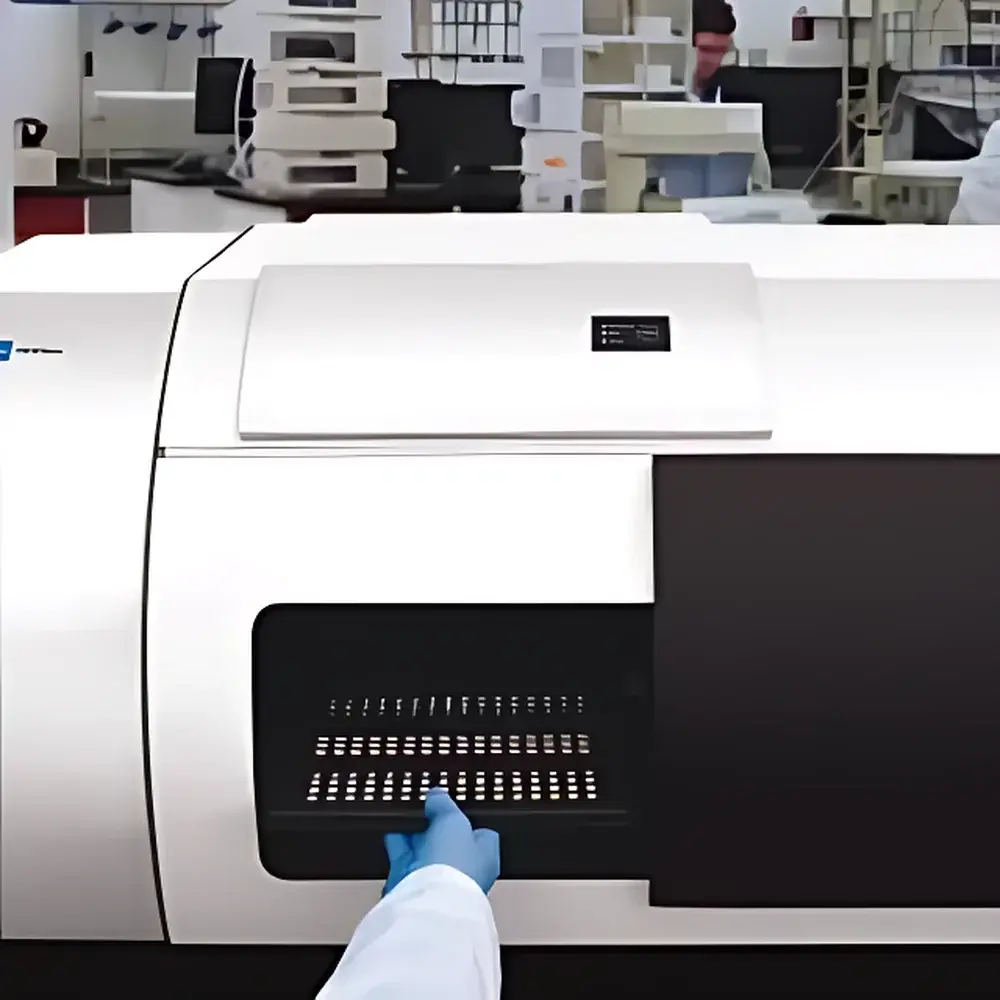
- High-throughput automation: Integrated motorized sample tray accommodates up to 96 positions; rapid sequential scanning enables analysis of >200 units per hour under routine QC conditions.
- Regulatory-ready architecture: Pre-validated software compliant with 21 CFR Part 11 and EU Annex 11, featuring electronic signatures, audit trails, role-based access control, and data integrity safeguards aligned with ALCOA+ principles.
- Optimized optical design: Custom 830 nm diode laser (650 mW output) coupled with high-efficiency transmission optics and back-illuminated CCD detector ensures signal-to-noise stability across diverse formulation matrices.
- Lean calibration methodology: Supports partial least squares (PLS) and principal component regression (PCR) models built using minimal reference standards; model maintenance requires only periodic verification—not full revalidation—per ICH Q2(R2) guidance.
- Sustainability-certified platform: Independently verified by My Green Lab and awarded the ACT Label, reflecting transparency in energy use, material sourcing, and end-of-life recyclability across its full lifecycle.
Sample Compatibility & Compliance
The TRS100 accepts a broad range of pharmaceutical sample formats without modification: standard blister-packed tablets, unblistered tablets in custom trays, size 0–5 hard capsules, softgel capsules (including opaque shells), lyophilized powders in vials, and liquid suspensions in quartz cuvettes. Optional accessories include tablet-specific holders with adjustable height compensation, capsule alignment plates, and multi-well powder trays compatible with high-throughput screening workflows. All hardware and firmware comply with ICH Q5A–Q5E biopharmaceutical guidelines where applicable, and analytical methods developed on the TRS100 have received formal acceptance from multiple global regulatory agencies—including the U.S. FDA, EMA, and PMDA—for content uniformity testing under ICH Q5C and Q6A. The system’s measurement uncertainty profile satisfies USP (Near-Infrared Spectroscopy) and EP (Raman Spectroscopy) requirements for identity, assay, and polymorphic characterization.
Software & Data Management
TRS100 Control Software is a GxP-compliant application built on a modular architecture supporting method development, acquisition, multivariate modeling, and reporting. It includes embedded tools for spectral preprocessing (baseline correction, vector normalization, Savitzky-Golay smoothing), PLS regression model building with cross-validation, outlier detection via Hotelling’s T² and DModX metrics, and real-time pass/fail decision logic based on user-defined specification limits. All raw spectra, processed data, model parameters, and audit trail entries are stored in a secure, encrypted SQLite database conforming to 21 CFR Part 11 Subpart B requirements. Electronic signatures are enforced at critical workflow steps—including method activation, result approval, and calibration verification—and all changes generate immutable timestamped records traceable to individual users. Integration with LIMS and MES platforms is supported via ASTM E1482-compliant data export (CSV, XML, and .trd binary format).
Applications
- Content Uniformity (CU) Testing: Delivers statistically robust CU results for batches of 30+ tablets in under 15 minutes—replacing traditional HPLC-based assays requiring dissolution, filtration, and chromatographic separation.
- Polymorph Screening & Quantification: Resolves crystalline vs. amorphous phases and quantifies low-level polymorphic impurities down to 0.1% w/w in final dosage forms—critical for stability studies and patent protection.
- Blend Homogeneity Monitoring: Validates powder blend uniformity prior to compression or encapsulation using representative subsamples, reducing risk of out-of-specification (OOS) events during manufacturing.
- Stability Indicating Assays: Tracks chemical degradation (e.g., oxidation, hydrolysis) and physical changes (e.g., hydration, phase transition) over time without altering sample integrity—enabling repeated measurements on identical units.
- Raw Material Identification (RMI): Performs rapid identity verification of incoming APIs and excipients against digital reference libraries, satisfying USP and EP 2.2.24 requirements.
FAQ
Is the TRS100 suitable for regulatory submission of analytical methods?
Yes. TRS100-based methods have been included in NDAs, ANDAs, and MAAs submitted to the FDA, EMA, and Health Canada. Full validation documentation—including specificity, linearity, accuracy, precision, LOD/LOQ, and robustness—aligns with ICH Q2(R2) and supports method transfer across sites.
Can the system analyze coated tablets with thick film coatings?
Yes. The 830 nm transmission geometry penetrates common polymeric coatings (e.g., Opadry®, Eudragit®) up to 120 µm thickness without signal attenuation or spectral distortion, provided coating opacity remains below 0.8 OD at 830 nm.
Does TRS100 require annual recalibration or service contracts?
No mandatory annual recalibration is required. System performance verification uses built-in NIST-traceable standards (SRM 706a, SRM 2246, Hg–Ar lamp); users perform this check before each analytical run or per internal SOP—typically daily or per shift.
How is data integrity maintained during remote operation or multi-user environments?
Role-based permissions, session timeouts, dual authentication (username/password + token), and write-protected archival ensure data immutability. All actions—including data export, model editing, and report generation—are logged with user ID, timestamp, IP address, and contextual metadata.
What training and support resources are available for new users?
Agilent provides GxP-aligned operator training (onsite or virtual), method development workshops, IQ/OQ/PQ protocol templates, and 24/7 technical support with SLA-backed response times. Remote diagnostics and firmware updates are delivered via secure Agilent Connect portal.





