
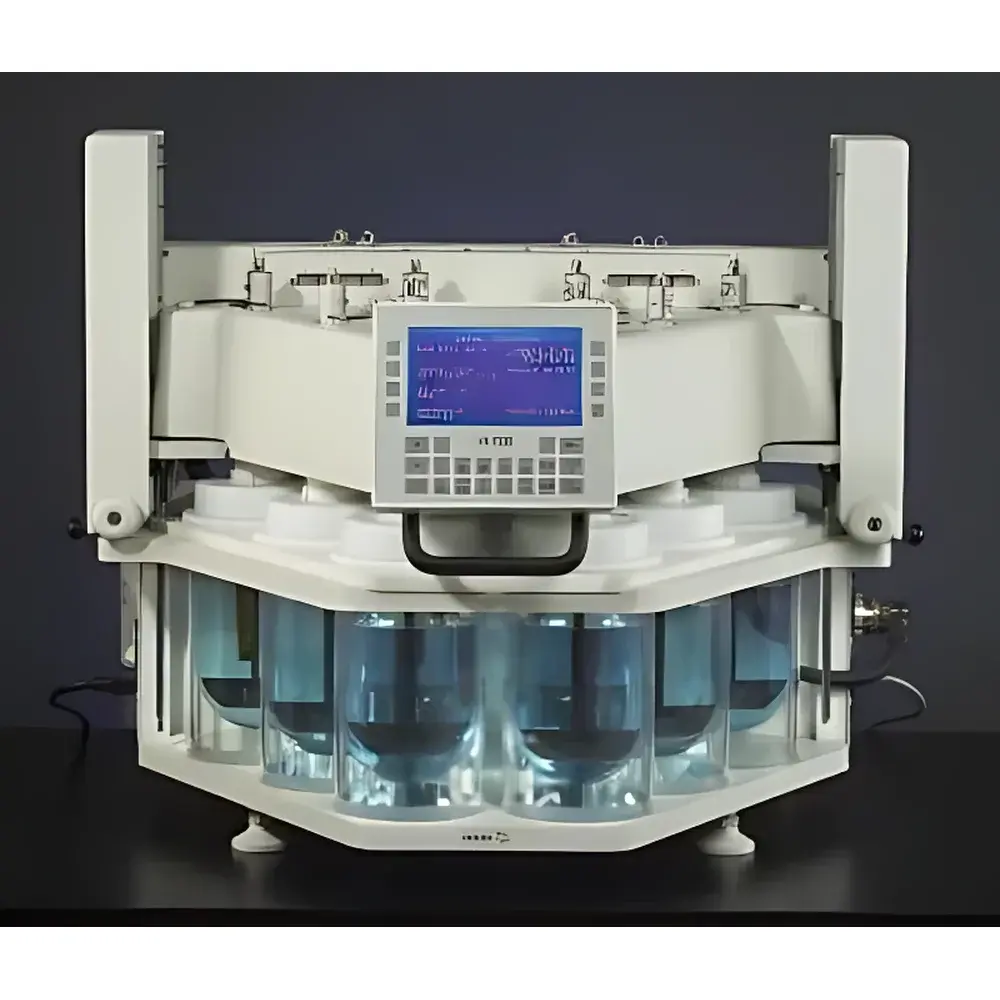
Agilent VanKel VK 7025/7010/705 Automated Dissolution Tester
| Brand | Agilent Technologies |
|---|---|
| Origin | Malaysia |
| Manufacturer Type | Original Equipment Manufacturer (OEM) |
| Origin Category | Imported Instrument |
| Model Series | VK 7025, VK 7010, VK 705, BIO-DIS (3-Method & 7-Method), 705-DS |
| Instrument Type | Offline Dissolution Testing System |
| Regulatory Compliance | Fully compliant with USP <711>, EP 2.9.3, JP XVII, and ChP 0931 |
Overview
The Agilent VanKel Automated Dissolution Tester represents the culmination of over seven decades of dedicated pharmaceutical dissolution engineering—tracing its lineage to VanKel’s founding in 1950 and subsequent integration into Agilent Technologies in 2000 following Varian’s acquisition. Engineered for precision, reproducibility, and regulatory rigor, this platform implements standardized paddle (USP Apparatus 2) and basket (USP Apparatus 1) dissolution methodologies under strictly controlled hydrodynamic and thermal conditions. Each system operates on the principle of maintaining defined fluid dynamics within calibrated vessels while monitoring analyte release kinetics via synchronized sampling and downstream quantification (e.g., UV-Vis or HPLC). Designed for full alignment with ICH Q5C, Q6A, and Q8(R2) guidance, these instruments serve as foundational tools in formulation development, stability studies, batch release testing, and post-approval change management across solid oral dosage forms—including immediate-release tablets, extended-release capsules, transdermal patches, suppositories, ointments, and granules.
Key Features
- True modular architecture supporting configurable automation levels—from manual operation (705-DS) to fully integrated offline dissolution systems (VK 7025/VK 7010) with programmable auto-sampling, auto-dosing, and real-time temperature monitoring.
- Patented TruCenter™ cup alignment mechanism (VK 7025) and EaseAlign™ centering ring (VK 7010/705-DS) ensure sub-millimeter positional repeatability across all vessels—critical for hydrodynamic equivalence per USP .
- Independent, motor-driven temperature probe per vessel enables continuous, traceable recording of medium temperature at the sample site—meeting FDA and EMA requirements for temperature validation in dissolution protocols.
- V-shaped chassis design (VK 7025) minimizes footprint while enabling unobstructed visual observation of dissolution behavior; low-profile drive shaft geometry reduces mechanical oscillation and improves rotational stability at high speeds (up to 250 rpm).
- Interchangeable paddle/basket assemblies with fixed-height mounting eliminate recalibration during method switching—ensuring method transfer integrity between Apparatus 1 and 2.
- One-piece PETG water bath tank with rapid drain port and external recirculating chiller integration delivers ±0.1 °C thermal uniformity across all vessels with minimal vibrational coupling (<0.1 mm peak-to-peak displacement).
- Integrated LCD interface with password-protected parameter access, audit trail logging, and configurable alarm thresholds for timepoints, temperature excursions, maintenance intervals, and calibration due dates.
Sample Compatibility & Compliance
The Agilent VanKel dissolution platforms accommodate a broad spectrum of dosage forms and vessel configurations: standard 1 L USP-compliant vessels, plus optional 100 mL, 200 L, and 2 L vessels for specialized applications. The BIO-DIS series extends capability to biorelevant, multi-pH testing per USP (Apparatus 3) and (Apparatus 7), supporting sequential immersion across six pH-gradient compartments using up to 12 sample tubes. All models are pre-validated for 3Q documentation (IQ/OQ/PQ), including mechanical verification kits, temperature mapping reports, and rotational speed calibration certificates. Systems comply with 21 CFR Part 11 when configured with electronic signature modules, and support GLP/GMP-aligned data integrity practices through time-stamped, immutable audit logs and role-based user permissions.
Software & Data Management
Dissolution test sequences are programmed and executed via Agilent’s validated Dissolution Workstation Software—a Windows-based application qualified under GAMP 5 principles. The software supports method storage (up to 15 protocols on BIO-DIS units), scheduled start-up, automated sampling timing, and real-time display of vessel-specific parameters (temperature, rpm, elapsed time). When interfaced with UV-Vis spectrophotometers or HPLC systems, it orchestrates synchronized detection, peak integration, concentration calculation, and report generation using customizable templates aligned with internal SOPs and regulatory submission standards (e.g., eCTD Module 5.3.2). Raw data files are stored in vendor-neutral formats (.csv, .txt) with embedded metadata, and optional database archiving ensures long-term retrievability per ALCOA+ principles.
Applications
These instruments are routinely deployed in QC laboratories for routine release testing of commercial batches; in R&D for comparative dissolution profiling (f2 similarity assessment), sink condition evaluation, and excipient interaction studies; and in regulatory affairs for generating dissolution data packages supporting ANDAs, NDAs, and post-approval supplement submissions. The BIO-DIS platforms specifically address complex release mechanisms—such as enteric-coated tablets requiring gastric/intestinal pH transitions, osmotic pumps, or matrix-based sustained-release systems—by simulating physiological transit through compartmentalized dissolution environments. Additionally, the VK series serves as reference instrumentation in pharmacopeial collaborative studies and USP Expert Committee working groups.
FAQ
Does the VK 7025 support both Apparatus 1 and Apparatus 2 methods without hardware recalibration?
Yes—the interchangeable paddle/basket assembly mounts at a fixed vertical position relative to the vessel bottom, eliminating need for re-leveling or height adjustment during method switching.
Can temperature data from each individual vessel be exported in compliance with 21 CFR Part 11?
Yes—when paired with the validated software package and enabled electronic signature module, temperature logs include user ID, timestamp, value, and digital signature, meeting Part 11 record retention and authenticity requirements.
Is the BIO-DIS 7-Method system capable of handling transdermal patch testing?
Yes—it accepts multiple fixture types (cylindrical holders, spring clamps, angled trays) optimized for non-tablet dosage forms, including patches, films, and implants, with programmable dwell times per pH compartment.
What validation documentation is provided with shipment?
Each unit ships with a complete 3Q package: Factory IQ/OQ protocols, mechanical verification checklist, temperature uniformity report, rotational speed calibration certificate, and user-accessible PQ templates compatible with site-specific acceptance criteria.
Can the VK 7010 be upgraded to full automation post-purchase?
Yes—modular add-ons include the Auto-Dosing Module (DDM), Auto-Sampling Module (ASM), and Multi-Vessel Temperature Monitoring Kit, all field-installable with firmware update and requalification support.




