
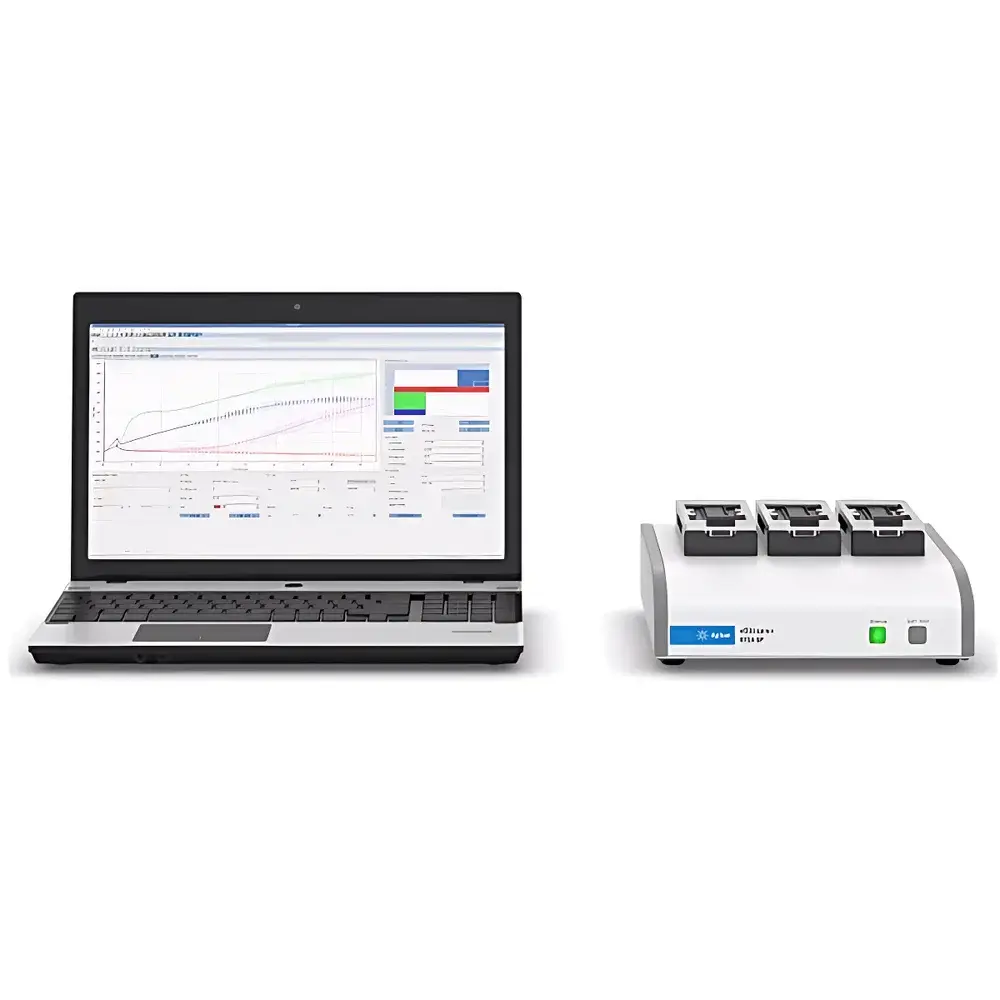
Agilent xCELLigence RTCA DP Real-Time, Label-Free Cell Analysis System
| Brand | Agilent Technologies |
|---|---|
| Origin | Zhejiang, China |
| Manufacturer Type | Original Equipment Manufacturer (OEM) |
| Regional Classification | Domestic (China-made) |
| Model | RTCA DP (3 × 16) |
| Pricing | Available upon request |
Overview
The Agilent xCELLigence RTCA DP (Real-Time Cell Analysis Dual Purpose) system is a fully integrated, label-free platform engineered for continuous, non-invasive monitoring of dynamic cellular responses under physiologically relevant conditions. Based on impedance-based biosensing technology, the system quantifies changes in electrical impedance across microelectrode-integrated culture surfaces—specifically E-Plate 16 and CIM-Plate 16—as cells adhere, spread, proliferate, migrate, or invade. Unlike endpoint assays requiring fixation, staining, or genetic labeling, this method preserves native cell physiology and enables kinetic profiling from seconds to days without perturbation. The RTCA DP accommodates up to three independent 16-well plates simultaneously—each plate operating under user-defined experimental timelines and environmental parameters—making it uniquely suited for multi-condition screening, longitudinal toxicity studies, and comparative functional assays across distinct biological models.
Key Features
- Triple-plate capacity: Supports concurrent operation of three E-Plate 16 or CIM-Plate 16 modules, each with independent temperature, CO2, and humidity control via external incubator integration.
- Label-free, real-time impedance sensing: Utilizes gold microelectrodes embedded in the bottom surface of each well; applies a low-amplitude (22 mV), high-frequency AC signal to measure impedance changes correlated with cell number, morphology, adhesion strength, and barrier integrity.
- CIM-Plate 16 architecture: Integrates miniaturized Boyden chamber geometry into each well—featuring a porous membrane (8 µm pore size standard) coated with extracellular matrix components—to enable quantitative, time-resolved assessment of cell migration and invasion kinetics.
- High temporal resolution: Captures data at configurable intervals ranging from 1 second to 60 minutes, supporting both rapid response events (e.g., GPCR activation) and long-term phenotypic drift (e.g., drug-induced senescence).
- Incubator-compatible design: Sensor modules operate inside standard CO2 incubators (37°C, 5% CO2); only the control unit and data acquisition hardware remain outside—minimizing thermal and gas exchange disruption.
- Automated parameter derivation: RTCA Software Pro calculates standardized metrics including Cell Index (CI), normalized CI, % cytotoxicity, IC50, KT50, and migration/invasion area under curve (AUC) with algorithmic consistency across replicates.
Sample Compatibility & Compliance
The RTCA DP system is validated for use with adherent mammalian cell lines (e.g., HeLa, A549, MCF-7, HUVEC), primary isolates (fibroblasts, PBMCs, neural progenitors), and co-culture systems—including endothelial–tumor and stromal–epithelial models. Both E-Plate 16 and CIM-Plate 16 are sterile, tissue-culture treated, and certified endotoxin-free. All hardware and software comply with ISO 13485:2016 quality management standards for in vitro diagnostic device manufacturing processes. RTCA Software Pro includes full audit trail functionality, electronic signatures, role-based access control, and data encryption—meeting FDA 21 CFR Part 11 requirements for electronic records and signatures in regulated research environments. The system is designated “For Research Use Only. Not for use in diagnostic procedures.”
Software & Data Management
RTCA Software Pro provides a unified interface for instrument control, live data visualization, batch analysis, and report generation. It supports simultaneous display of multiple plate datasets with synchronized time axes, overlayable CI curves, and customizable normalization options (e.g., baseline subtraction, reference well alignment). Raw impedance values are stored in vendor-neutral .csv and .xlsx formats, enabling downstream statistical analysis in R, Python, or GraphPad Prism. Audit logs record all user actions—including parameter edits, data exports, and software updates—with timestamps and operator IDs. Data integrity safeguards include automatic backup to network drives, version-controlled protocol templates, and exportable metadata compliant with MIAME and MIAPE reporting guidelines.
Applications
- Cell viability and proliferation kinetics under compound treatment or nutrient stress
- Real-time cytotoxicity screening for oncology, immunology, and neuropharmacology programs
- Functional characterization of immune cell activation (e.g., NK cell-mediated lysis, T-cell cytotoxicity)
- Quantitative assessment of tumor cell migration and basement membrane invasion in metastasis models
- Endothelial barrier function monitoring during inflammation or angiogenic stimulation
- Stem cell differentiation tracking via impedance-derived morphodynamic signatures
- Host–pathogen interaction studies (e.g., bacterial adhesion, viral cytopathic effects)
FAQ
What is the difference between E-Plate 16 and CIM-Plate 16?
E-Plate 16 measures general cell behavior (adhesion, proliferation, cytotoxicity) using flat-bottom wells with integrated electrodes. CIM-Plate 16 contains a transwell-like insert per well, enabling directional migration/invasion assays across a porous membrane.
Can the RTCA DP be used outside a CO2 incubator?
No—the sensor plates must remain within a controlled incubation environment (37°C, 5% CO2, >95% humidity) throughout the assay; only the controller and software workstation reside externally.
Is calibration required before each experiment?
No routine recalibration is needed; each E-Plate and CIM-Plate undergoes factory calibration. Users perform a background impedance measurement (with medium only) prior to cell seeding to establish baseline reference values.
How does impedance relate to biological parameters like cell number or confluence?
Impedance magnitude correlates empirically with cell coverage, attachment quality, and membrane integrity. While not a direct linear proxy for absolute cell count, Cell Index (CI) demonstrates high reproducibility and sensitivity to relative changes across identical experimental conditions.
Does the system support GLP or GMP-compliant workflows?
Yes—RTCA Software Pro’s 21 CFR Part 11 compliance features (audit trails, e-signatures, data immutability) support GLP-regulated preclinical safety studies and early-phase bioprocess development under GMP-aligned quality systems.



