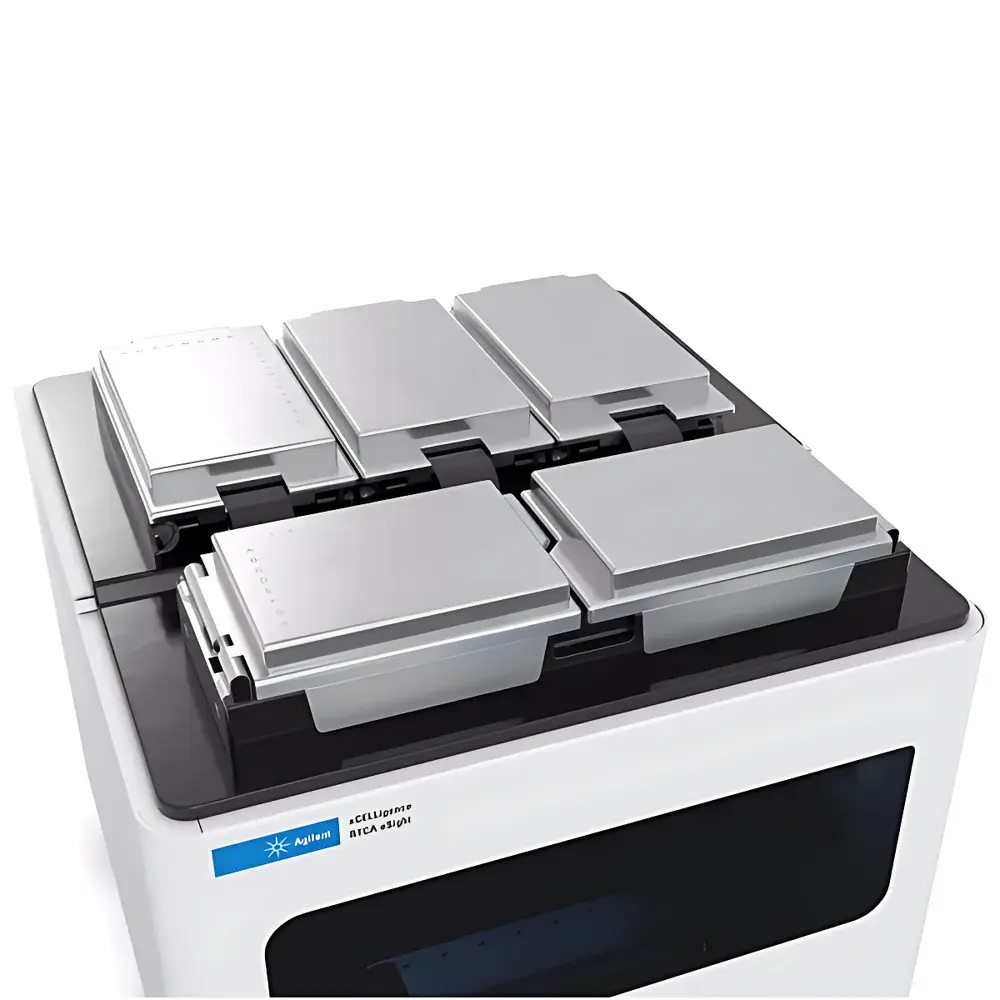
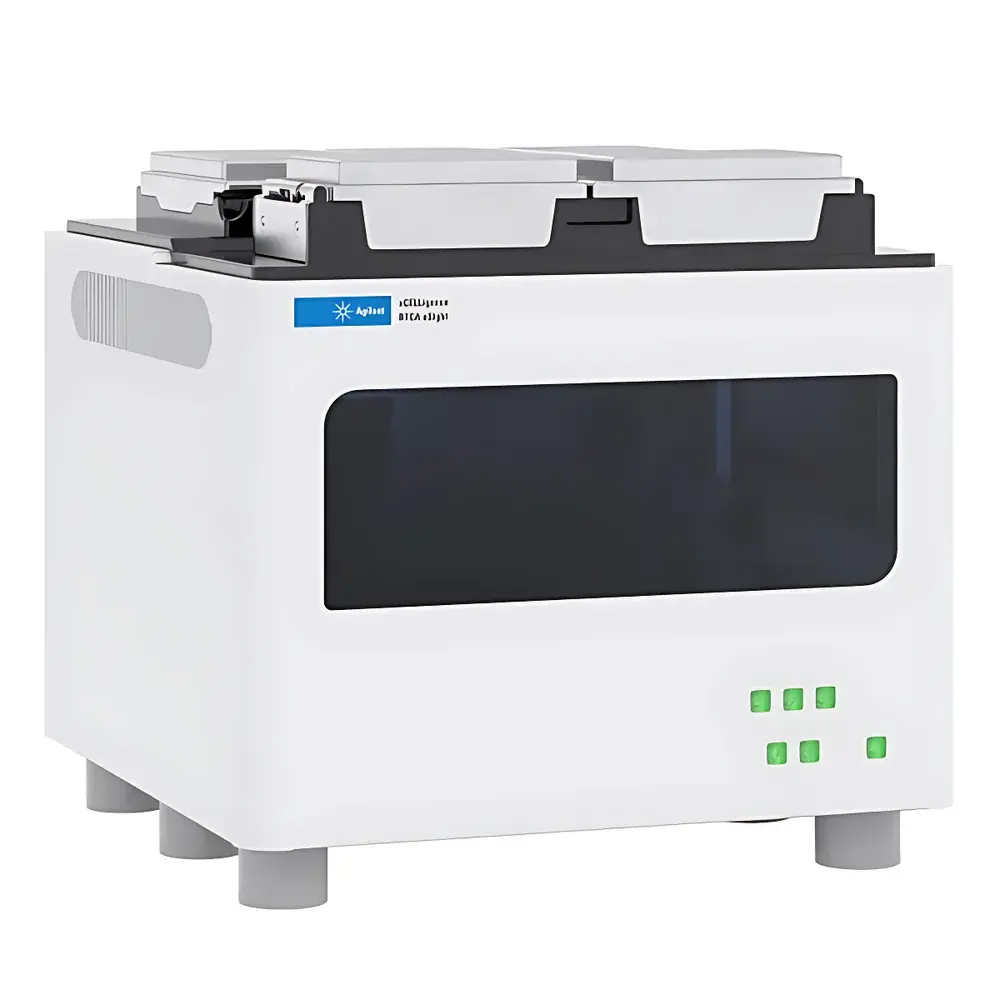
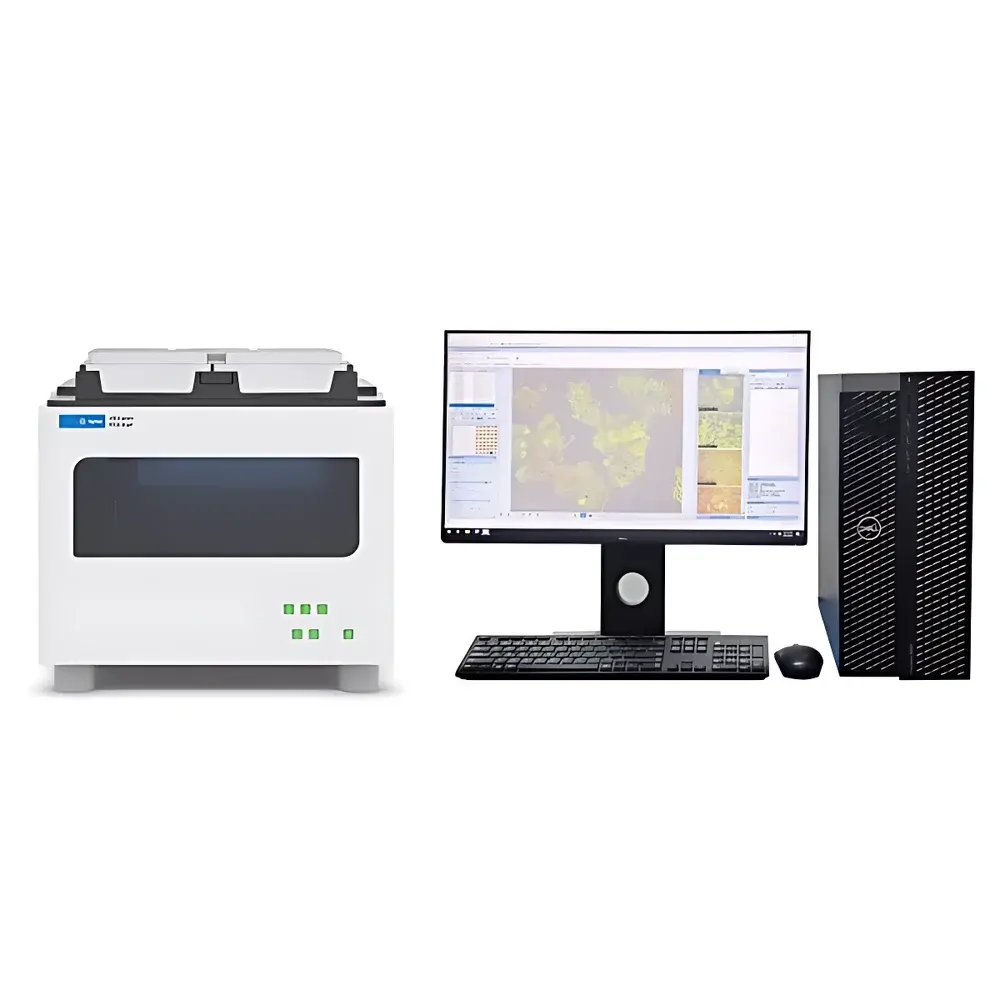
Agilent xCELLigence RTCA eSight Real-Time Cell Analysis System
| Brand | Agilent Technologies |
|---|---|
| Origin | Zhejiang, China |
| Manufacturer Type | Manufacturer |
| Regional Category | Domestic (China) |
| Model | RTCA eSight |
| Pricing | Available Upon Request |
Overview
The Agilent xCELLigence RTCA eSight Real-Time Cell Analysis System is an integrated, label-free platform engineered for longitudinal, non-invasive monitoring of living cells under physiologically relevant conditions. It combines two complementary, simultaneously acquired modalities: impedance-based real-time cell analysis (RTCA) and high-content live-cell imaging. The system operates on the principle of microelectronic biosensing—where gold microelectrodes embedded in the bottom of standard tissue culture vessels measure electrical impedance changes induced by cell attachment, spreading, proliferation, morphological remodeling, and detachment. Concurrently, its advanced optical module captures quantitative brightfield and trichromatic fluorescence (red/green/blue) images across 5×, 10×, and 20× magnifications—enabling correlative interpretation of functional dynamics (e.g., barrier integrity, cytotoxicity, migration) with structural phenotypes (e.g., confluence, morphology, nuclear translocation). Designed exclusively for research use, the eSight platform supports both 2D monolayers and 3D spheroid/organoid cultures within standard incubators, eliminating workflow disruption and preserving environmental stability.
Key Features
- Integrated dual-modality acquisition: Simultaneous, time-synchronized impedance readouts and multi-channel imaging in a single well—no sample transfer or assay multiplexing required.
- Label-free impedance sensing: Real-time quantification of cell index (CI), reflecting dynamic changes in cell number, viability, adhesion strength, and morphology without dyes or genetic modification.
- Flexible live-cell imaging: Brightfield + RGB fluorescence channels (excitation/emission optimized for common fluorophores including DAPI, FITC, TRITC, and Cy5 analogs); motorized objective turret supporting 5×, 10×, and 20× objectives.
- Universal vessel compatibility: Supports 6-, 12-, 24-, 48-, 96-, and 384-well E-Plates™ as well as 35 mm and 60 mm tissue culture dishes—enabling scalable experimental design from screening to mechanistic validation.
- Incubator-integrated architecture: Fully functional inside standard CO₂ incubators (up to 40°C, 5–20% CO₂); temperature- and humidity-stabilized optics and electronics ensure long-term imaging fidelity.
- Automated image acquisition scheduling: Time-lapse protocols programmable via intuitive software interface; customizable focus algorithms for consistent z-stack acquisition across heterogeneous samples.
Sample Compatibility & Compliance
The RTCA eSight accommodates primary cells, immortalized lines, co-cultures, and 3D models—including spheroids, organoids, and endothelial barrier assays—without requiring protocol re-optimization. Its impedance sensors are compatible with standard culture media formulations, serum-containing or serum-free, and tolerate common transfection reagents and therapeutic biologics. All hardware and firmware comply with IEC 61000-6-3 (EMC emission standards) and IEC 61010-1 (safety requirements for laboratory equipment). Data acquisition and storage support audit trails, user access controls, and electronic signatures in alignment with GLP and GMP documentation practices. While not intended for clinical diagnostics, the system meets ISO 13485-aligned manufacturing quality standards per Agilent’s global QMS.
Software & Data Management
The eSight Control Software provides unified control of impedance acquisition, imaging parameters, and environmental logging. It features built-in batch processing for CI curve normalization, automated confluence estimation from brightfield images, and fluorescence intensity quantification per channel using region-of-interest (ROI) segmentation. Export options include CSV, TIFF, and OME-TIFF formats compliant with Bio-Formats and ImageJ/Fiji ecosystems. Data files retain full metadata (timestamp, objective, exposure, gain, plate map), enabling traceability across experiments. For regulated environments, optional software modules support 21 CFR Part 11 compliance—including role-based permissions, change history logs, and digital signature workflows.
Applications
- Immunooncology: Kinetic assessment of T-cell–mediated tumor cell lysis, NK cell activation, and checkpoint inhibitor efficacy using impedance-derived cytotoxicity curves correlated with fluorescent caspase or membrane integrity markers.
- Neurotoxicity & neuropharmacology: Long-term monitoring of neuronal network activity via impedance-derived beating-like oscillations in iPSC-derived neurons, combined with synaptic marker immunofluorescence.
- Barrier function studies: Quantitative TEER-equivalent analysis in endothelial or epithelial monolayers using impedance slope metrics, validated against fluorescent dextran permeability imaging.
- 3D model pharmacodynamics: Real-time tracking of spheroid growth inhibition, necrosis expansion, and stromal invasion using dual-parameter heatmaps generated from CI decline and GFP+ cell dispersion patterns.
- Stem cell differentiation kinetics: Correlation of impedance-driven morphological maturation indices with lineage-specific fluorescent reporter expression over 7–14 days.
FAQ
Is the RTCA eSight suitable for FDA-regulated preclinical studies?
Yes—the system’s data integrity framework, audit trail capability, and adherence to ISO 13485 manufacturing standards support its use in GLP-compliant toxicology and pharmacology studies.
Can impedance and imaging data be time-aligned at sub-minute resolution?
Yes—both modalities are triggered by a shared internal clock; temporal synchronization accuracy is ±100 ms across all acquisition modes.
Does the system require specialized plates or consumables?
It uses Agilent’s proprietary E-Plate vessels with integrated electrodes; however, standard tissue culture dishes (35 mm, 60 mm) are also supported without modification.
What fluorescence filters are included by default?
Standard configuration includes bandpass filters optimized for DAPI (blue), FITC/GFP (green), and TRITC/Cy3 (red); custom filter sets can be installed upon request.
Is remote monitoring supported during long-term experiments?
Yes—software enables secure web-based access to live impedance plots and thumbnail image previews; full raw data download requires local network authentication.