
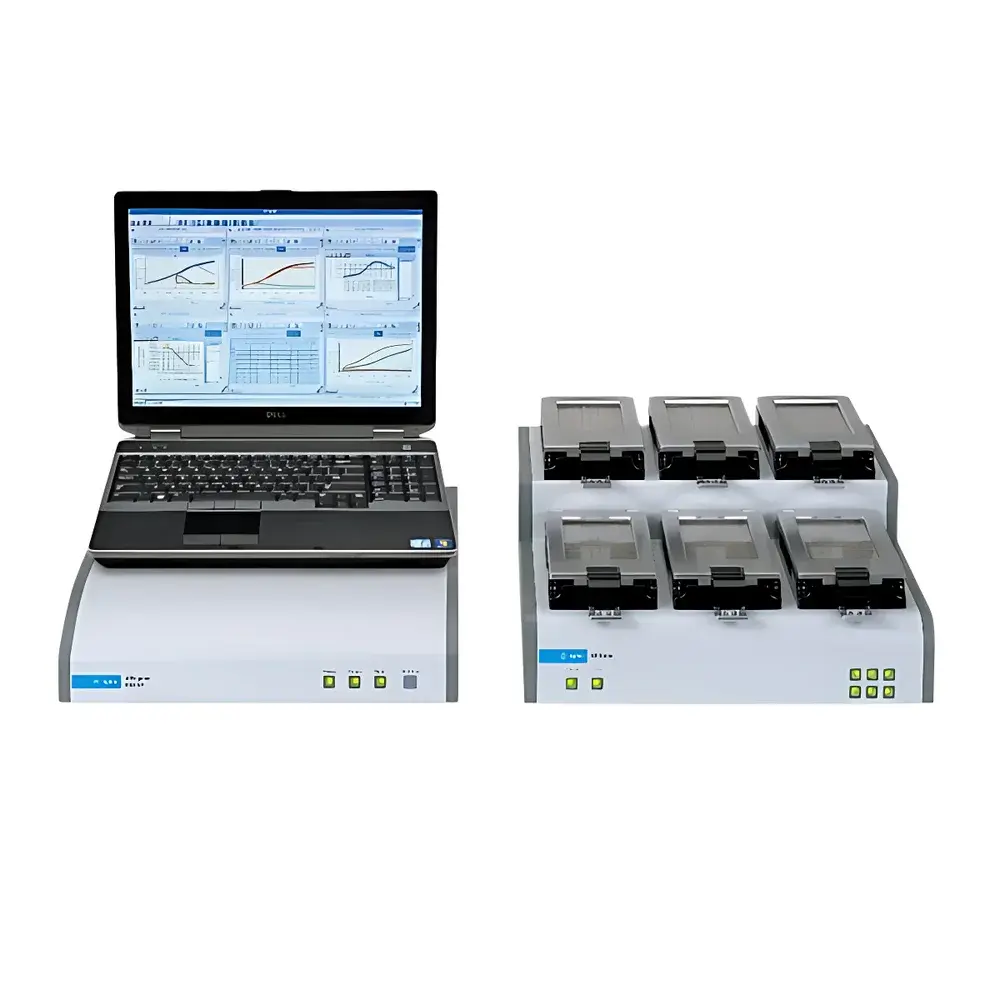
Agilent xCELLigence RTCA MP Real-Time, Label-Free Cell Analysis System
| Brand | Agilent Technologies |
|---|---|
| Origin | Zhejiang, China |
| Manufacturer Type | Original Equipment Manufacturer (OEM) |
| Regional Classification | Domestic (China-manufactured) |
| Model | RTCA MP (6 × 96-well) |
| Pricing | Upon Request |
Overview
The Agilent xCELLigence RTCA MP Real-Time, Label-Free Cell Analysis System is an engineered platform for continuous, non-invasive monitoring of adherent mammalian cell behavior in physiologically relevant environments. It operates on the principle of electric cell-substrate impedance sensing (ECIS), a well-established biophysical method that quantifies dynamic changes in cellular morphology, adhesion, proliferation, and cytotoxic responses through real-time measurement of impedance across microelectrode-integrated E-Plates. Unlike endpoint assays or fluorescent labeling techniques, this system requires no dyes, transfection reagents, or genetic modification—eliminating perturbation artifacts and enabling longitudinal studies under standard CO2 incubator conditions. The RTCA MP accommodates up to six 96-well E-Plates simultaneously, each operating independently or in synchronized batches, thereby supporting high-throughput comparative experiments while maintaining single-plate experimental flexibility.
Key Features
- Simultaneous or independent operation of up to six 96-well E-Plates for scalable assay design and multi-user workflow efficiency
- Real-time impedance acquisition with sub-second temporal resolution, enabling detection of rapid cellular events such as GPCR activation kinetics or early-stage cytotoxicity
- Micron-scale gold microelectrodes embedded in the bottom surface of E-Plates generate a low-voltage (22 mV RMS) AC signal—non-perturbative to cell viability, metabolism, or signaling integrity
- Cell Index (CI), a dimensionless parameter derived from normalized impedance values, serves as a quantitative, reproducible metric for cell attachment, spreading, proliferation, and detachment dynamics
- Integrated hardware architecture designed for stable placement outside the incubator, with only the sensor plates housed inside—minimizing thermal drift and mechanical disturbance
- Automated calibration and plate recognition ensure inter-run consistency and reduce operator-dependent variability
Sample Compatibility & Compliance
The RTCA MP supports a broad range of adherent human and animal cell lines—including primary cells, stem cells, and co-cultures—as well as organoid and spheroid models when adapted to specialized E-Plate formats. Its label-free nature ensures compatibility with pharmacological agents, biologics, nanoparticles, and viral vectors without interference from optical quenching or phototoxicity. The system complies with Good Laboratory Practice (GLP) and Good Manufacturing Practice (GMP)-aligned data integrity standards. RTCA Software Pro implements full audit trail functionality, electronic signatures, and role-based access control in accordance with FDA 21 CFR Part 11 requirements—making it suitable for regulated preclinical research environments where traceability and data authenticity are critical.
Software & Data Management
RTCA Software Pro provides a unified interface for instrument control, real-time data visualization, and advanced offline analysis. It supports time-series plotting, kinetic curve fitting, automated calculation of pharmacodynamic parameters (e.g., IC50, KT50, EC50), and comparative statistical analysis across multiple plates or conditions. Raw impedance data are stored in vendor-neutral HDF5 format, facilitating integration with third-party analysis pipelines (e.g., Python-based scikit-learn or R/Bioconductor workflows). All user actions—including data export, parameter modification, and report generation—are logged with timestamps, user IDs, and change descriptions to satisfy regulatory documentation needs.
Applications
- Real-time assessment of cytotoxicity and cytoprotection in drug screening and toxicology studies
- Quantification of immune cell-mediated target cell lysis (e.g., NK cell or CAR-T killing kinetics)
- Monitoring of virus-induced cytopathic effects (CPE) and antiviral compound efficacy
- Dynamic evaluation of epithelial/endothelial barrier integrity via transepithelial electrical resistance (TEER)-equivalent metrics
- GPCR and kinase pathway modulation studies using impedance-based functional readouts
- Cell adhesion, migration, and morphological remodeling under mechanical or biochemical stimulation
FAQ
Is the RTCA MP compatible with existing Agilent E-Plate consumables?
Yes—the system uses the same standardized E-Plate 96 format across all xCELLigence platforms, ensuring seamless transition and consumable interoperability.
Can the RTCA MP be used for suspension cell analysis?
No—this system is optimized exclusively for adherent cell types; suspension cells require alternative impedance configurations not supported by the MP model.
What environmental conditions are required for operation?
The E-Plates must be maintained in a standard humidified CO2 incubator (37 °C, 5% CO2); the instrument base station operates at ambient laboratory temperature outside the incubator.
Does the system support GLP-compliant reporting?
Yes—RTCA Software Pro includes 21 CFR Part 11–compliant features including electronic signatures, audit trails, and secure data archiving.
Is technical validation documentation available for regulatory submissions?
Agilent provides instrument qualification protocols (IQ/OQ/PQ templates), software validation summaries, and performance verification reports upon request for internal validation processes.




