
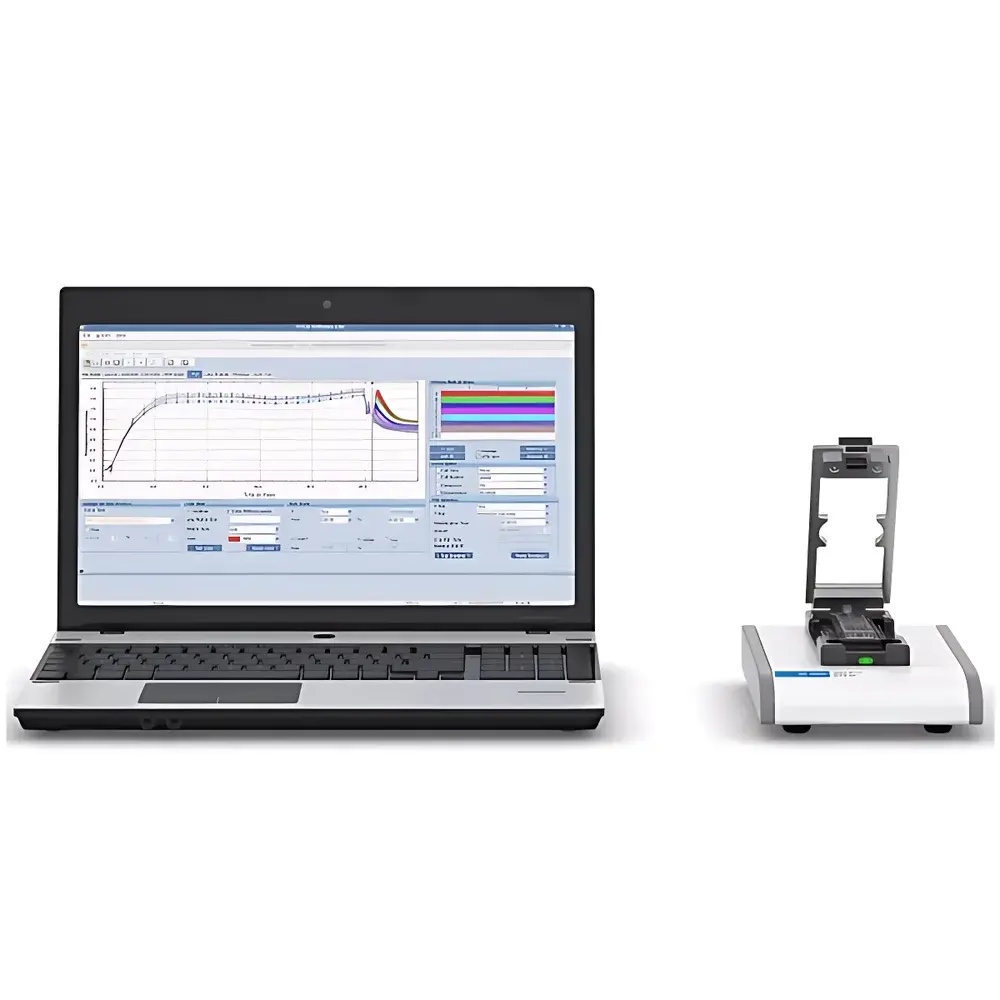
Agilent xCELLigence RTCA S16 Real-Time, Label-Free Cell Analysis System
| Brand | Agilent Technologies |
|---|---|
| Origin | Zhejiang, China |
| Manufacturer Type | Original Equipment Manufacturer (OEM) |
| Regional Classification | Domestic (China-manufactured) |
| Model | RTCA S16 (1 × 16-well format) |
| Pricing | Available upon request |
Overview
The Agilent xCELLigence RTCA S16 is a real-time, label-free cell analysis system engineered for continuous, non-invasive monitoring of adherent mammalian cell behavior under physiologically relevant conditions. It operates inside standard CO2 incubators, with the control unit and data acquisition hardware located externally to maintain sterility and thermal stability. At its core, the system employs impedance-based biosensing—specifically, real-time cell electronic sensing (RT-CES)—to quantify dynamic cellular responses without requiring fluorescent dyes, radioactive labels, or genetic modification. Microfabricated gold microelectrodes integrated into the bottom surface of proprietary E-Plate 16 plates generate a low-magnitude (22 mV), high-frequency alternating current signal. As cells attach, spread, proliferate, or detach, they modulate the local ionic current path across the electrode–electrolyte interface, resulting in measurable changes in electrical impedance. These changes are translated into the dimensionless Cell Index (CI), a quantitative metric reflecting collective changes in cell number, morphology, adhesion strength, and substrate coverage over time—from seconds to days.
Key Features
- Real-time, kinetic monitoring of cell proliferation, cytotoxicity, migration, and adhesion dynamics without labeling or endpoint assays
- 16-well E-Plate format optimized for medium-throughput screening and comparative experimental design
- Fully integrated incubator-compatible architecture with external workstation for remote operation and environmental isolation
- Non-perturbative measurement: 22 mV AC excitation voltage ensures no adverse impact on cell viability, metabolism, or signaling pathways
- High temporal resolution: Impedance measurements acquired every 15–60 seconds, enabling detection of rapid morphological transitions (e.g., rounding during mitosis or apoptosis)
- Automated calibration and plate recognition via embedded RFID tags in E-Plates for traceable, operator-independent setup
Sample Compatibility & Compliance
The RTCA S16 supports a broad range of adherent human and animal cell lines—including primary cells, stem cells, and co-cultures—across diverse applications in oncology, immunology, toxicology, and virology. E-Plates are certified sterile, tissue-culture treated, and compatible with standard culture media formulations (e.g., DMEM, RPMI-1640) and common supplements (FBS, antibiotics). The system complies with ISO 13485 design control principles for research instrumentation and meets electromagnetic compatibility (EMC) requirements per IEC 61326-1. While intended solely for research use (RUO), its data structure and audit trail capabilities align with GLP-compliant workflows when configured with appropriate IT controls. It is not intended for clinical diagnostic use and is not FDA-cleared or CE-marked for in vitro diagnostic (IVD) applications.
Software & Data Management
The RTCA Software Suite (v2.x or later) provides intuitive instrument control, real-time visualization, and robust post-acquisition analysis. Users can define custom measurement intervals, set automated start/stop triggers based on CI thresholds, and export time-series CI data in CSV or HDF5 formats for integration with MATLAB, Python (SciPy/Pandas), or statistical platforms (GraphPad Prism, R). The software maintains full electronic records including user login logs, plate ID metadata, protocol parameters, and timestamped raw impedance values—supporting 21 CFR Part 11 readiness when deployed on validated networked systems with role-based access control and electronic signatures. Version-controlled method templates ensure inter-laboratory reproducibility and facilitate SOP documentation.
Applications
- Quantitative cytotoxicity profiling: Dose–response kinetics of chemotherapeutics, targeted inhibitors, or nanomaterials
- Cell adhesion and migration assays: Integrin-mediated attachment, wound healing, and transwell-independent motility assessment
- Viral infection kinetics: Real-time tracking of host cell detachment or cytopathic effect progression
- Immuno-oncology: Monitoring T-cell–mediated tumor cell lysis or CAR-T functional potency
- Stem cell differentiation: Correlating impedance-derived morphological metrics with lineage-specific marker expression
- Quality control of bioproduction processes: Monitoring viability and confluence of CHO or HEK293 cultures in upstream development
FAQ
What does “label-free” mean in this context?
It indicates that no exogenous dyes, antibodies, or reporter genes are required—the system detects intrinsic biophysical properties of living cells via impedance changes.
Can the RTCA S16 be used with suspension cells?
No—it is specifically designed for adherent cell types; suspension cells do not generate measurable impedance shifts on standard E-Plates.
Is the Cell Index (CI) an absolute or relative metric?
CI is a dimensionless, relative value derived from normalized impedance measurements; it enables intra- and inter-experiment comparisons but is not convertible to absolute cell counts without parallel validation (e.g., by microscopy or flow cytometry).
How frequently is data acquired during an experiment?
Default sampling intervals are configurable from 15 seconds to 60 minutes, with typical protocols using 1–5 minute intervals for balanced temporal resolution and data storage efficiency.
Are E-Plates reusable?
No—E-Plates are single-use, sterile, disposable consumables designed to ensure assay consistency and eliminate cross-contamination risk.





