
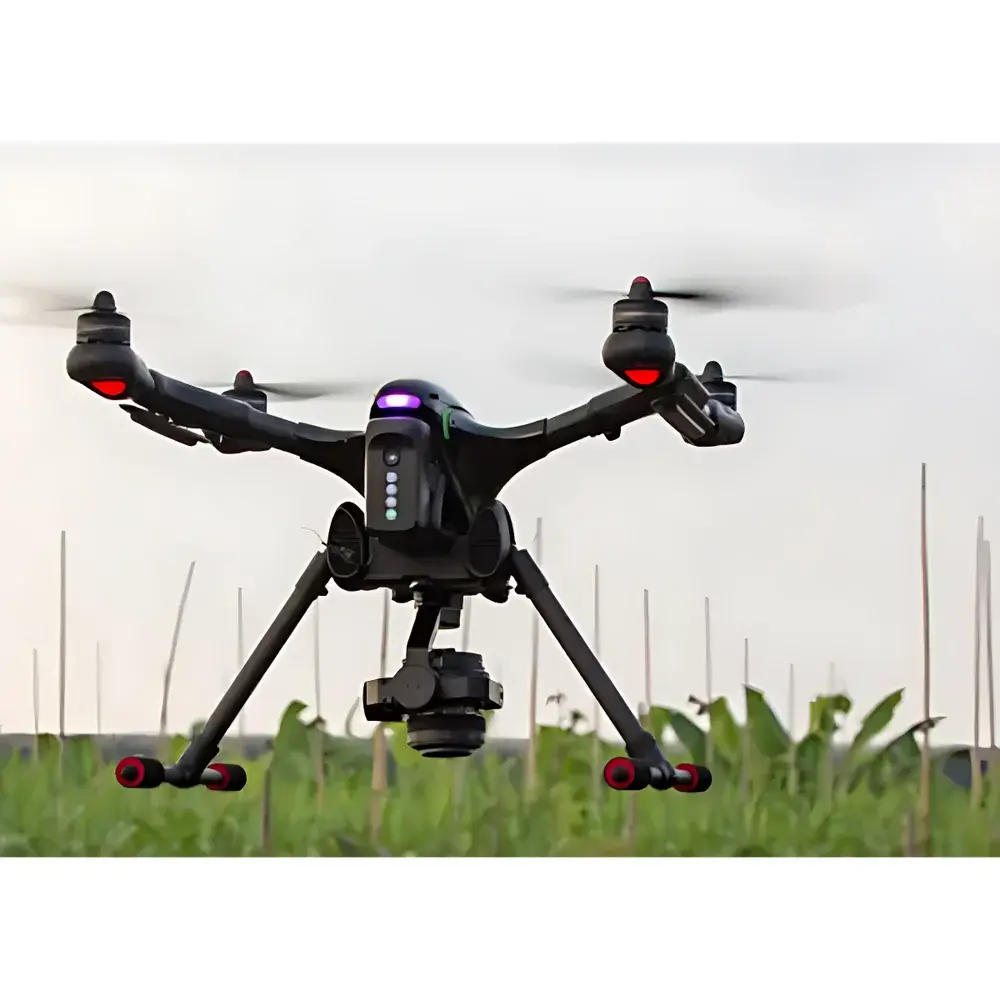
Agrowing AMS-10 Multispectral Imaging System
| Brand | Agrowing |
|---|---|
| Origin | Israel |
| Model | AMS-10 |
| Spectral Channels | 10 (405, 430, 450, 550, 560, 570, 650, 685, 710, 850 nm) |
| Sensor Resolution per Channel | 12 MP |
| Synchronization | Full-frame simultaneous capture across all bands |
| Optical Distortion | <1% |
| Detector Architecture | Monolithic large-area CMOS sensor |
| Video Capability | 4K multispectral video (10-channel synchronized) |
| Housing | All-metal/glass optical train |
| Dynamic Range | Extended (≥14-bit ADC) |
| Customization | Filter wheel and bandpass filter sets available (MOQ applies) |
Overview
The Agrowing AMS-10 Multispectral Imaging System is a high-fidelity, monolithic-sensor-based imaging platform engineered for scientific-grade spectral data acquisition in field-deployable and laboratory-integrated environments. Unlike conventional multi-camera multispectral systems relying on spatially separated sensors and post-hoc geometric registration, the AMS-10 employs a single large-format CMOS detector coupled with precision interference filter arrays to achieve true pixel-aligned, temporally synchronized acquisition across ten discrete spectral bands. Its measurement principle is based on snapshot spectral imaging—where each pixel records intensity values simultaneously at ten defined wavelengths (405–850 nm), eliminating motion-induced misregistration and inter-band parallax errors inherent in scanning or tiled-camera architectures. This architecture ensures radiometric consistency, geometric fidelity, and temporal coherence—critical prerequisites for quantitative vegetation index derivation, time-series phenotyping, and AI-driven classification pipelines.
Key Features
- Monolithic Sensor Architecture: Utilizes one large-area CMOS detector instead of multiple micro-cameras—eliminating inter-sensor response variation, gain mismatch, and chromatic registration drift.
- Sub-Millimeter Spatial Resolution: Capable of resolving features down to 0.5 mm at operational working distances when integrated with appropriate optics and platforms (e.g., UAV gimbals or fixed-mount industrial rigs).
- Optical Fidelity: All-glass, metal-mounted lens assembly with ≤1% geometric distortion—significantly surpassing typical off-the-shelf multispectral cameras (often >15% distortion), reducing or eliminating the need for intensive orthorectification and band co-registration preprocessing.
- Simultaneous 10-Band Capture: All channels acquired in a single exposure—enabling robust NDVI, PRI, MCARI, and other index calculations without temporal aliasing or illumination shift artifacts.
- 4K Multispectral Video Support: Real-time streaming and recording of synchronized 10-channel video sequences at full resolution, facilitating dynamic process monitoring (e.g., irrigation response, pest infestation progression, or canopy closure kinetics).
- Extended Dynamic Range & Bit Depth: ≥14-bit analog-to-digital conversion per channel supports high-contrast scene capture—from shadowed understory to sunlit canopy—without saturation or noise floor limitations.
Sample Compatibility & Compliance
The AMS-10 is designed for non-contact, non-destructive spectral characterization of planar and semi-planar surfaces including vegetative canopies, soil patches, crop rows, greenhouse trays, and controlled-environment growth chambers. It complies with standard optical metrology practices for reflectance-based remote sensing and adheres to foundational calibration traceability requirements outlined in ISO 17025 for measurement uncertainty reporting. While not certified as medical or aerospace-grade hardware, its mechanical stability, thermal resilience (operating range: −10 °C to +50 °C), and sealed optical path make it suitable for GLP-compliant agricultural phenotyping workflows. Users are advised to perform routine radiometric calibration using NIST-traceable reflectance standards (e.g., Spectralon® panels) prior to quantitative analysis.
Software & Data Management
The AMS-10 delivers raw 16-bit TIFF stacks (one file per band) with embedded EXIF metadata including timestamp, GPS coordinates (when GNSS module is connected), exposure parameters, and filter ID mapping. Native SDKs support integration with Python (NumPy, OpenCV, scikit-image), MATLAB, and ENVI for batch processing, spectral unmixing, and PCA-based feature extraction. The system supports FAIR data principles: files are self-describing, time-stamped, and structured for direct ingestion into cloud-based analytics platforms such as Google Earth Engine or AWS Ground Station workflows. Optional software modules include automated vignetting correction, flat-field normalization, and spectral library matching compliant with ASTM E1777 (Standard Guide for Spectral Matching). Audit trails for image processing steps—including calibration application history—are exportable for FDA 21 CFR Part 11–aligned documentation in regulated agritech trials.
Applications
- Agricultural remote sensing for early detection of biotic stressors (insect herbivory, fungal infection) and abiotic stressors (drought, nutrient deficiency, salinity)
- Precision agriculture decision support: variable-rate irrigation/fertilization mapping via NDVI, REIP, and CCI indices
- Forestry inventory and health assessment using red-edge and NIR band ratios
- Controlled-environment phenotyping in growth chambers and vertical farms
- Integration into robotic platforms for autonomous in-field scouting and real-time classification via edge-AI inference engines
- Environmental monitoring of wetland vegetation, algal blooms, and soil erosion indicators
FAQ
Does the AMS-10 require external calibration before each use?
Routine radiometric calibration is recommended before critical measurement campaigns; however, factory-installed dark current and flat-field correction profiles enable stable operation between recalibrations.
Can the spectral bands be modified after purchase?
Yes—custom bandpass filter configurations are available upon request, subject to minimum order quantity (MOQ) and lead time; optical redesign requires factory service.
Is the system compatible with DJI Matrice or Autel EVO drones?
The AMS-10 integrates with industry-standard UAV gimbals via MavLink-compatible trigger interfaces and supports PTP/USB3.0 tethered operation for onboard processing.
What is the maximum frame rate for full-resolution 10-band capture?
At native 12 MP per channel, the sustained frame rate is 3.2 fps; reduced ROI modes enable up to 12 fps for targeted monitoring applications.
Does the system support radiometric calibration traceable to NIST standards?
Yes—users may apply NIST-traceable reflectance targets during field calibration; raw DN values preserve linearity for post-acquisition radiance conversion.



