
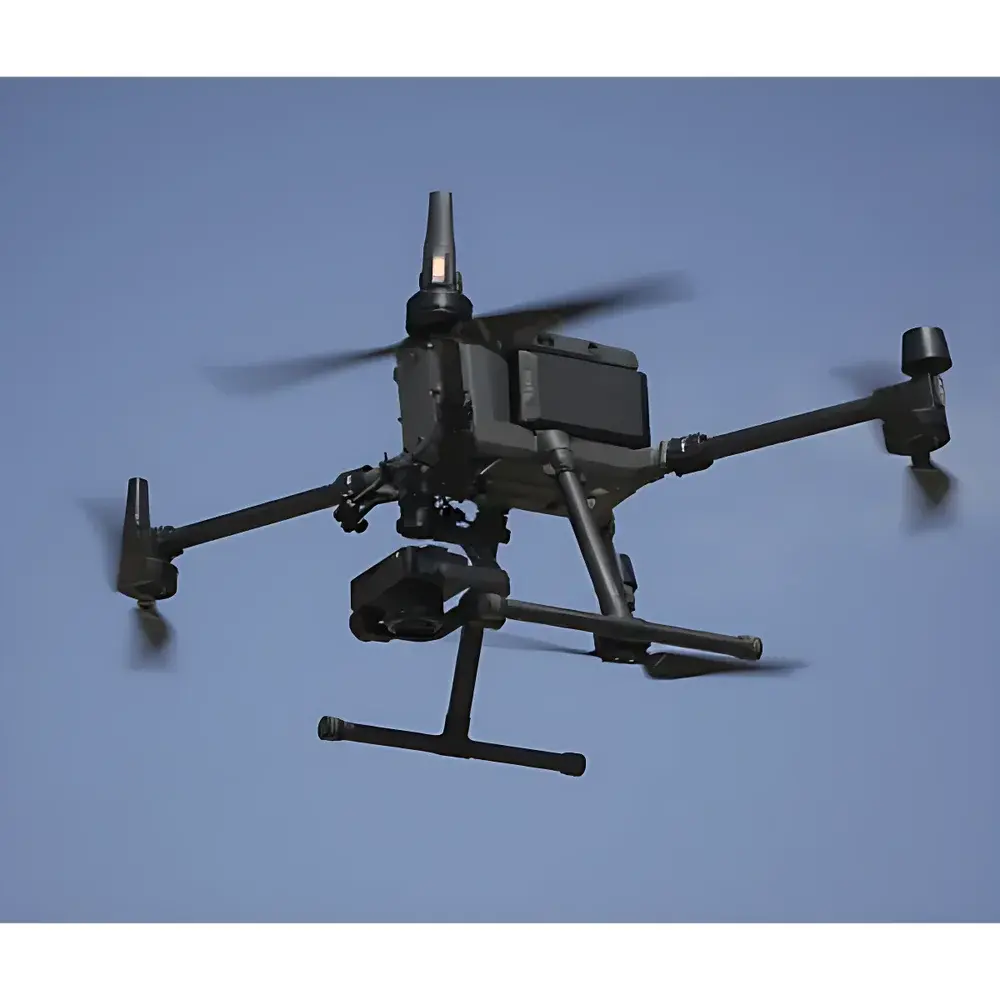
Agrowing AMS-10 Multispectral Imaging System
| Brand | Agrowing |
|---|---|
| Origin | Israel |
| Model | AMS-10 |
| Detector | 60 MP monolithic CMOS sensor |
| Spectral Channels | 10-band (405, 430, 450, 550, 560, 570, 650, 685, 710, 850 nm) |
| Spatial Resolution per Band | 12 MP |
| Ground Sampling Distance (GSD) at 100 m | 1.5 cm |
| Video Capability | 4K (3840 × 2160), 1.65 MP per spectral band |
| Optical Distortion | <1% |
| Software Features | Automated cropping, vegetation index computation (NDVI, NDRE, GNDVI, etc.), radiometric calibration, batch processing, format conversion, auto-alignment |
Overview
The Agrowing AMS-10 Multispectral Imaging System is a high-fidelity, monolithic-sensor-based imaging platform engineered for quantitative remote sensing and precision optical metrology in laboratory, field, and industrial environments. Unlike conventional multispectral systems relying on multi-camera arrays or filter-wheel mechanisms, the AMS-10 employs a single, large-format 60-megapixel CMOS detector coupled with a custom-designed, low-distortion optical train. This architecture eliminates inter-sensor radiometric and geometric misregistration — a persistent source of uncertainty in multi-head or sequential-acquisition systems. The instrument operates on the principle of simultaneous spectral capture: all 10 narrowband channels (centered at 405, 430, 450, 550, 560, 570, 650, 685, 710, and 850 nm) are acquired in a single exposure, ensuring pixel-perfect spatial co-registration without post-hoc warping or interpolation. With an optical distortion of less than 1%, the AMS-10 delivers geometric fidelity suitable for photogrammetric integration, GIS alignment, and metrological-grade surface reflectance modeling.
Key Features
- Monolithic 60 MP CMOS sensor enabling true simultaneous acquisition across all 10 spectral bands — no temporal or mechanical registration artifacts.
- Sub-1% optical distortion achieved via aspheric-corrected, apochromatic lens design optimized for multispectral transmission across UV–NIR (405–850 nm).
- Native per-band resolution of 12 megapixels (4000 × 3000), supporting high-fidelity spectral unmixing and sub-centimeter feature discrimination at operational altitudes.
- Ground Sampling Distance (GSD) of 1.5 cm at 100 m altitude — validated using ISO 12233 slanted-edge methodology under controlled illumination.
- Onboard 4K video recording capability (3840 × 2160) with synchronized spectral band output (1.65 MP per channel), enabling dynamic process monitoring in agriculture, material inspection, and environmental surveillance.
- Radiometrically stable acquisition chain calibrated traceably to NIST-traceable standards; includes integrated dark-frame and flat-field correction routines.
Sample Compatibility & Compliance
The AMS-10 is designed for non-contact, non-destructive optical characterization of planar and quasi-planar surfaces including vegetation canopies, painted substrates, printed electronics, pharmaceutical tablets, and composite materials. Its spectral response aligns with key ASTM standards for reflectance measurement (ASTM E259, E308) and vegetation health assessment (ASTM E2922). The system supports GLP-compliant data acquisition workflows through audit-trail-enabled software logging, metadata embedding (EXIF/XMP), and user-accessible calibration certificate archives. While not certified for medical device use, its hardware architecture complies with IEC 61000-6-3 (EMC emissions) and IEC 60950-1 (safety) for industrial instrumentation.
Software & Data Management
The bundled Agrowing SpectraSuite v4.x provides a deterministic, scriptable environment for multispectral data handling. Core modules include automated vignetting and chromatic aberration correction, band-to-band alignment verification (sub-pixel RMS error <0.15 px), and standardized vegetation index computation (NDVI, NDRE, GNDVI, SAVI, OSAVI) with customizable ROI definition. All processing pipelines support batch execution, TIFF/BSQ/BIL export, and ENVI-compatible header generation. Raw data files retain full bit-depth (16-bit linear DN) and embedded irradiance metadata. The software enforces FDA 21 CFR Part 11 compliance via electronic signature logging, role-based access control, and immutable audit trails for calibration events and processing parameters.
Applications
- Agricultural phenotyping: High-throughput quantification of chlorophyll content, water stress, and nitrogen status across experimental plots.
- Industrial quality control: Detection of coating thickness variation, pigment dispersion anomalies, and substrate contamination in roll-to-roll manufacturing.
- Environmental monitoring: Mapping of algal bloom composition, soil organic matter distribution, and post-fire vegetation recovery using time-series spectral indices.
- Research-grade plant physiology: Time-resolved spectral response analysis under controlled LED illumination protocols.
- Cultural heritage documentation: Non-invasive pigment identification and degradation mapping on manuscripts and mural surfaces.
FAQ
Does the AMS-10 require external calibration targets for routine operation?
No — the system includes factory-applied radiometric and geometric calibration profiles stored onboard. Field recalibration is optional and supported via reflective reference panels (e.g., Spectralon® 99% white standard).
Can the AMS-10 be integrated with UAV platforms?
Yes — its compact form factor (192 × 125 × 98 mm), weight (<1.8 kg), and 12 V DC input make it compatible with Class II and III commercial drones. Vibration-damping mounts and GNSS synchronization interfaces are available as OEM options.
Is raw sensor data accessible for custom algorithm development?
Yes — all acquisitions are saved in lossless TIFF format with complete metadata headers, including exposure time, sensor temperature, lens focus position, and spectral band assignment per frame.
What spectral bandwidths are used for each channel?
Each channel employs interference filters with FWHM ≤15 nm centered precisely at the specified wavelengths; full spectral transmission curves are provided in the instrument’s calibration report.
How is thermal drift managed during extended imaging sessions?
The detector incorporates Peltier-based active cooling stabilized to ±0.2°C, minimizing dark current drift and maintaining SNR stability over >60-minute continuous operation.





