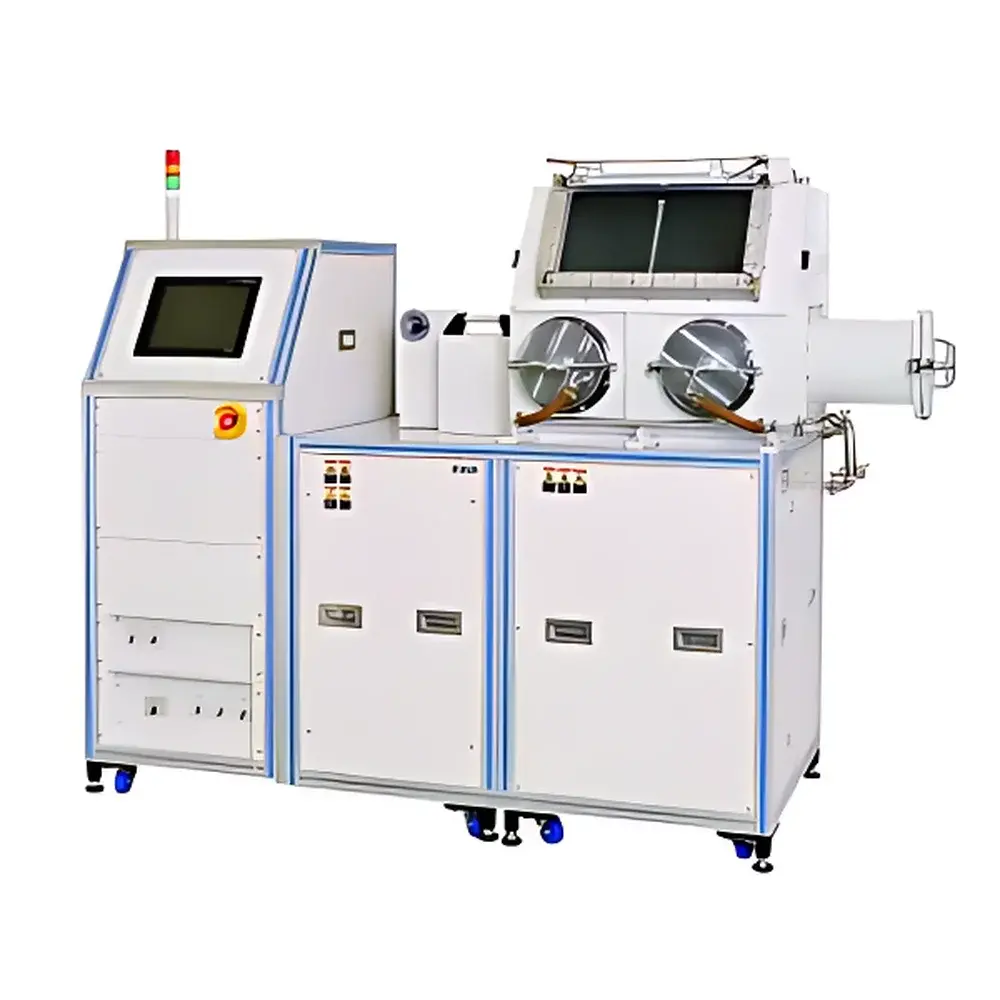
AGUS SAL3000 Atomic Layer Deposition System
| Brand | AGUS |
|---|---|
| Origin | Japan |
| Model | SAL3000 |
| Substrate Compatibility | Up to φ100 mm (4-inch) |
| Maximum Precursor Channels | 6 |
| Uniformity | ≤3% @ 100 mm |
| Process Temperature Range | Ambient to 800 °C (with optional heater) |
| Precursor Temperature Control | Up to 200 °C |
| Vacuum System | Dry Pump Compatible |
| Exhaust Treatment | Optional Scrubber Integration |
| Software | Touchscreen GUI with ≥30 Programmable Recipes |
| System Architecture | Integrated Mainframe and Control Enclosure |
Overview
The AGUS SAL3000 Atomic Layer Deposition (ALD) System is a research-grade thin-film synthesis platform engineered for precise, self-limiting surface reactions under ultra-high purity vacuum conditions. Based on the sequential, saturative chemisorption of gaseous precursors—each separated by inert purge steps—the SAL3000 enables monolayer-level thickness control via digital dosing cycles. Its core architecture supports thermal ALD processes across a wide temperature range (ambient to 800 °C), making it suitable for depositing oxides (e.g., Al₂O₃, HfO₂), nitrides (e.g., TiN, TaN), sulfides, and emerging metal-organic frameworks (MOFs) with atomic-scale conformity on planar, high-aspect-ratio, and recessed substrates. Designed for university cleanrooms, national lab process development facilities, and semiconductor R&D centers, the SAL3000 meets foundational requirements for reproducible nanoscale film engineering in next-generation logic, memory, and MEMS applications.
Key Features
- 6 independent precursor delivery lines with mass-flow-controlled injection and individually heated vaporization zones (up to 200 °C), enabling complex multi-component film stacks and combinatorial process exploration.
- Dual deposition orientation configuration: SAL3000D (top-side deposition) and SAL3000U (bottom-side deposition), minimizing particle adhesion risk during substrate handling and improving interface cleanliness for sensitive heterostructures.
- Integrated load-lock chamber option for rapid, contamination-free substrate transfer—critical for air-sensitive materials (e.g., alkali-metal chalcogenides, low-work-function electrodes) and multi-step processing sequences.
- Modular glovebox integration capability (via ISO-KF or CF flanges), supporting inert-atmosphere loading and post-deposition characterization without ambient exposure.
- Touchscreen-based graphical user interface with ≥30 programmable recipe slots, real-time parameter logging, and cycle-by-cycle event timestamping—fully compliant with GLP documentation workflows.
- Unified mainframe design incorporating vacuum chamber, gas distribution manifold, heating elements, and embedded controller—reducing footprint and interconnect complexity while enhancing thermal and mechanical stability.
Sample Compatibility & Compliance
The SAL3000 accommodates wafers and coupons up to φ100 mm (4-inch) with standard carrier plates; custom fixtures support irregular geometries including microfluidic chips, fiber optics, and MEMS cantilevers. Film uniformity is validated per ASTM F390-22 (Standard Test Method for Thickness Uniformity of Thin Films) and demonstrates ≤3% 3σ variation across full 100 mm substrates. The system’s vacuum integrity (<5×10⁻⁷ mbar base pressure with dry pump) and residual gas analysis compatibility align with ISO 14644-1 Class 4 cleanroom integration standards. Optional ozone generator and exhaust scrubber modules meet local occupational safety requirements (OSHA 29 CFR 1910.1200) and environmental discharge limits (EPA 40 CFR Part 63).
Software & Data Management
The embedded control software provides deterministic timing resolution (±10 ms for pulse/purge sequencing), full audit trail functionality (user login, parameter changes, alarm history), and export-ready CSV/Excel reports compatible with statistical process control (SPC) platforms. All recipes include metadata fields for material ID, lot traceability, and calibration timestamps—supporting 21 CFR Part 11-compliant electronic records when deployed with network authentication and role-based access controls. Remote monitoring via Ethernet (TCP/IP) enables integration into centralized facility management systems without compromising local operational autonomy.
Applications
- Gate dielectric optimization for sub-5 nm FinFET and GAA transistor prototypes.
- Conformal passivation layers on porous low-k interlayer dielectrics (e.g., SiCOH).
- Atomic-scale encapsulation of perovskite photovoltaic absorbers and solid-state battery cathodes.
- Functional coatings for biosensor surfaces requiring sub-nanometer thickness repeatability (e.g., ZnO for glucose oxidase immobilization).
- Seed layer engineering for selective epitaxial growth in III–V compound semiconductor integration.
- Research into spatial ALD (S-ALD) using masked precursor injection, enabled by the SAL3000’s modular gas routing architecture.
FAQ
What is the maximum achievable aspect ratio for conformal deposition using the SAL3000?
The system has demonstrated uniform step coverage (>95%) in trenches with aspect ratios exceeding 40:1 (e.g., 500 nm width × 20 µm depth), contingent upon precursor diffusion kinetics and purge efficiency optimization.
Does the SAL3000 support plasma-enhanced ALD (PE-ALD)?
No—this model is configured exclusively for thermal ALD. PE-ALD capability requires retrofitting with an integrated RF or microwave plasma source, available as a factory-engineered upgrade path.
Can the system be qualified for ISO/IEC 17025-accredited laboratories?
Yes—full metrological traceability documentation, as-installed calibration certificates (vacuum gauges, thermocouples, MFCs), and IQ/OQ protocols are provided upon request to support accreditation audits.
Is remote diagnostics supported?
Yes—optional Secure Shell (SSH) and VNC access modes enable authorized service engineers to perform firmware updates, log analysis, and sensor diagnostics without physical presence.
What vacuum pumping configurations are certified for use with aggressive precursors (e.g., TiCl₄, WF₆)?
Dry scroll pumps with fluoropolymer-coated internals and optional cryogenic trapping are recommended; detailed chemical compatibility matrices are included in the Safety Operating Procedure (SOP) manual.