
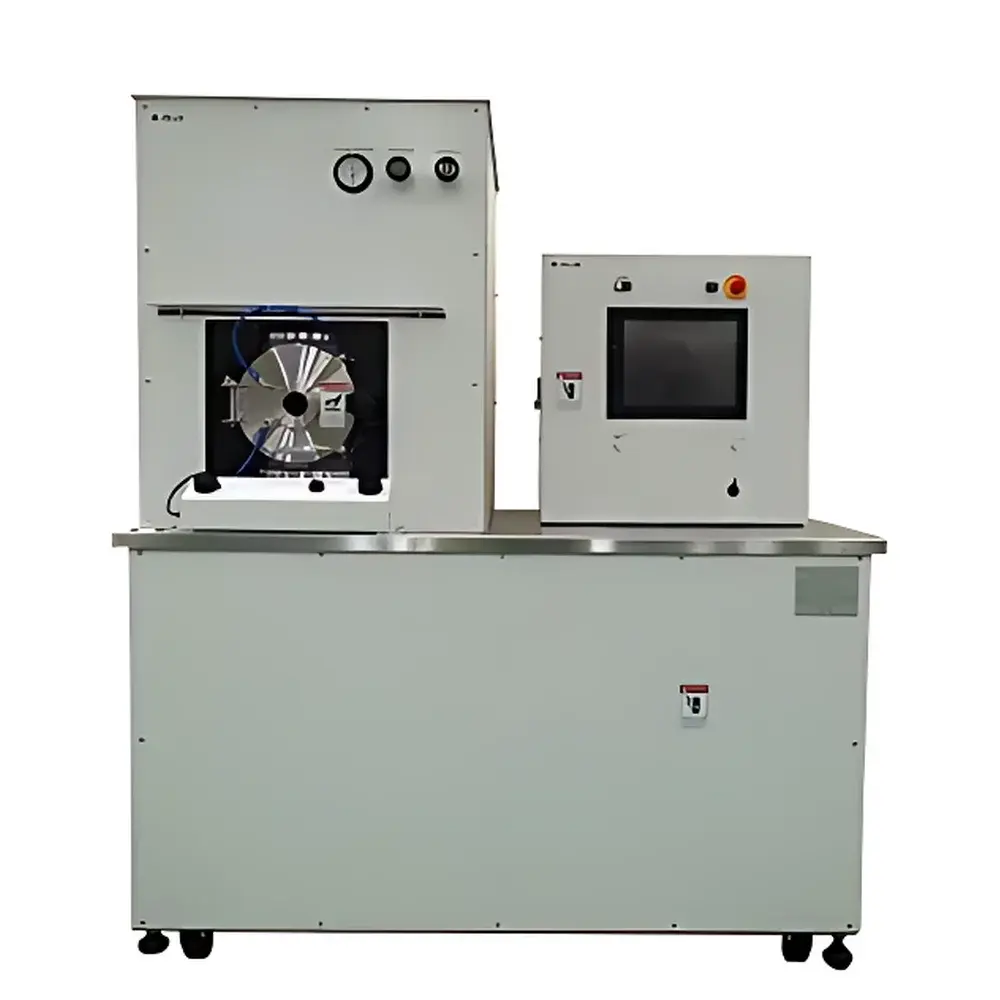
AGUS SPS-Rx Series Spark Plasma Sintering System
| Brand | AGUS |
|---|---|
| Origin | Japan |
| Manufacturer Type | Authorized Distributor |
| Origin Category | Imported |
| Model | SPS-Rx Series |
| Pricing | Available Upon Request |
Overview
The AGUS SPS-Rx Series Spark Plasma Sintering (SPS) System is a high-precision, vacuum-compatible sintering platform engineered for rapid densification of advanced ceramic, metallic, intermetallic, and composite powders. Based on the fundamental principle of pulsed direct current (DC) joule heating—where high-intensity, low-duration electrical pulses pass directly through the conductive graphite die and sample—the system achieves ultra-fast heating rates (up to 1,000 °C/min) and precise thermal control without external radiant heating elements. Unlike conventional hot pressing or pressureless sintering, SPS enables near-net-shape consolidation at significantly reduced temperatures (typically 20–50% below conventional sintering thresholds) and shortened dwell times (seconds to minutes), thereby minimizing grain growth, suppressing volatile loss, and preserving metastable phases. The Rx series specifically employs a high-stability hydraulic pressure actuation system—delivering controlled, repeatable uniaxial compaction up to 100 kN (configurable)—ensuring uniform stress distribution across large-diameter dies (up to Ø120 mm standard) and enabling reproducible microstructural outcomes in research and pilot-scale production environments.
Key Features
- Hydraulic-driven axial pressure system with closed-loop load feedback and real-time pressure stabilization—optimized for high-force consistency during transient thermal expansion.
- Integrated high-vacuum chamber (base pressure ≤5 × 10⁻³ Pa) with optional inert gas (Ar, N₂) backfill capability and leak-tight stainless-steel construction compliant with ISO 10816-3 mechanical vibration standards.
- Dual-channel independent temperature monitoring: Type C thermocouple (W–Re 5/26) embedded in the die bottom + pyrometric measurement (optional) for cross-validated thermal profiling.
- Pulsed DC power supply (max. 10 kA / 10 V) with adjustable pulse frequency (1–10 Hz), duty cycle (1–50%), and synchronized current ramping—enabling fine-tuned control over plasma activation and interparticle bonding kinetics.
- Modular die assembly interface supporting standard graphite tooling (e.g., Ø20–Ø100 mm dies), segmented dies for graded composites, and insulating sleeves for non-conductive powder systems.
- CE-marked control cabinet with integrated PLC-based motion & thermal sequencing logic and emergency stop circuitry meeting IEC 60204-1 safety requirements.
Sample Compatibility & Compliance
The SPS-Rx system accommodates a broad spectrum of powder feedstocks—including oxide ceramics (Al₂O₃, ZrO₂, SiC), nitrides (Si₃N₄, AlN), carbides (TiC, WC), refractory metals (W, Mo), nanostructured alloys (NiFe, CoCr), and functionally graded materials—without requiring organic binders or plasticizers. This eliminates binder removal steps, preventing carbon contamination, pore formation, and dimensional distortion common in conventional tape-casting or injection molding routes. All vacuum and pressure subsystems conform to PED 2014/68/EU (Pressure Equipment Directive) and ASME BPVC Section VIII Div. 1 design criteria. Process documentation supports GLP-compliant audit trails when paired with optional electronic logbook modules aligned with FDA 21 CFR Part 11 data integrity requirements.
Software & Data Management
The proprietary AGUS-SPS Control Suite (v4.x) provides full-cycle automation via intuitive graphical workflow scripting—supporting multi-step programs with conditional branching (e.g., “hold at 800 °C until resistance drop <5 mΩ”), real-time parameter logging (≥100 Hz sampling), and synchronized acquisition of voltage, current, displacement, pressure, and dual-temperature signals. Export formats include CSV, HDF5, and ASTM E2927-compliant sintering report templates. Remote monitoring and diagnostics are enabled via TLS-secured Ethernet interface; historical run archives are indexed by material ID, operator, and timestamp—facilitating traceability across R&D iterations and technology transfer to manufacturing.
Applications
- Development of ultrafine-grained or nanocrystalline structural ceramics for aerospace turbine components and wear-resistant coatings.
- Consolidation of thermoelectric oxides (e.g., Ca₃Co₄O₉, Bi₂Te₃) with preserved phonon-scattering interfaces.
- Processing of metastable high-entropy alloys (HEAs) where rapid quenching suppresses phase segregation.
- Prototyping of solid-state battery electrolyte pellets (LLZO, LATP) with controlled grain boundary chemistry.
- Joining dissimilar materials (e.g., Cu–AlN, Ti–SiC) via transient liquid-phase-assisted SPS under sub-solidus conditions.
FAQ
What distinguishes the Rx series from the Sx series?
The Rx series utilizes a servo-hydraulic pressure system optimized for high-load stability (≥50 kN) and long-term force retention during extended high-temperature holds; the Sx series employs electromechanical actuation better suited for lower-force, high-speed cyclic loading applications.
Can the system be configured for reactive SPS (R-SPS)?
Yes—optional gas introduction manifolds and programmable partial-pressure control enable in-situ synthesis during sintering (e.g., Ti + C → TiC), provided raw powders meet ASTM B891 reactivity classification guidelines.
Is remote validation support available for IQ/OQ protocols?
AGUS provides pre-validated test scripts and calibration certificates traceable to JCSS (Japan Calibration Service System); on-site or virtual FAT/SAT execution is coordinated through authorized service partners in EU, US, and APAC regions.



