
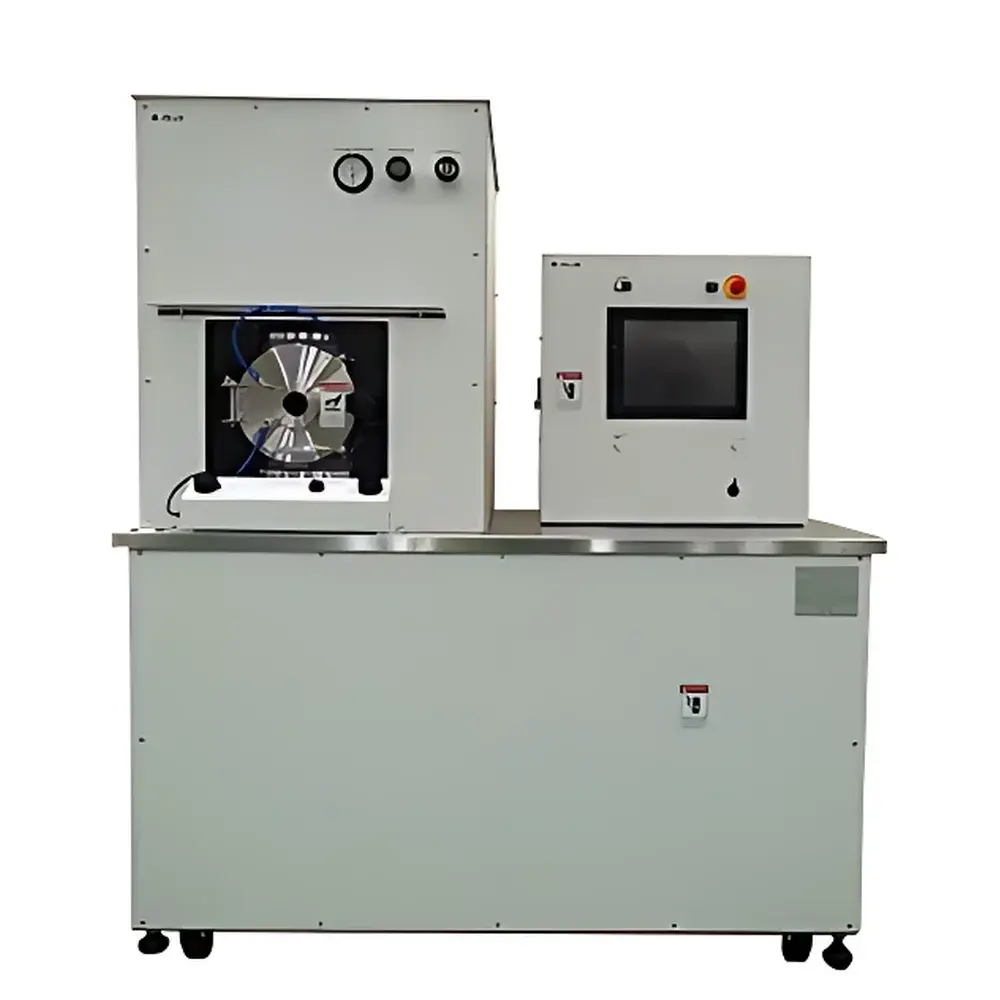
AGUS SPS-Sx Series Spark Plasma Sintering System
| Brand | AGUS |
|---|---|
| Origin | Japan |
| Manufacturer Type | Authorized Distributor |
| Origin Category | Imported |
| Model | SPS-Sx Series |
| Pricing | Available Upon Request |
Overview
The AGUS SPS-Sx Series Spark Plasma Sintering (SPS) System is a high-precision, electrically assisted powder consolidation platform engineered for rapid, low-temperature densification of advanced ceramics, intermetallics, nanocomposites, and functionally graded materials. Unlike conventional sintering methods—such as hot pressing or pressureless sintering—the SPS process relies on the simultaneous application of uniaxial pressure and pulsed direct current (DC) passed directly through the conductive graphite die and sample assembly. This generates localized Joule heating at particle contacts while minimizing bulk thermal inertia, enabling heating rates up to 1000 °C/min and dwell times measured in seconds to minutes. The result is exceptional microstructural control: minimal grain growth, suppressed phase decomposition, and retention of metastable phases or nanostructures that would otherwise be lost under prolonged thermal exposure. The Sx series employs a servo-motor-driven mechanical press system, delivering precise, programmable force control with high repeatability and real-time load feedback—ideal for research-scale optimization and reproducible process development under GLP-compliant laboratory conditions.
Key Features
- Servo-motor-based uniaxial pressure actuation (up to 50 kN standard; configurable to 100 kN), ensuring sub-newton force resolution and closed-loop load regulation throughout the entire sintering cycle
- Integrated high-current DC pulse generator (max. 12,000 A, 10 V) with adjustable pulse width (1–50 ms), frequency (1–10 Hz), and duty cycle for tailored thermal coupling to diverse powder systems
- Water-cooled stainless-steel vacuum chamber rated to ≤5 × 10⁻³ Pa (base pressure), compatible with inert gas backfilling (Ar, N2) up to 0.5 MPa
- Multi-zone thermocouple monitoring (Type C or B, optional pyrometry) with spatially resolved temperature profiling across die height and sample surface
- Modular graphite die system—including punch/die sets, insulating sleeves, and spacers—designed for rapid tooling changeover and cross-contamination mitigation
- Compliance-ready architecture: supports audit trails, user-level access control, electronic signatures, and data export in CSV/ASCII formats aligned with FDA 21 CFR Part 11 and ISO/IEC 17025 documentation requirements
Sample Compatibility & Compliance
The SPS-Sx system accommodates cylindrical samples from Ø6 mm to Ø100 mm (standard configurations), with custom die geometries available for rectangular or multi-pellet arrangements. It is routinely employed for sintering oxide ceramics (Al2O3, ZrO2, SiC), MAX phases, thermoelectric chalcogenides (Bi2Te3, SnSe), metal matrix composites (Ti6Al4V + TiB2), and amorphous alloy powders. All vacuum and electrical subsystems conform to IEC 61000-6-2 (EMC immunity) and IEC 61000-6-4 (EMC emissions). Pressure vessel components meet ASME BPVC Section VIII Div. 1 design criteria. System validation documentation—including IQ/OQ protocols and traceable calibration certificates for load cells, thermocouples, and vacuum gauges—is provided per ISO 9001:2015 and JIS Z 8401 standards.
Software & Data Management
The proprietary AGUS SPS Control Suite (v4.x) provides deterministic real-time control of pressure, current, voltage, temperature, and vacuum parameters via synchronized 100 Hz sampling. Process recipes are structured hierarchically (preheat → ramp → dwell → cool) with conditional logic (e.g., “hold temperature until load stabilizes within ±0.5%”). All operational data—including raw sensor streams, event logs, and alarm histories—are timestamped, digitally signed, and stored in an encrypted SQLite database. Export modules support ASTM E2928-compliant reporting templates and seamless integration with LIMS platforms via OPC UA or RESTful API. Audit trail functionality records operator ID, parameter changes, and system state transitions with immutable hashing—fully satisfying GLP, GMP, and internal QA traceability mandates.
Applications
- Development of ultrafine-grained or nanostructured ceramics for cutting tools and wear-resistant coatings
- Densification of oxygen-sensitive refractory metals (Mo, W, Nb) without carburization or embrittlement
- Consolidation of thermoelectric materials preserving phonon-scattering interfaces
- Rapid prototyping of functionally graded materials (FGMs) via sequential layer-wise sintering
- Processing of metastable phases (e.g., high-entropy ceramics, amorphous-to-crystalline transition studies)
- Academic and industrial R&D requiring strict parameter reproducibility across multi-lab collaborative projects
FAQ
What distinguishes the Sx series from the Rx series?
The Sx series utilizes a servo-motor-driven mechanical press for precise, low-noise force application ideal for fine-grained powders and sensitive material systems. The Rx series employs a hydraulic press for higher maximum loads and greater thermal stability during extended high-temperature holds.
Can the system operate under reactive atmospheres such as H₂ or CO?
Standard configuration supports inert gases only. Reactive atmosphere operation requires optional explosion-proof upgrades, specialized gas train components, and third-party safety certification—available upon engineering review.
Is remote monitoring and control supported?
Yes—via secure TLS-encrypted Ethernet connection. Full GUI mirroring, real-time data streaming, and recipe upload/download are enabled through authenticated web interface or dedicated client software.
What vacuum pumping configuration is standard?
A two-stage rotary vane pump combined with a turbomolecular pump (600–1200 L/s) achieves base pressures below 5 × 10⁻³ Pa. Cryogenic or diffusion pump alternatives are configurable.
Are calibration services traceable to national standards?
Yes—load cell calibrations are performed per ISO/IEC 17025 by an ILAC-accredited laboratory; thermocouple calibrations follow NIST-traceable procedures with certificate of conformity included.



