
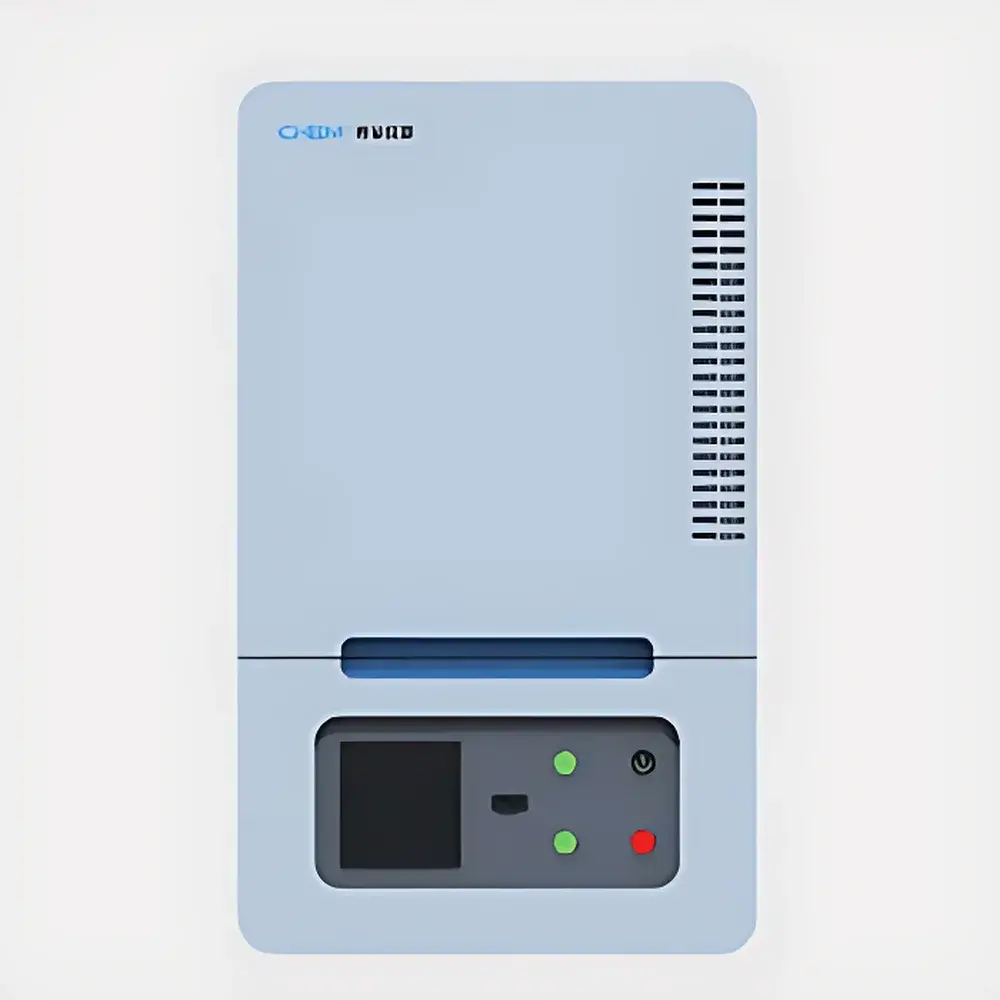
Ahkemi BFC-1200-7.2L Desktop Box Furnace
| Brand | Ahkemi |
|---|---|
| Origin | Anhui, China |
| Model | BFC-1200-7.2L |
| Maximum Temperature | 1200 °C |
| Temperature Uniformity | ±1 °C |
| Rated Power | 2.5 kW |
| Heating Rate (to max temp) | 5–20 °C/min |
| Internal Dimensions | 200 × 300 × 120 mm (7.2 L) |
| Heating Element | Resistance Wire (3-sided: left, right, top) |
| Insulation | Vacuum-formed alumina fiber |
| Cooling | Dual-layer air-cooled jacket |
| Surface Temperature at Max Operation | <60 °C |
| Control System | Fuzzy PID with auto-tuning |
| Programmability | 30-segment intelligent ramp-soak profile |
| Safety Features | Over-temperature alarm, thermocouple break detection, emergency stop button |
| Input Voltage | AC 220 V, 50/60 Hz |
| External Dimensions | 440 × 500 × 600 mm |
Overview
The Ahkemi BFC-1200-7.2L Desktop Box Furnace is a compact, high-performance laboratory furnace engineered for precise thermal processing in research, quality control, and small-batch materials development. Designed around a robust resistive heating architecture with three-sided (left, right, and top) resistance wire elements, the furnace delivers rapid, uniform heat distribution across its 7.2-liter chamber—critical for reproducible sintering, ashing, calcination, annealing, and heat treatment of ceramics, metals, polymers, and catalysts. Its maximum operating temperature of 1200 °C (short-term), with a recommended continuous use limit of 1100 °C, positions it within Class III high-temperature benchtop instrumentation. The unit integrates a fully sealed muffle cavity with vacuum-formed, low-conductivity alumina fiber insulation—eliminating thermal bridging and minimizing standby losses. Unlike conventional brick-lined furnaces, this design achieves superior thermal efficiency: power consumption is approximately 25% of comparable 7–8 L units under identical duty cycles.
Key Features
- Triple-zone resistive heating configuration ensures ±1 °C temperature uniformity across the full 200 × 300 × 120 mm working volume—verified per ASTM E220 calibration methodology.
- Fuzzy PID temperature controller with self-tuning capability enables stable setpoint maintenance under variable load conditions; supports 30-segment programmable ramp-soak profiles for complex thermal schedules.
- Dual-layer forced-air cooling jacket maintains external casing surface temperature below 60 °C during sustained operation at 1200 °C—compliant with IEC 61000-3-2 harmonic emission and EN 61000-6-3 EMC standards for lab environments.
- Integrated safety architecture includes independent over-temperature cutoff (hardware-limited to 1250 °C), thermocouple failure detection (open-circuit alarm), and front-panel emergency stop switch—meeting UL 61010-1 and CSA C22.2 No. 61010-1 requirements.
- Energy-optimized insulation system reduces thermal mass and accelerates cool-down rates—typical cooldown from 1100 °C to 100 °C requires ≤90 minutes without forced quenching.
Sample Compatibility & Compliance
The BFC-1200-7.2L accommodates crucibles up to Φ80 mm × 100 mm height (e.g., alumina, quartz, silicon carbide), supporting standard ASTM C114, ISO 3262, and USP ash content protocols. Its sealed muffle design prevents cross-contamination and enables inert-atmosphere operation when paired with optional gas purge kits (N₂, Ar). The furnace conforms to GLP documentation requirements through time-stamped, non-volatile profile logging (via optional RS485/Modbus interface) and supports audit-ready operation under FDA 21 CFR Part 11 when integrated with validated LIMS or ELN platforms. All electrical components meet RoHS 3 and REACH SVHC criteria.
Software & Data Management
While the base model features a front-panel digital display with intuitive menu navigation, optional communication modules enable remote monitoring and data capture via Modbus RTU (RS485) or USB-to-serial emulation. Logged parameters—including actual vs. setpoint temperature, segment elapsed time, alarm events, and power-on duration—are exportable as CSV files for traceability. Firmware supports firmware update via SD card, ensuring long-term compatibility with evolving laboratory informatics systems. Calibration certificates (traceable to NIM, China) are provided with each unit, including as-found/as-left data per ISO/IEC 17025 procedures.
Applications
- Thermal gravimetric analysis (TGA) sample pre-conditioning and residue quantification
- Sintering of oxide-based dental and electronic ceramics (e.g., ZrO₂, Al₂O₃)
- Residue-on-ignition (ROI) testing per APHA Standard Methods 2540E
- Pre-oxidation of metal powders prior to HIP or SLM processing
- Controlled atmosphere annealing of thin-film substrates (with purge kit)
- Calibration reference source for infrared pyrometer validation (within 900–1100 °C range)
FAQ
What is the recommended maximum continuous operating temperature?
1100 °C—operation above this temperature is permissible only for short durations (≤30 min) and must be preceded by full thermal soak at 1000 °C.
Can the furnace be used under reducing atmospheres?
Yes, when equipped with an optional gas inlet/outlet port kit and compatible with H₂/N₂ mixtures up to 5% H₂ concentration; quartz or MoSi₂ heating elements are required for such applications (not included in standard configuration).
Is the temperature controller compliant with FDA 21 CFR Part 11?
The embedded controller does not include electronic signature or audit trail functionality by default; however, full Part 11 compliance is achievable via integration with third-party validated SCADA or LIMS software using Modbus data streaming.
How often should the furnace be recalibrated?
Annual calibration is recommended for GMP/QC environments; more frequent verification (e.g., quarterly) is advised when used for regulatory submissions or ISO 17025-accredited testing.
Does the unit include a thermocouple?
Yes—a Type K thermocouple is factory-installed and calibrated; replacement sensors conform to IEC 60584-2 tolerance Class 1 specifications.



