
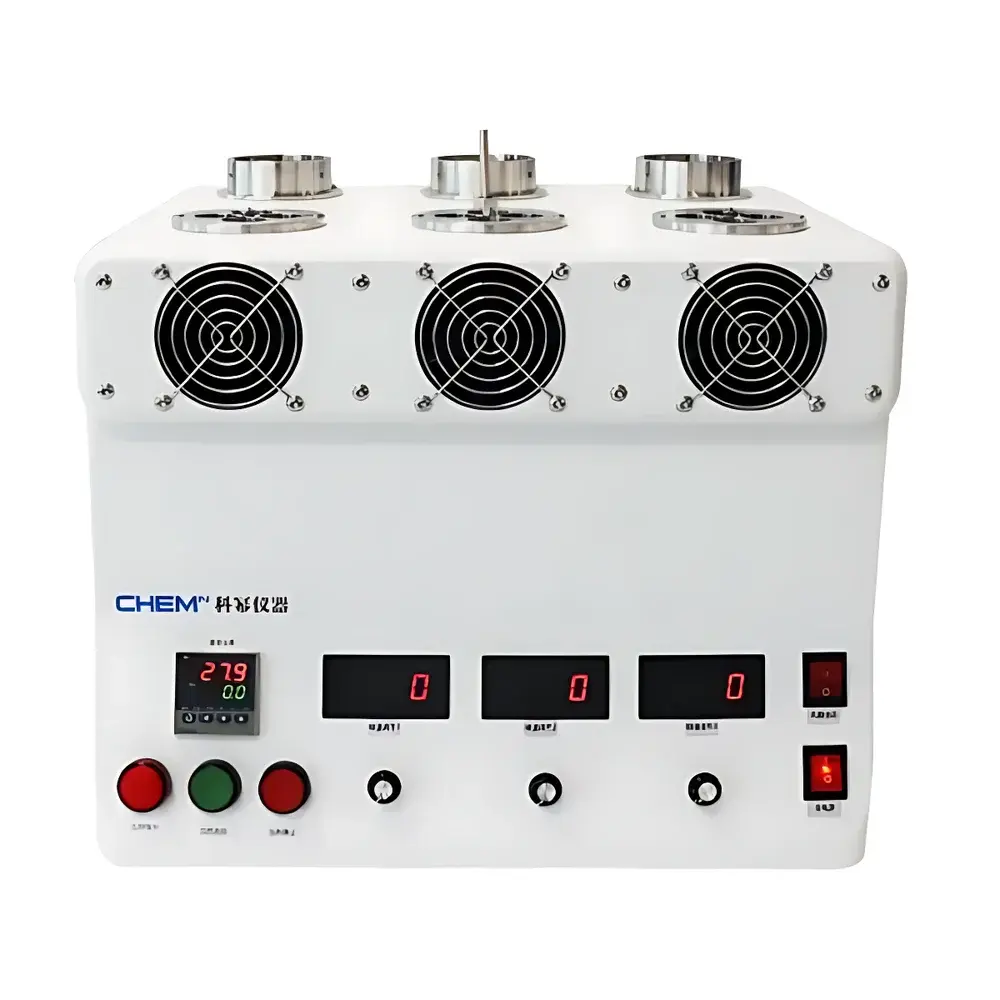
Ahkemi SCH-PCRS-8-427-K Temperature-Controlled High-Throughput Photocatalytic Reactor
| Brand | Ahkemi |
|---|---|
| Origin | Anhui, China |
| Model | SCH-PCRS-8-427-K |
| Cooling Capacity | 130–445 W |
| Heating Method | Ceramic Fan Heater |
| Cooling Method | DC Inverter Compressor (R134a) |
| Temperature Control Range | 10–50 °C |
| Temperature Stability | ±0.2 °C |
| Stirring Mode | Direct-Drive Rare-Earth Permanent Magnet Motor |
| Stirring Speed | 150–1000 rpm, Continuously Adjustable |
| Light Source Interface | 24 V / 8 A DC Output |
| Standard Reaction Stations | 12 (3 × 4 configuration) |
| Dimensions (W×D×H) | 420 × 470 × 550 mm |
Overview
The Ahkemi SCH-PCRS-8-427-K Temperature-Controlled High-Throughput Photocatalytic Reactor is an engineered platform for quantitative, reproducible photocatalytic screening under rigorously controlled thermal and irradiation conditions. It operates on the principle of simultaneous multi-channel photochemical activation—where UV–vis photons drive redox reactions on semiconductor catalysts (e.g., TiO₂, g-C₃N₄, or MOFs) while active thermal management suppresses photothermal artifacts. Unlike conventional batch reactors, this system decouples light delivery from thermal drift via integrated refrigeration, enabling kinetic studies where temperature is a defined independent variable—not a confounding output. Its architecture supports parallel reaction kinetics analysis, catalyst library evaluation, and mechanistic photoredox profiling in compliance with OECD TG 129 and ISO 10678 guidelines for photocatalytic activity assessment.
Key Features
- Integrated Thermal Management: A DC inverter-driven R134a compressor system delivers precise cooling (130–445 W nominal capacity) paired with ceramic fan-assisted heating, maintaining chamber temperature within ±0.2 °C across the 10–50 °C operating range—critical for distinguishing photochemical from thermally activated pathways.
- Tri-Face Reflective Illumination: A proprietary reflective cavity design ensures uniform photon flux distribution across front, rear, and bottom surfaces of each reaction tube, minimizing radial intensity gradients and improving inter-replicate coefficient of variation (CV) to <3.5% (measured at 365 nm using calibrated silicon photodiode arrays).
- Modular Reaction Chamber: The quick-release chamber interface allows field-swappable optical configurations—including collimated LED arrays, fiber-coupled lamp modules, or custom quartz-windowed variants—enabling adaptation to wavelength-specific protocols (e.g., UVC sterilization screening or visible-light H₂ evolution).
- Independent Magnetic Stirring: Each of the 12 standard reaction positions employs a dedicated rare-earth permanent magnet motor with direct shaft coupling, delivering consistent 150–1000 rpm agitation without cross-talk or torque loss—even at low-viscosity aqueous or organic media.
- Scalable Parallelism: Base configuration supports 12 simultaneous reactions (3 × 4 array); optional expansion kits enable up to 80-position throughput via stacked chamber modules—ideal for DoE-based catalyst optimization or high-content photostability testing.
Sample Compatibility & Compliance
The reactor accommodates standard 10–25 mL borosilicate or quartz reaction tubes (including screw-cap and septum-sealed formats), compatible with acidic, basic, and halogenated solvent systems. All wetted materials meet USP Class VI biocompatibility standards. Thermal control performance is validated per ASTM E2882–22 for laboratory-scale photoreactor stability, and the electrical subsystem complies with IEC 61010-1:2012 for safety in laboratory equipment. Data logging functionality supports audit-ready records aligned with GLP and FDA 21 CFR Part 11 requirements when used with compliant third-party software.
Software & Data Management
While the SCH-PCRS-8-427-K operates as a standalone hardware platform, its 24 V / 8 A DC power interface enables seamless integration with external programmable light sources (e.g., Thorlabs LED drivers or Omicron laser controllers) and digital temperature loggers. Optional RS-485 or USB-C communication modules support real-time acquisition of chamber temperature, stir speed, and power supply status into LIMS or ELN environments. Timestamped metadata export (CSV/JSON) includes setpoint deviations, compressor duty cycle, and motor current draw—facilitating root-cause analysis of thermal transients during long-duration experiments (>24 h).
Applications
- Quantitative comparison of photocatalyst quantum yield across material libraries (e.g., doped TiO₂ vs. perovskite oxides)
- Wavelength-resolved action spectrum determination for solar fuel generation (H₂, CH₄, CO)
- Photocorrosion resistance screening under accelerated irradiation and controlled O₂/H₂O partial pressures
- Photo-Fenton and persulfate activation kinetics under thermostatically stabilized conditions
- Regulatory-compliant photocatalytic degradation testing of pharmaceuticals (e.g., ibuprofen, carbamazepine) per ISO 22192
FAQ
Can the reactor accommodate quartz reaction tubes for UV-C applications?
Yes—the standard chamber geometry accepts 15 mm OD quartz tubes with optional quartz-bottom inserts to maximize UV transmission below 200 nm.
Is remote monitoring supported out of the box?
No native Ethernet/WiFi module is included; however, the RS-485 interface enables integration with industrial PLCs or Raspberry Pi–based telemetry nodes.
What is the maximum allowable ambient temperature for stable 10 °C operation?
For sustained sub-ambient control, ambient must remain ≤25 °C with ≥20 cm clearance around exhaust vents to ensure compressor thermal efficiency.
Does the system support inert atmosphere purging?
Yes—dual gas inlet ports (1/8″ Swagelok) are pre-installed on the chamber lid, allowing simultaneous N₂/Ar purge and headspace pressure regulation up to 2 bar(g).
Are calibration certificates provided for temperature sensors?
NIST-traceable calibration reports (±0.1 °C uncertainty) are available upon request at time of order, including as-found/as-left data per ISO/IEC 17025 requirements.



