
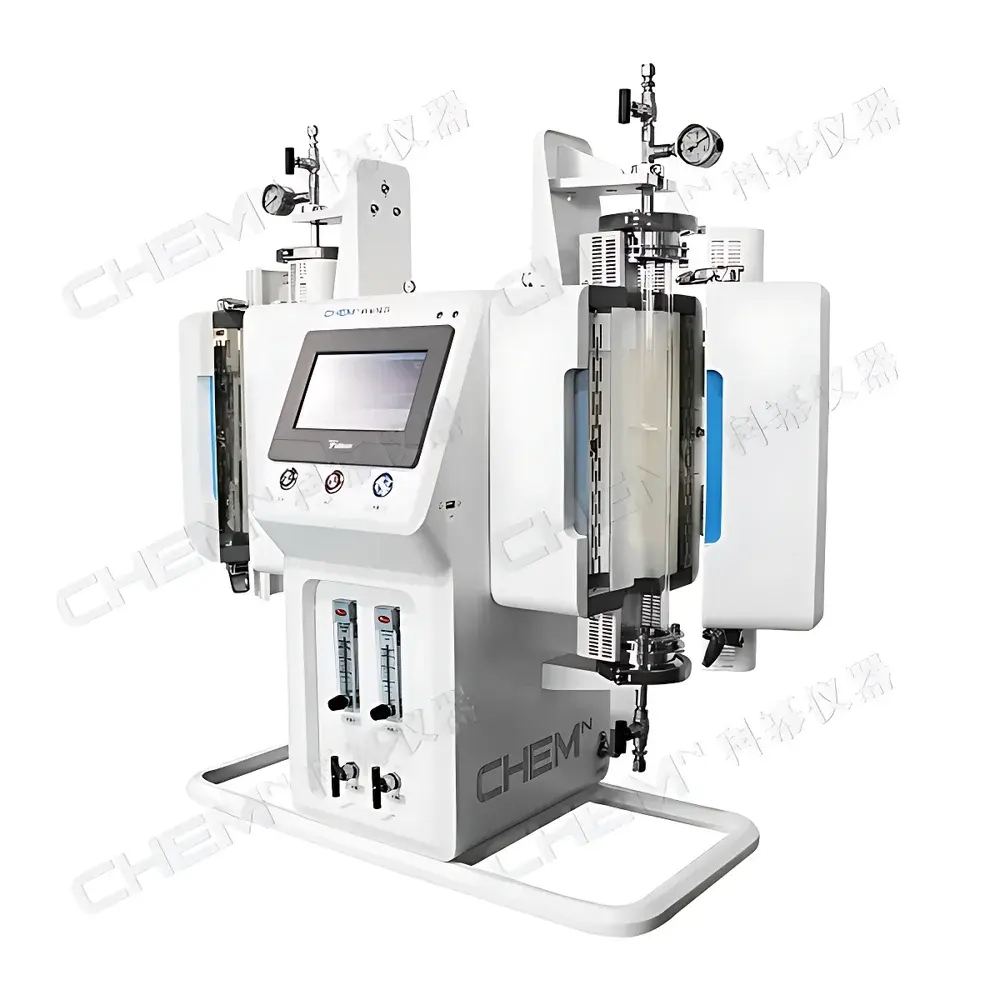
Ahkemi TFG-1200-50-I-220 Vertical Tube Furnace for Catalytic Atmosphere Calcination and Activation
| Brand | Ahkemi |
|---|---|
| Origin | Anhui, China |
| Model | TFG-1200-50-I-220 |
| Instrument Type | Vertical Tube Furnace |
| Max Temperature | 1100 °C |
| Temperature Control Accuracy | ±1 °C |
| Max Power | 2.0 kW |
| Heating Rate (to Max Temp) | ≤10 °C/min |
| Heating Method | Resistance Wire |
| Internal Chamber Dimensions | 660 × 320 × 580 mm |
| Tube ID × Length | 50 × 450 mm |
| Sample Boat Capacity | 10 mL (customizable) |
| Sample Boat Diameter | 30 mm |
| Heated Zone Length | 220 mm |
| Mass Flow Range (Rotameter) | 30–200 mL/min (customizable) |
| Control System | Dual-Channel Intelligent Programmable Controller with Color Touchscreen |
| Power Supply | AC 220 V, 50/60 Hz |
| Weight | 35 kg |
Overview
The Ahkemi TFG-1200-50-I-220 is a vertically oriented, programmable tube furnace engineered specifically for controlled atmosphere calcination and thermal activation of heterogeneous catalysts. Unlike conventional muffle furnaces or horizontal tube systems, this instrument integrates precise gas-flow management, uniform axial heating, and ergonomically optimized sample handling to address critical reproducibility challenges in catalyst R&D and QC workflows. Its operational principle relies on resistive heating of a high-purity quartz tube under continuous, metered gas flow—enabling oxidation, reduction, sulfidation, or inert annealing treatments while maintaining strict thermal and atmospheric homogeneity across the active sample zone. Designed for laboratory-scale catalyst development, it supports GLP-aligned process documentation and meets foundational requirements for method validation under ISO/IEC 17025 and ASTM D7213 (for catalyst thermal stability assessment).
Key Features
- Vertical orientation with top-loading quartz tube assembly minimizes catalyst powder displacement during insertion/removal and eliminates gravitational segregation during heating.
- Integrated dual-channel intelligent controller with color touchscreen interface supports up to 30-segment programmable ramp-soak profiles, real-time temperature logging, and alarm-triggered shutdown.
- High-stability Super OMEGACLAD™ XL thermocouple (Type K) ensures long-term drift <2.8 °C over 25 weeks—validated per ASTM E230/E230M—and extends sensor service life approximately 10× beyond standard industrial equivalents.
- Dwyer RATE-MASTER rotameter with monolithic fluid guide rod delivers ±2% full-scale repeatability in gas flow control (30–200 mL/min range), critical for stoichiometric precision in redox activation protocols.
- Optimized 220 mm heated zone length aligned with 10 mL sample boat geometry ensures ΔT ≤ ±1.5 °C across the entire catalyst bed at 1100 °C—verified by multi-point mapping per IEC 60584-2.
- Quartz tube (Ø50 × 450 mm) and removable alumina/ceramic sample boats are chemically inert to H₂, NH₃, O₂, N₂, CO, and diluted SO₂ atmospheres—compatible with USP <661> and ASTM C725 for ceramic component certification.
Sample Compatibility & Compliance
The TFG-1200-50-I-220 accommodates granular, pelletized, or extrudate catalyst forms ranging from 0.1 to 10 mL volume (standard boat: Ø30 mm × 25 mm depth). Its vertical configuration prevents particle migration and ensures consistent gas–solid contact time—essential for achieving uniform metal dispersion or phase transformation. The system complies with electrical safety standards IEC 61010-1 and EMC directive 2014/30/EU. All firmware operations—including parameter setting, data export (CSV), and audit trail generation—support traceability requirements aligned with FDA 21 CFR Part 11 when paired with validated networked data acquisition software.
Software & Data Management
The embedded controller provides local data capture of temperature, setpoint, and elapsed time at user-defined intervals (1–60 s). Historical curves and tabular logs can be exported via USB port without proprietary drivers. Optional Ethernet-enabled data acquisition modules support Modbus TCP integration into LIMS or SCADA environments. All recorded events—including manual overrides, alarm triggers, and power interruptions—are timestamped and retained in non-volatile memory for ≥12 months, satisfying internal QA record retention policies per ISO 9001:2015 Clause 7.5.3.
Applications
- Thermal activation of Ni/Al₂O₃, Co/Mo/Al₂O₃, and Pt/zeolite catalysts under H₂/N₂ mixtures.
- Controlled oxidative calcination of metal-organic framework (MOF) precursors to derive porous oxide catalysts.
- Regeneration studies of spent FCC catalysts under steam–air atmospheres.
- Pre-sulfiding protocols for hydrodesulfurization (HDS) catalysts using H₂S/N₂ blends.
- Accelerated aging tests per ASTM D7213 to assess thermal degradation onset temperatures.
FAQ
What gas atmospheres are compatible with the quartz tube assembly?
Nitrogen, argon, hydrogen, oxygen, air, carbon monoxide, ammonia, and diluted sulfur-containing gases (e.g., 5% H₂S in N₂) are supported. Avoid halogenated or fluorinated compounds above 400 °C.
Can the heated zone length be extended for larger sample volumes?
Yes—custom configurations with 300 mm or 400 mm heated zones are available upon request, with recalibrated thermal uniformity mapping.
Is the system compliant with GLP audit requirements?
When used with optional audit-trail-enabled software and calibrated reference thermocouples (NIST-traceable), it satisfies core GLP documentation criteria for thermal process validation.
How is temperature uniformity verified across the sample zone?
Uniformity is certified per IEC 60584-2 using three independent Type K thermocouples placed at center, +50 mm, and −50 mm along the tube axis—results provided in factory calibration report.
What maintenance intervals are recommended for the rotameter and heating elements?
Dwyer rotameter requires annual visual inspection and zero-check; resistance wire elements typically exceed 5,000 hours of operation at ≤1000 °C—no scheduled replacement interval is specified under normal use.
Related Products



