
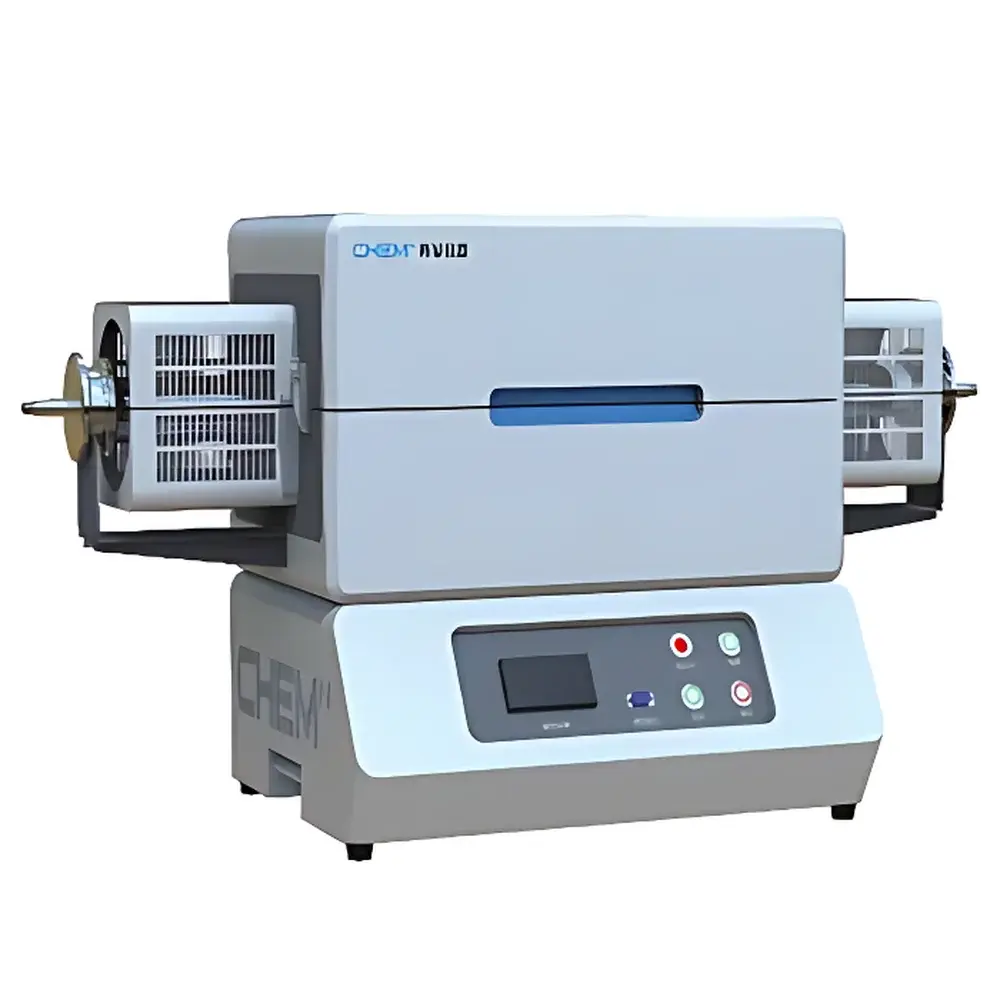
Ahkemi TFH-1200-I-50 Laboratory-Grade Assisted Tube Furnace
| Brand | Ahkemi |
|---|---|
| Origin | Anhui, China |
| Model | TFH-1200-I-50 |
| Maximum Temperature | 1200 °C |
| Temperature Control Accuracy | ±1 °C |
| Rated Power | 3 kW |
| Heating Rate (to Max Temp) | ≤10 °C/min |
| Heating Method | Resistance Wire Heating |
| Internal Dimensions | 580 × 500 × 520 mm |
| Tube Diameter | Φ50 mm (OD) × 1000 mm (L), customizable |
| Heating Zone Length | 440 mm |
| Control System | Yudian AI-3756P 7-inch Color Touchscreen Controller with 30-Stage Programmable Ramp/Soak |
| Thermocouple Type | K-type |
| Power Supply | AC 220 V, 50/60 Hz |
| Net Weight | 45 kg |
| Cooling | Dual-layer Air-Cooled Housing (Surface Temp ≤60 °C) |
| Tube Material | Fused Quartz |
| Sealing | Stainless Steel Flanges with Vacuum/Atmosphere Compatibility |
| Insulation | High-Purity Alumina Microcrystalline Fiber Vacuum-Formed Crucible Liner |
Overview
The Ahkemi TFH-1200-I-50 is a laboratory-grade assisted tube furnace engineered for precise thermal processing under controlled atmospheres or vacuum conditions. Designed around the fundamental principles of resistive heating and axial thermal symmetry, it delivers stable, repeatable temperature profiles across its 440 mm active heating zone. The furnace employs a high-purity alumina microcrystalline fiber insulation matrix—vacuum-formed to eliminate air gaps and minimize thermal lag—enabling rapid heat-up while maintaining exceptional energy efficiency (>50% reduction in standby power versus conventional refractory brick designs). Its fused quartz tube (Φ50 mm OD × 1000 mm L) provides broad spectral transparency, chemical inertness, and thermal shock resistance up to 1100 °C continuous operation (1200 °C short-term), making it suitable for synthesis, annealing, sintering, and calcination protocols requiring strict environmental control.
Key Features
- Integrated 7-inch color touchscreen controller (Yudian AI-3756P) supporting 30-stage programmable ramp/soak sequences with real-time graphical display and USB data logging
- Dual-layer air-cooled housing architecture ensuring external surface temperature remains ≤60 °C during full-power operation—enhancing operator safety and reducing ambient heat load
- High-density alumina microcrystalline fiber insulation, vacuum-formed for uniform density and minimal thermal conductivity (≤0.09 W/m·K at 1000 °C)
- Radially symmetric resistance wire winding (HRE alloy, Beijing Shougang) aligned parallel to the quartz tube axis—optimized for axial temperature uniformity (±3 °C over 400 mm zone at 1100 °C)
- Quick-release stainless steel flange system with Viton O-rings (standard) or Kalrez-compatible seals (optional) for vacuum-tight or gas-purged operation down to 10⁻³ mbar
- Compliant with IEC 61000-6-3 (EMC emission limits) and IEC 61000-6-2 (immunity to electrostatic discharge and fast transients)
Sample Compatibility & Compliance
The TFH-1200-I-50 accommodates standard ceramic crucibles (Al₂O₃, SiC), quartz boats, and custom substrates up to 45 mm in diameter and 900 mm in length. Its quartz tube permits direct optical access for in-situ monitoring (e.g., pyrometry, Raman spectroscopy coupling via side ports). The furnace meets general-purpose laboratory safety requirements per EN 61010-1:2010 and supports GLP-compliant workflows through audit-trail-capable controller firmware (time-stamped parameter changes, event logs exportable via USB). Optional upgrades include integrated mass flow controllers (MFCs) for multi-gas atmosphere management (N₂, Ar, H₂, forming gas) and pressure transducers compatible with ISO 27423 vacuum calibration standards.
Software & Data Management
The Yudian AI-3756P controller features embedded non-volatile memory retaining up to 100 user-defined programs and full-cycle temperature/time logs (sampled at 1 s intervals). All data—including setpoints, actual PV readings, alarm events, and power output—are exportable in CSV format via USB 2.0 port for traceability and post-processing in MATLAB, Python (pandas), or LabVIEW. While the base unit does not include network connectivity, RS485 Modbus RTU interface is available as an add-on for integration into centralized SCADA or MES platforms compliant with ISA-88/ISA-95 frameworks.
Applications
- Thermal decomposition and precursor pyrolysis in nanomaterial synthesis (e.g., MOF carbonization, graphene oxide reduction)
- Controlled-atmosphere annealing of thin-film devices (ITO, perovskite precursors, transition metal dichalcogenides)
- Catalyst activation and regeneration under reducing or inert gas environments
- Calibration of thermocouples and reference materials per ASTM E230/E230M Annex A2
- Pre-treatment of electrodes for solid-state battery research (LiCoO₂, NMC, sulfide electrolytes)
- Low-pressure chemical vapor deposition (LPCVD) precursor cracking studies using quartz tube reactors
FAQ
What vacuum level can the furnace achieve with standard configuration?
With included mechanical vacuum pump (not supplied) and Viton-sealed flanges, typical base pressure is 10⁻³ mbar; upgrading to a turbomolecular pump and metal gaskets enables operation down to 10⁻⁶ mbar.
Is the quartz tube replaceable, and what is its expected service life at 1100 °C?
Yes—the tube is field-replaceable; under continuous operation at 1100 °C in inert atmosphere, average service life exceeds 1,200 hours before visible devitrification or warping occurs.
Can the controller be configured for remote monitoring via Ethernet or Wi-Fi?
The standard AI-3756P lacks native Ethernet/Wi-Fi; however, third-party Modbus-to-Ethernet gateways (e.g., Moxa EDS-205A) enable secure remote readout and limited setpoint adjustment within local networks.
Does the furnace comply with FDA 21 CFR Part 11 for electronic records?
The base controller does not provide Part 11–compliant electronic signatures or audit trails; for regulated pharmaceutical or biotech applications, a validated PLC-based control retrofit with 21 CFR Part 11 software stack is available as a custom engineering option.
What maintenance intervals are recommended for optimal thermal performance?
Inspect insulation integrity and flange seal condition every 200 operating hours; recalibrate K-type thermocouple annually against NIST-traceable reference; clean air intake filters weekly in dusty lab environments.



