
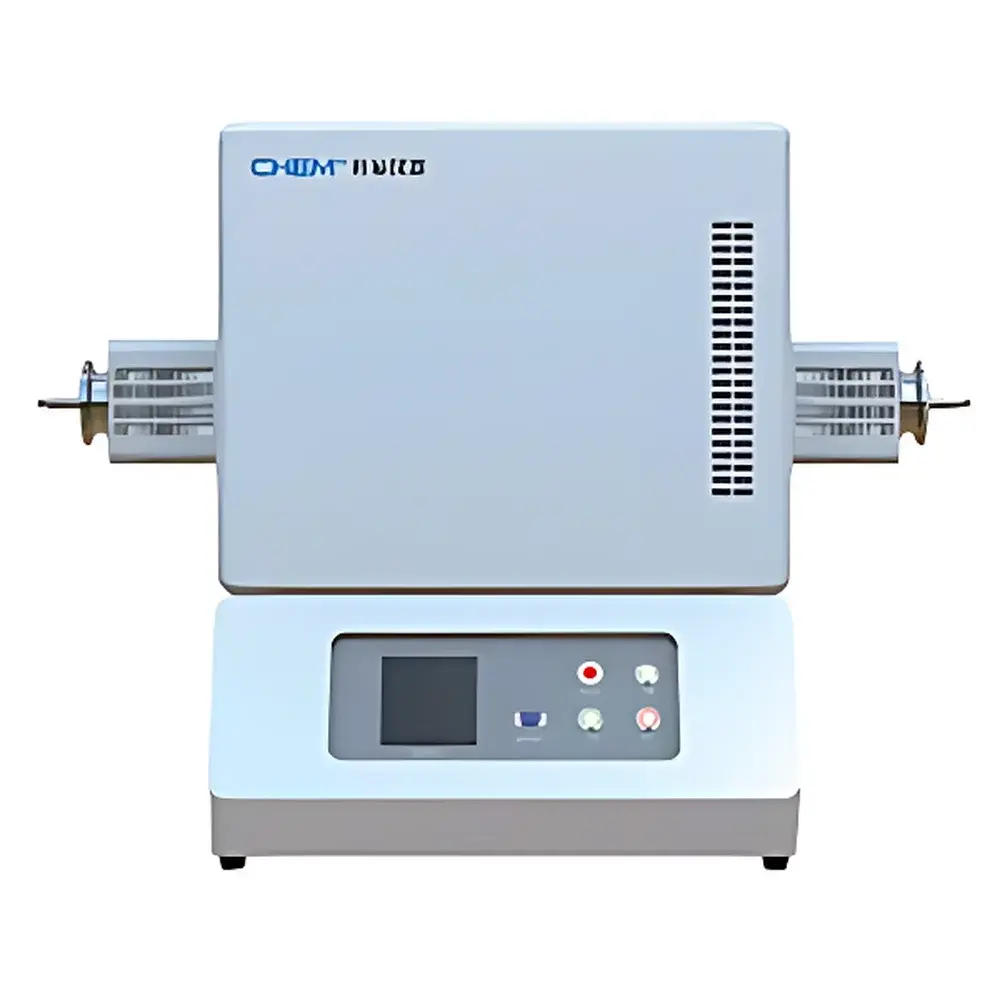
Ahkemi TFH-1500-50-I-260 Single-Zone Tube Furnace
| Brand | Ahkemi |
|---|---|
| Origin | Anhui, China |
| Model | TFH-1500-50-I-260 |
| Maximum Temperature | 1500 °C (rated), 1450 °C (short-term) |
| Temperature Control Accuracy | ±1 °C |
| Heating Element | Silicon Carbide Rods |
| Power Rating | 6 kW |
| Max Heating Rate (to max temp) | ≤10 °C/min |
| Internal Chamber Dimensions | 260 × 130 × 190 mm |
| Heating Zone Length | 260 mm |
| Uniform Temperature Zone Length | 100 mm |
| Tube Diameter Options | Φ30/50/60/80 × 1000 mm |
| Tube Material Compatibility | Quartz, Alumina, Stainless Steel (316L) |
| Control System | Yudian Programmable PID Controller with 30-Stage Ramp-Soak Profile |
| Thermocouple Type | S-Type (Platinum/Rhodium) |
| Sealing System | Dual-Ring 316L Stainless Steel Quick-Release Flange |
| External Dimensions | 510 × 560 × 640 mm |
| Net Weight | 60 kg |
Overview
The Ahkemi TFH-1500-50-I-260 is a precision-engineered single-zone horizontal tube furnace designed for controlled thermal processing in research and development laboratories. It operates on the principle of resistive heating via high-purity silicon carbide (SiC) rods, delivering stable and uniform temperature distribution across its 260 mm heating zone. With a rated operating temperature of 1400 °C and short-term capability up to 1450 °C—validated under continuous load—the furnace meets stringent requirements for ceramic sintering, solid-state synthesis, thin-film deposition (e.g., CVD/PVD precursor decomposition), phosphor calcination, and inert/reducing/atmospheric gas-phase reactions. Its robust thermal insulation architecture minimizes radial heat loss while maintaining axial temperature homogeneity within ±1 °C across the 100 mm uniform zone—a critical parameter for reproducible material phase transformation studies.
Key Features
- High-stability SiC heating elements with extended service life under cyclic thermal loading and oxidizing atmospheres
- Yudian AI-PID programmable controller supporting up to 30 independent ramp-soak segments, enabling complex thermal profiles for kinetic studies or multi-step annealing
- S-type (Pt–10%Rh / Pt) thermocouple integrated into the hot zone for NIST-traceable temperature measurement and closed-loop feedback control
- Dual-ring sealing system using electropolished 316L stainless steel flanges, compatible with vacuum down to 10⁻³ mbar and positive pressure up to 0.1 MPa
- Modular tube compatibility: accommodates standard quartz (up to 1100 °C), high-purity alumina (up to 1600 °C), and metal alloy tubes (e.g., Inconel, Hastelloy) depending on process gas and temperature requirements
- Front-access quick-release mechanism enables rapid tube insertion/removal without disassembly of electrical or thermal components
- Integrated over-temperature protection (independent safety controller) and real-time power monitoring circuitry compliant with IEC 61000-6-2 EMC standards
Sample Compatibility & Compliance
The TFH-1500-50-I-260 supports diverse sample geometries—including powders, pellets, wafers, fibers, and coated substrates—within standardized tube diameters (Φ30–80 mm × 1000 mm). Its design conforms to key international laboratory equipment standards: IEC 61010-1 (Safety Requirements for Electrical Equipment for Measurement, Control, and Laboratory Use), ISO/IEC 17025:2017 (for calibration traceability of temperature sensors), and ASTM E220 (Standard Test Method for Calibration of Thermocouples by Comparison Techniques). When operated with optional vacuum pumps and gas mass flow controllers, it facilitates experiments aligned with ASTM C1171 (Ceramic Fiber Thermal Stability) and ISO 11507 (UV Exposure of Coatings), particularly in atmosphere-controlled aging or oxidation resistance testing.
Software & Data Management
While the base configuration features standalone hardware control, the furnace is fully compatible with optional RS485 Modbus RTU communication for integration into centralized lab automation platforms. Third-party SCADA systems (e.g., LabVIEW, Ignition, or Siemens Desigo CC) can log real-time temperature, power draw, and program stage status at user-defined intervals (1–60 s resolution). All profile data—including timestamps, setpoints, actual temperatures, and alarm events—is exportable in CSV format for audit-ready documentation. For GLP/GMP environments, optional firmware upgrade provides 21 CFR Part 11-compliant electronic signatures, audit trails, and role-based access control—ensuring full traceability during qualification protocols (IQ/OQ/PQ).
Applications
- Controlled-atmosphere synthesis of transition metal oxides (e.g., LiCoO₂, Ni-rich NMC cathodes) for battery materials R&D
- CVD growth of graphene, MoS₂, and other 2D materials on SiO₂/Si or sapphire substrates
- Thermal annealing of sol-gel derived optical coatings and luminescent phosphors (YAG:Ce, SrAl₂O₄:Eu)
- High-temperature corrosion testing of aerospace alloys under simulated exhaust gas compositions
- Decomposition kinetics studies of metal-organic frameworks (MOFs) and perovskite precursors
- Pre-sintering of green bodies prior to HIP or spark plasma sintering (SPS) consolidation
FAQ
What tube materials are recommended for operation at 1450 °C?
For sustained use above 1300 °C, high-purity recrystallized alumina (99.8% Al₂O₃) or molybdenum disilicide (MoSi₂)-coated quartz tubes are recommended. Standard fused quartz is limited to ≤1100 °C.
Can this furnace be used under vacuum without additional accessories?
Yes—the dual-ring 316L flange system achieves reliable sealing at pressures down to 10⁻³ mbar when paired with a standard mechanical vacuum pump and vacuum gauge. Optional water-cooled feedthroughs support electrical or optical access under vacuum.
Is the temperature uniformity specification validated per ASTM E220?
Uniformity mapping is performed during factory acceptance testing using five calibrated S-type thermocouples placed axially and radially across the hot zone. Full validation reports—including uncertainty budgets per GUM (JCGM 100:2008)—are available upon request.
How is thermal safety managed during unattended overnight operation?
The furnace includes redundant safety layers: independent over-temperature cutoff (set 50 °C above nominal max), thermal fuse in series with main power, and automatic program halt on communication timeout or sensor open-circuit detection.
Does the controller support custom PID tuning for specific load conditions?
Yes—the Yudian controller allows manual adjustment of P, I, and D parameters via front-panel menu, enabling optimization for low-mass samples (e.g., thin films) or high-thermal-mass loads (e.g., dense ceramic crucibles).



