
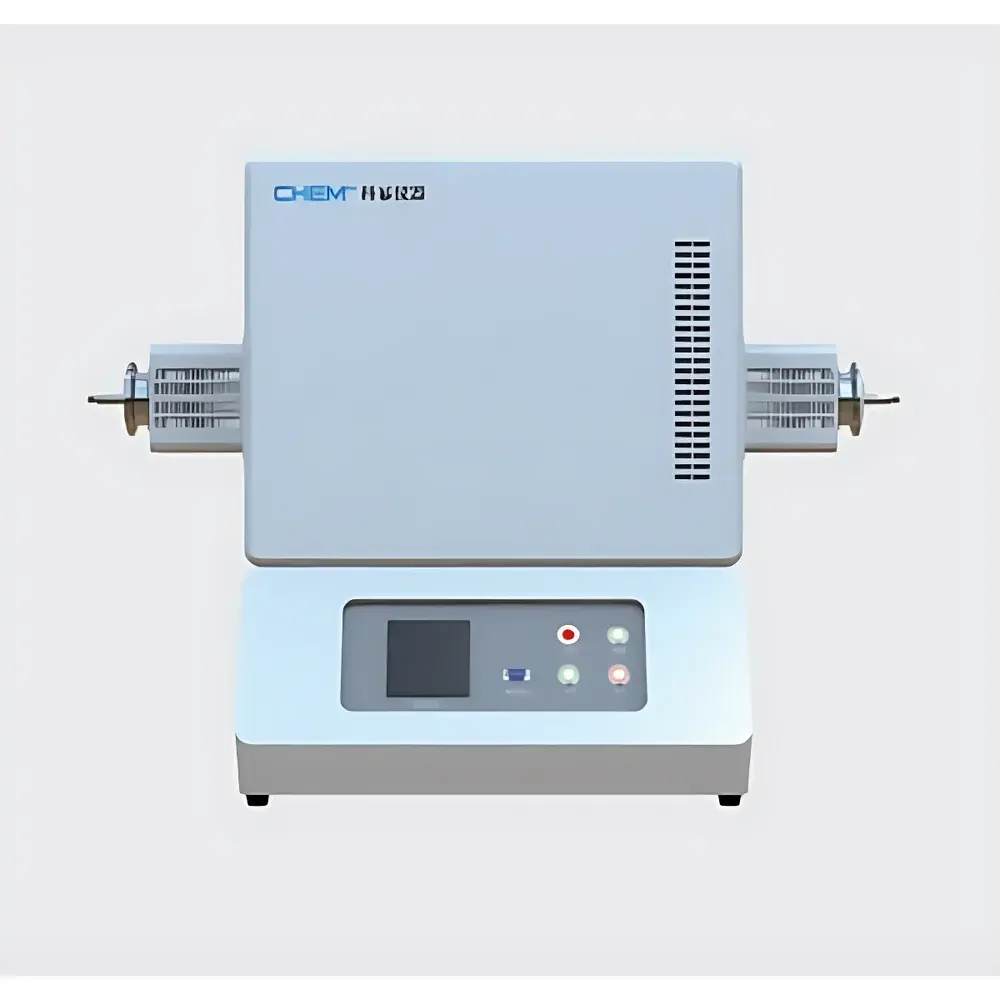
Ahkemi TFH-1700-25-290 Single-Zone High-Temperature Tube Furnace
| Brand | Ahkemi |
|---|---|
| Origin | Anhui, China |
| Model | TFH-1700-25-290 |
| Maximum Temperature | 1700 °C |
| Temperature Control Accuracy | ±1 °C |
| Heating Power | 5.5 kW |
| Heating Rate | ≤10 °C/min (≤1400 °C), ≤5 °C/min (1400–1600 °C), ≤2 °C/min (>1600 °C) |
| Heating Element | Grade-1800 Molybdenum Disilicide (MoSi₂) Rods |
| Tube Dimensions | OD 25 mm × ID 19 mm × L 1000 mm (customizable) |
| Heating Zone Length | 290 mm |
| Thermocouple Type | Type B (Platinum-Rhodium) |
| Control System | 30-Stage Programmable PID with Auto-Tuning, Touchscreen HMI (Yudian AI-3756P, 7″ color) |
| Cooling Design | Dual-layer air-cooled housing, surface temperature ≤60 °C |
| Insulation | Dual-layer high-purity polycrystalline mullite fiber vacuum-formed chamber |
| Vacuum/Atmosphere Compatibility | Equipped with quick-release flanges, needle valves, analog vacuum gauges, and standard hose ports (upgradable to KF-25 or 1/4″ VCR fittings) |
| Data Interface | USB real-time data export, optional PC software for live monitoring (separately ordered) |
Overview
The Ahkemi TFH-1700-25-290 is a precision-engineered single-zone tube furnace designed for controlled high-temperature thermal processing under inert, reducing, oxidizing, or vacuum atmospheres. Operating on the principle of resistive heating via grade-1800 molybdenum disilicide (MoSi₂) elements, it delivers stable, uniform thermal profiles up to 1700 °C—validated for short-term operation at design temperature and rated for continuous use between 800 °C and 1600 °C. Its compact footprint (820 × 500 × 760 mm) and optimized dual-layer polycrystalline mullite fiber insulation enable rapid thermal response while reducing standby heat loss by over 50% compared to conventional alumina fiber designs. The furnace meets fundamental requirements for laboratory-scale sintering, annealing, crystal growth, catalyst activation, and precursor decomposition—particularly where reproducible thermal history, atmosphere integrity, and spatial temperature homogeneity are critical.
Key Features
- Grade-1800 MoSi₂ heating elements ensure long service life, minimal resistance drift, and stable output above 1400 °C—critical for repeatable high-temperature protocols.
- 30-stage programmable PID controller (Yudian AI-3756P, 7″ color touchscreen) with auto-tuning, overshoot suppression, and real-time parameter visualization—including ramp/soak profiles, alarm status, and thermocouple health diagnostics.
- Dual-layer air-cooled stainless steel housing maintains external surface temperature ≤60 °C during full-power operation—enhancing lab safety and minimizing ambient thermal interference.
- High-integrity vacuum/atmosphere interface: Standard quick-release flanges include precision needle valves, analog Bourdon-tube vacuum/pressure gauges (0–760 Torr), and flexible hose connectors—field-upgradable to KF-25 vacuum ports or 1/4″ VCR gas inlets for integration into sealed glovebox or UHV systems.
- USB-host interface enables direct logging of time-stamped temperature, setpoint, and power data to FAT32-formatted flash drives—compatible with GLP-compliant record-keeping without proprietary software.
- Thermal chamber constructed from vacuum-formed, high-purity polycrystalline mullite fiber (Al₂O₃ ≥99.5%)—offering superior thermal shock resistance, low outgassing, and minimal particulate shedding versus traditional ceramic fiber boards.
Sample Compatibility & Compliance
The TFH-1700-25-290 accommodates cylindrical samples and reactor tubes with outer diameters of 25 mm (standard), with optional configurations supporting 30 mm, 50 mm, 60 mm, or 80 mm OD tubes—each with 1000 mm length and customizable aspect ratios. Its uniform 290 mm heating zone ensures ±2 °C axial temperature deviation across the hot zone under steady-state conditions. The furnace supports ASTM C1273 (high-temperature dimensional stability), ISO 8501-1 (surface preparation prior to coating), and USP environmental conditioning protocols when integrated with validated gas purging or vacuum pumping systems. While not pre-certified to IEC 61000-6-3 or UL 61010-1, its electrical architecture complies with CE marking requirements for laboratory equipment (EN 61010-1:2010 + A1:2013), and its control firmware implements hardware-enforced overtemperature cutoff (independent of PID loop) per functional safety principles.
Software & Data Management
The embedded controller supports local data acquisition via USB mass storage mode—no drivers required. Time-series temperature logs are saved as CSV files with millisecond-resolution timestamps, compatible with MATLAB, Python (pandas), or LabVIEW for post-hoc analysis. Optional PC-based monitoring software (sold separately) provides live graphing, remote setpoint adjustment, and alarm email/SMS notifications via SMTP or HTTP API. All data exports include metadata: operator ID (manually entered), session start time, program ID, and thermocouple calibration offset (if applied). Audit trails are maintained for all configuration changes, satisfying basic GLP traceability requirements per FDA 21 CFR Part 11 Annex 11 guidance—though electronic signatures require supplementary validation.
Applications
- Solid-state synthesis of oxide ceramics (e.g., LiCoO₂, YBCO), carbides, and nitrides under Ar/H₂/N₂ atmospheres.
- Controlled oxidation of transition metal foils for nanowire templating and interfacial engineering.
- Thermal gravimetric analysis (TGA) pre-conditioning—sample holders mounted on quartz rods within the central isothermal zone.
- Post-deposition annealing of thin-film devices (perovskite solar cells, ferroelectric capacitors) requiring precise ramp/cool cycles.
- Calibration of high-temperature reference materials (e.g., gold, palladium, and nickel fixed points) in metrology labs.
- Low-pressure chemical vapor deposition (LPCVD) precursor pyrolysis using custom quartz reaction boats.
FAQ
What atmosphere types can this furnace safely operate under?
It is rated for continuous use under high-purity argon, nitrogen, hydrogen (≤5% in N₂), forming gas (5% H₂/95% N₂), and static vacuum down to 10⁻² mbar with standard fittings—or 10⁻⁵ mbar when upgraded to KF-25 vacuum components.
Is the B-type thermocouple included and calibrated?
Yes—a dual-element Type B (Pt-30%Rh / Pt-6%Rh) thermocouple is factory-installed and verified against NIST-traceable standards; calibration certificate available upon request.
Can the furnace be integrated into an automated process line?
Yes—RS485 Modbus RTU port enables PLC-level communication for setpoint synchronization, status polling, and fault reporting; analog 4–20 mA output optional.
What maintenance is required for the MoSi₂ heating elements?
No periodic replacement is needed under normal use; however, avoid thermal cycling below 800 °C in oxidizing atmospheres to prevent accelerated pest oxidation—follow manufacturer-recommended cooldown protocols.
Does the furnace meet GMP documentation requirements?
It supports essential GMP data integrity functions (time-stamped CSV logs, user-defined session IDs, hardware alarms), but formal qualification (IQ/OQ/PQ) must be performed by the end user per their internal SOPs and regulatory jurisdiction.



