
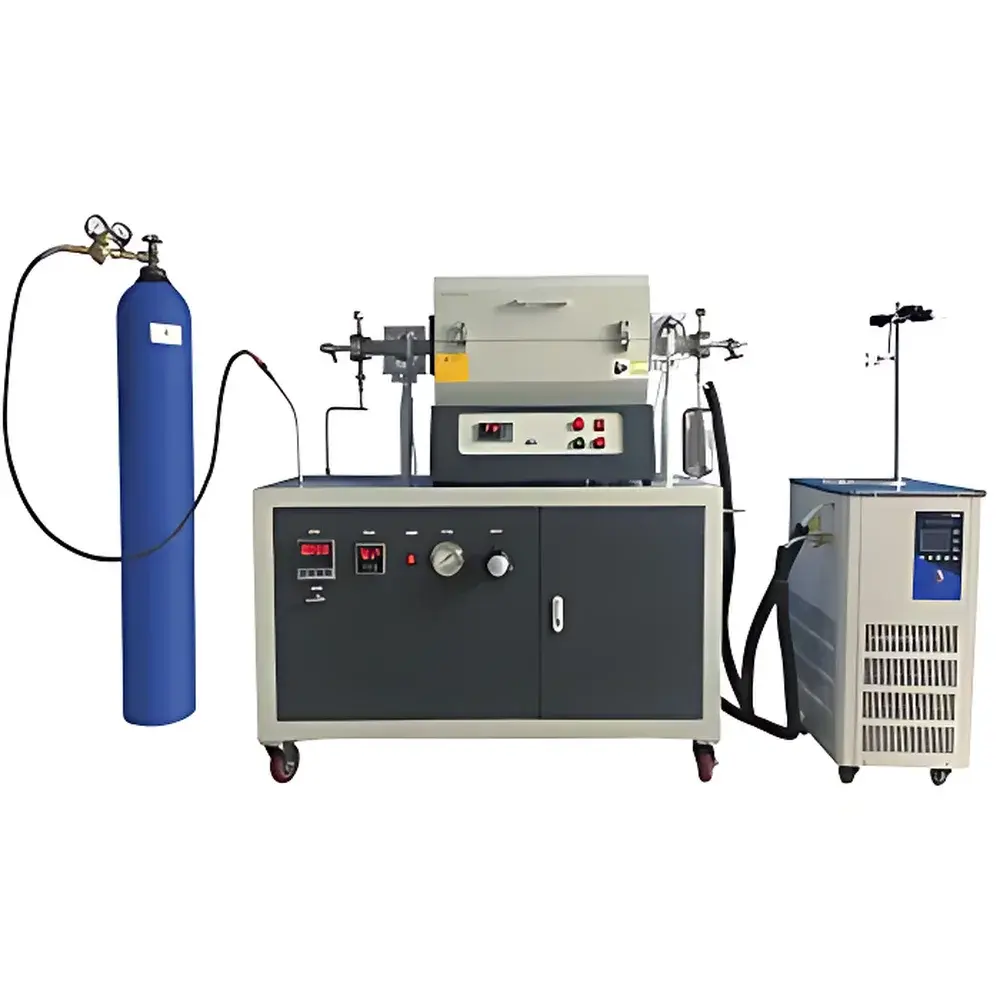
ahkemi TFP-1200-50-440 Sustainable Feedthrough High-Temperature High-Pressure Tube Furnace
| Brand | ahkemi |
|---|---|
| Origin | Anhui, China |
| Model | TFP-1200-50-440 |
| Instrument Type | High-Pressure Tube Furnace |
| Max Temperature | 1100°C |
| Temperature Control Accuracy | ±1°C |
| Max Power | 1.5 kW |
| Heating Rate (to Max Temp) | 10°C/min |
| Heating Method | Resistive Wire Heating |
| Tube Dimensions | φ50 mm OD × φ42 mm ID × 1000 mm L |
| Tube Material | GH3128 High-Temperature Alloy Steel |
| Max Internal Pressure | ≤9 MPa (derated with temperature) |
| Cooling System | Dual-layer air-cooled housing + flange-mounted axial fans |
| Insulation | High-Purity Al₂O₃ Fiber |
| Controller | PID-based with Over-Temperature & Thermocouple Break Protection |
| Optional PC Software | Real-time logging, programmable ramp/soak profiles, CSV export |
| External Dimensions | 1400 × 600 × 1200 mm |
Overview
The ahkemi TFP-1200-50-440 is an engineered high-temperature, high-pressure tube furnace designed for continuous or semi-continuous sample introduction under rigorously controlled thermal and pressure conditions. Unlike conventional static tube furnaces, this system integrates a hermetic feedthrough interface that enables sustained material feeding—solid powders, granules, or pre-formed pellets—into the hot zone while maintaining internal pressure integrity up to 9 MPa. Its operational principle relies on resistive heating of a GH3128 alloy tube housed within a dual-shell, forced-air-cooled enclosure, ensuring surface temperatures remain below 60°C during extended operation at 1100°C. The furnace complies with fundamental safety architecture requirements for pressurized thermal systems, including redundant over-temperature cutoff, thermocouple failure detection, and pressure-rated flange assemblies conforming to ASME B16.5 Class 300 standards (as applicable to custom configurations). It is intended for laboratory-scale process development in catalysis, materials synthesis, thermochemical decomposition, and gas–solid reaction kinetics where simultaneous control of temperature, pressure, residence time, and reactive atmosphere is essential.
Key Features
- Integrated sustainable feedthrough port with dynamic sealing mechanism, rated for continuous operation at ≤7 MPa and ≤500°C or ≤4 MPa and ≤750°C—enabling uninterrupted solid-phase introduction without depressurization
- Dual-layer stainless steel housing with axial cooling fans at both ends and flange junctions; external shell temperature maintained <60°C at full load, flange temperature <80°C
- High-purity alumina fiber insulation (≥99.5% Al₂O₃) minimizing radial heat loss and improving thermal uniformity across the 440 mm active heating zone
- PID temperature controller with programmable multi-segment ramp/soak profiles, real-time deviation monitoring, and hardware-enforced safety interlocks (over-temp cut-off, TC break detection)
- GH3128 alloy tube (φ50 × φ42 × 1000 mm) offering superior creep resistance above 700°C and compatibility with inert, reducing, and mildly oxidizing atmospheres
- Front-panel digital pressure display linked to a calibrated pressure transducer; integrated high-pressure mass flow controller (rated to 10 MPa, 500 SCCM) at inlet for precise gas dosing
Sample Compatibility & Compliance
The TFP-1200-50-440 accommodates solid samples ranging from fine catalyst powders (<10 µm) to cylindrical pellets (up to φ8 mm × 10 mm) via its feedthrough assembly. Gas-phase compatibility includes N₂, Ar, He, H₂, CO, CO₂, NH₃, and diluted hydrocarbon streams—provided flammability limits are not exceeded and appropriate explosion-proof auxiliary equipment (e.g., purge cabinets, vent stacks) is deployed per local safety regulations. The system meets baseline mechanical integrity requirements outlined in ISO 10297 (gas cylinder valves) and EN 13445-3 (unfired pressure vessels) for laboratory-class pressure containment. All electrical components comply with IEC 61000-6-3 (EMC emission) and IEC 61000-6-2 (immunity). When operated with optional audit-trail-enabled PC software, data acquisition satisfies GLP documentation requirements for traceable temperature/pressure history.
Software & Data Management
Optional Windows-compatible control software provides bidirectional communication with the furnace controller via RS485 or USB-to-RS485 adapter. Users can define up to 32-step temperature programs, assign dwell times and ramp rates, and log timestamped temperature, pressure, and power consumption at user-selectable intervals (1–60 s). Exported datasets are saved in CSV format with metadata headers (date, operator ID, program name, calibration offsets), supporting integration into LIMS or statistical analysis platforms. The software supports alarm logging with event timestamps and retains historical run files for ≥12 months. For regulated environments, optional 21 CFR Part 11-compliant modules are available upon request, including electronic signatures, role-based access control, and immutable audit trails.
Applications
- Catalytic reaction screening under industrially relevant pressure–temperature conditions (e.g., Fischer–Tropsch synthesis, ammonia decomposition, methane reforming)
- Thermal stability assessment of battery electrode materials, MOFs, and metal hydrides under controlled H₂ or inert overpressure
- Continuous pyrolysis or carbothermic reduction of mineral precursors with real-time off-gas analysis
- Development of pressure-assisted sintering protocols for ceramic and composite powders
- Gas–solid equilibrium studies requiring precise stoichiometric gas dosing and condensable product recovery via integrated cryogenic trap (−20°C to 98°C chiller compatible)
FAQ
Can the furnace operate continuously at 1100°C and 5 MPa simultaneously?
No. Maximum allowable pressure is temperature-dependent per ASME-referenced derating curves. At 1100°C, the safe operating limit is ≤2 MPa; at 750°C, it is ≤5 MPa; at 400°C, ≤9 MPa.
Is the GH3128 tube replaceable, and what is its typical service life?
Yes—the tube is field-replaceable using standard flange tools. Under cyclic operation (20 cycles/week, 1100°C/1 h hold), expected lifetime exceeds 18 months before creep-induced dimensional drift affects sealing integrity.
Does the system support automated gas switching between multiple inlet lines?
Not natively—but third-party 6-port high-pressure solenoid manifolds (rated to 10 MPa) can be integrated upstream of the mass flow controller with custom PLC coordination.
What certifications accompany the unit for international shipment?
CE marking (LVD + EMC directives), RoHS compliance documentation, and factory-calibrated test reports for temperature uniformity (±3°C over 400 mm zone) and pressure leak rate (<1×10⁻⁶ mbar·L/s He) are provided.
Can the feedthrough accommodate fibrous or agglomerated feedstocks?
Only with prior validation. Feedstock must exhibit free-flowing characteristics and particle size distribution D90 < 2 mm to prevent bridging; vibratory assist or screw-feed augmentation may be required for cohesive materials.



