
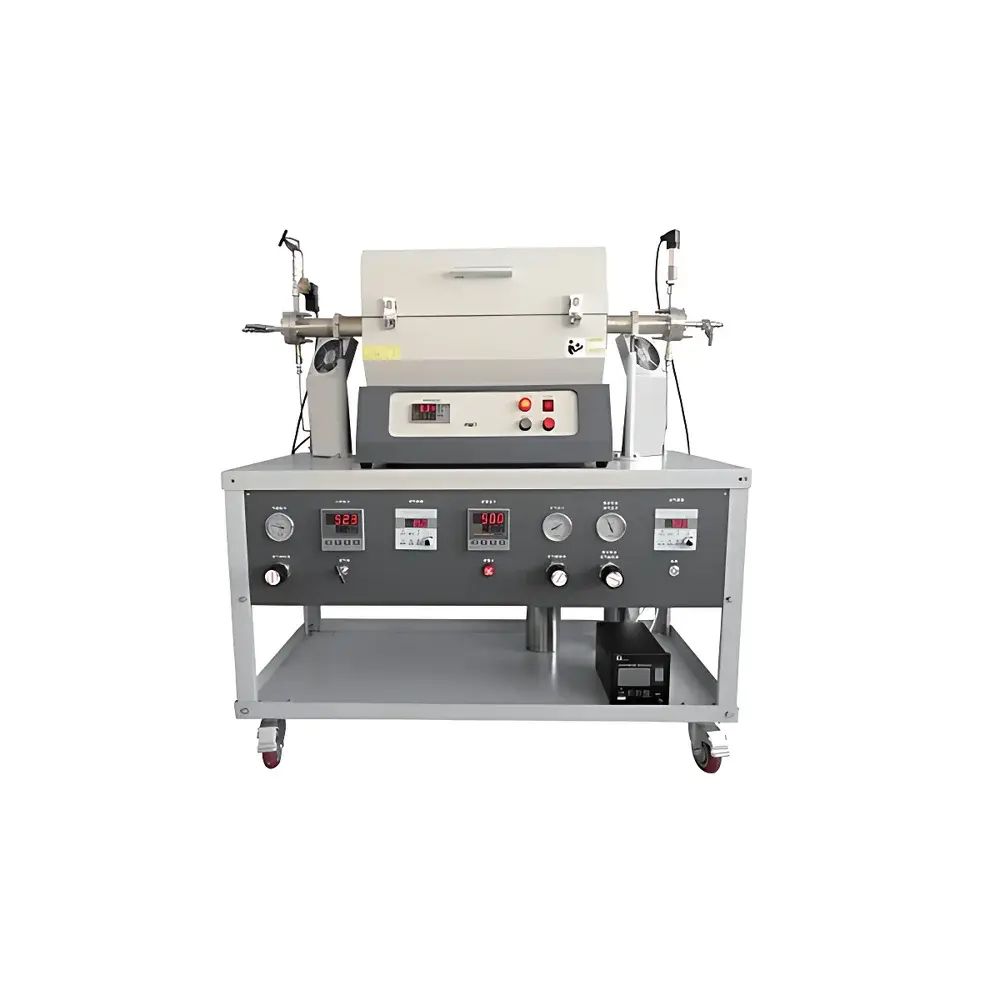
Ahkemi TFP-1200-51-I-440-NH3 High-Temperature High-Pressure Tube Furnace with Ammonia-Compatible Gas Handling System
| Brand | Ahkemi |
|---|---|
| Origin | Anhui, China |
| Model | TFP-1200-51-I-440-NH3 |
| Max. Temperature | 1000 °C |
| Temp. Control Accuracy | ±1 °C |
| Max. Power | 1.5 kW |
| Heating Rate (to max temp) | 10 °C/min |
| Heating Element | MoSi₂ (1800-grade) |
| External Dimensions | 1250 × 650 × 1330 mm |
| Tube ID/OD/Length | Ø45 / Ø51 / 1000 mm |
| Tube Material | GH202 nickel-based superalloy |
| Max. Operating Pressure | 10 MPa (≤800 °C) |
| Pressure Monitoring | Dual 0–16 MPa transducers + triple mechanical gauges |
| Gas Flow Control | Inlet MFC (0–500 sccm), Outlet MFC (0–1000 sccm) |
| Oxygen Detection | 0–1000 ppm trace O₂ analyzer (H₂-compatible) |
| Safety | High-temp solenoid valve (15 MPa rating), audible overpressure alarm, NH₃-specific exhaust scrubber |
Overview
The Ahkemi TFP-1200-51-I-440-NH3 is a purpose-engineered high-temperature, high-pressure tube furnace designed for controlled thermal processing under reactive and corrosive atmospheres—specifically optimized for ammonia (NH₃)-rich environments. Unlike standard muffle or box-type furnaces, this system integrates a pressure-rated GH202 nickel-based alloy reaction tube, precision gas delivery architecture, and real-time pressure/flow/oxygen monitoring to support thermally driven reactions such as catalytic ammonia decomposition, nitridation, metal ammine synthesis, and high-pressure pyrolysis. The furnace operates on the principle of resistive heating via dual-zone MoSi₂ elements, delivering uniform axial temperature profiles across a 440 mm active heating zone. Its vacuum-formed high-purity alumina insulation ensures thermal stability and minimizes radial gradients, while the rigid steel frame and integrated gas manifold provide structural integrity under sustained pressure loads up to 10 MPa at ≤800 °C.
Key Features
- GH202 alloy reaction tube (Ø45 mm ID / Ø51 mm OD / 1000 mm length) certified for continuous operation at ≤10 MPa below 800 °C, with derated pressure limits at elevated temperatures (5 MPa at 800–900 °C; 3 MPa at 900–1000 °C)
- Dual independent pressure monitoring: Two 0–16 MPa industrial-grade pressure transducers for inlet differential and internal tube pressure, supplemented by three calibrated mechanical Bourdon-tube gauges for redundancy and operational verification
- Automated pressure regulation and safety interlock: High-temperature-rated solenoid valve (15 MPa burst rating) linked to an audible overpressure alarm system that triggers at user-defined thresholds
- Mass flow-controlled gas handling: Inlet MFC (0–500 sccm, 0–10 MPa rated) and outlet MFC (0–1000 sccm, 0–3 MPa rated), each with digital display and analog output for external data logging
- Trace oxygen monitoring: Hydrogen-compatible electrochemical sensor with 0–1000 ppm range, 300–500 mL/min sample flow requirement, and 35–210 kPa operating pressure tolerance—critical for oxygen-sensitive NH₃ chemistry
- Integrated NH₃ abatement: Dedicated exhaust scrubber module using acid-neutralizing media to capture residual ammonia prior to venting, compliant with local occupational exposure limit (OEL) requirements
Sample Compatibility & Compliance
The TFP-1200-51-I-440-NH3 accommodates solid powders, pellets, foils, and supported catalysts within its 1000 mm-long GH202 tube. Its design conforms to fundamental mechanical integrity standards for pressurized thermal reactors, including ASME BPVC Section VIII Division 1 principles for pressure boundary assessment. While not CE-marked as a complete system, all electrical components meet IEC 61000-6-3 (EMC) and IEC 61000-6-2 (immunity) specifications. The PID temperature controller supports 30-segment programmable ramp-soak profiles and complies with ASTM E220 calibration traceability guidelines when used with NIST-traceable thermocouples. For GLP/GMP-aligned labs, the system permits manual audit trails; optional RS485/Modbus RTU interface enables integration into validated SCADA environments supporting 21 CFR Part 11 electronic record requirements.
Software & Data Management
The furnace operates via a front-panel intelligent PID controller (model YUDIAN UT550) with local setpoint programming, real-time PV/SV display, and password-protected parameter locking. Analog outputs (4–20 mA) are provided for temperature, inlet pressure, and internal pressure signals, enabling connection to third-party DAQ systems (e.g., National Instruments CompactDAQ, Keysight 34972A). Optional USB-to-RS485 adapter and custom Python-based acquisition scripts (available upon request) allow time-synchronized logging of temperature, pressure, flow, and O₂ concentration at user-defined intervals (1–60 s resolution). All logged data export in CSV format with ISO 8601 timestamps, facilitating post-run kinetic analysis and regulatory submission packages.
Applications
- Catalytic ammonia cracking for hydrogen generation studies under industrially relevant pressure-temperature conditions
- Nitride ceramic synthesis (e.g., Si₃N₄, AlN) via direct nitridation of elemental precursors in flowing NH₃
- High-pressure thermal reduction of transition metal oxides in NH₃/H₂ mixtures for nanoparticle formation
- Stability testing of ammonia storage materials (e.g., Mg(NH₂)₂–LiH composites) under dynamic pressure cycling
- In situ XRD-compatible thermal treatments where gas-tight containment and precise p–T control are mandatory
- Corrosion resistance validation of reactor alloys exposed to hot, pressurized NH₃–H₂O vapor mixtures
FAQ
What is the maximum allowable operating pressure at 950 °C?
At 950 °C, the GH202 tube is rated for ≤3 MPa per the manufacturer’s pressure–temperature derating curve. Exceeding this limit voids mechanical warranty and compromises creep resistance.
Can the system be configured for H₂S or Cl₂ atmospheres?
No—the current configuration is validated exclusively for NH₃ service. GH202 exhibits poor resistance to sulfur and chlorine species above 400 °C; alternative alloys (e.g., Inconel 625 or Hastelloy C-276) would require full requalification.
Is the oxygen analyzer certified for use with hydrogen-rich streams?
Yes—the supplied trace O₂ sensor is explicitly rated for hydrogen, helium, nitrogen, argon, and hydrocarbon carrier gases, with built-in compensation for H₂-induced signal drift.
Does the system include pressure relief protection?
It does not include an ASME-certified rupture disc or spring-loaded safety valve. Users must install external overpressure protection per local jurisdictional requirements (e.g., DIN EN ISO 4126) upstream of the inlet train.
How is calibration traceability maintained for temperature and pressure sensors?
The Type S thermocouple is supplied with a NIST-traceable calibration certificate (±0.5 °C at 1000 °C). Pressure transducers are factory-calibrated to ISO/IEC 17025-accredited standards; field recalibration is recommended annually or after 500 pressure cycles.



