
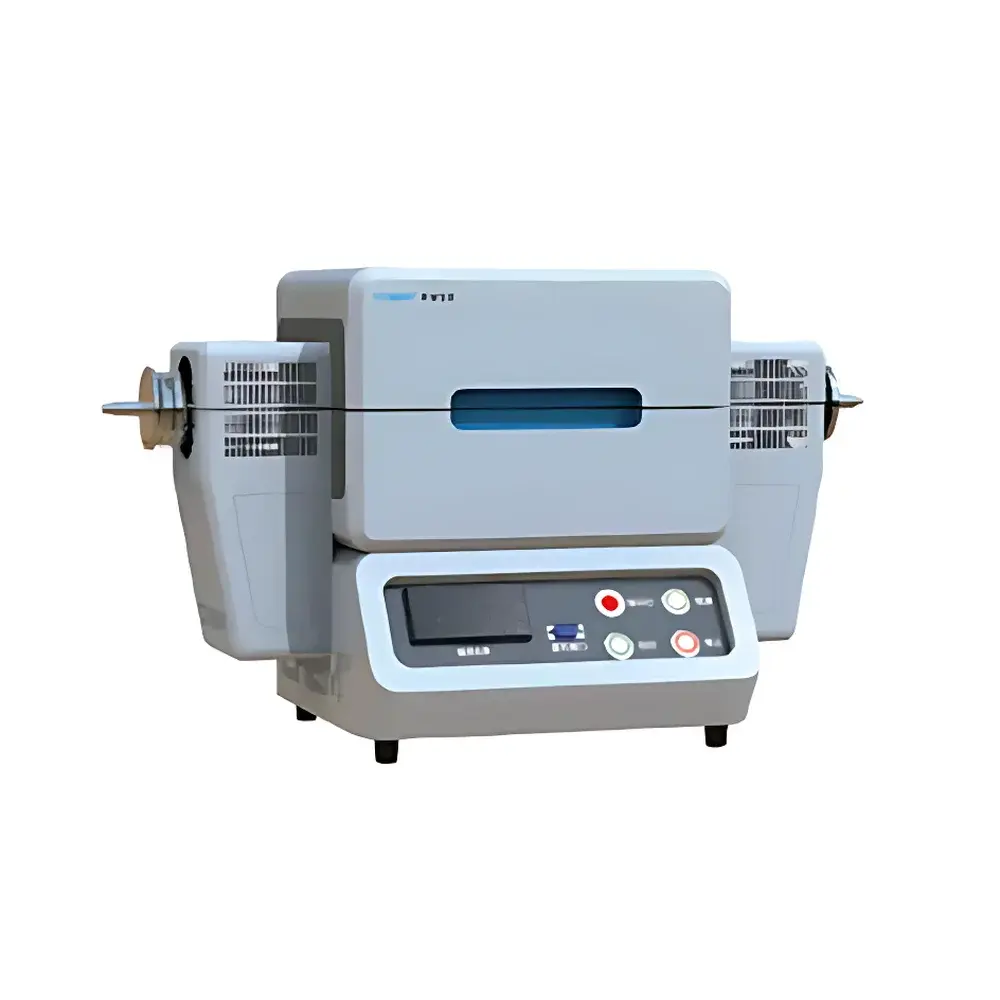
Ahkemi TFR-1200-30-I-220 Miniature Rotating Tube Furnace
| Brand | Ahkemi |
|---|---|
| Origin | Anhui, China |
| Model | TFR-1200-30-I-220 |
| Maximum Temperature | 1200 °C |
| Temperature Control Accuracy | ±1 °C |
| Rated Power | 1.5 kW |
| Heating Rate (to max temp) | ≤10 °C/min |
| Heating Method | Resistance Wire (HRE alloy) |
| Internal Chamber Dimensions | Φ80 × 220 mm |
| Tube Dimensions | Ø30 × 700 mm or Ø50 × 150 mm (customizable) |
| Heating Zone Length | 220 mm |
| Uniform Temperature Zone Length | 60 mm |
| Thermocouple Type | K-type |
| Power Supply | AC 220 V, 50/60 Hz |
| Net Weight | 20 kg |
| External Dimensions | 340 × 300 × 380 mm |
Overview
The Ahkemi TFR-1200-30-I-220 is a compact, single-zone rotating tube furnace engineered for controlled thermal processing of powdered or granular materials under inert or reactive atmospheres. Its core operational principle relies on continuous low-speed rotation of the quartz tube—driven by a precision DC motor—to induce gentle tumbling and uniform material exposure to the radial temperature gradient. This mechanical agitation eliminates sedimentation and thermal stratification, significantly enhancing heat and mass transfer during calcination, reduction, carburization, or solid-state synthesis. Designed with a dual-layer stainless steel housing and integrated forced-air cooling system, the furnace maintains stable external surface temperatures below 60 °C at maximum operating conditions, ensuring safe benchtop deployment in analytical laboratories and R&D facilities. The furnace operates within a rated temperature range of 20–1100 °C (with short-term capability up to 1200 °C), making it suitable for applications requiring precise thermal profiles without exceeding material degradation thresholds.
Key Features
- Low-speed, high-stability rotation mechanism with adjustable speed (0–15 rpm) and direction reversal capability for optimized particle mixing
- Custom-engineered asymmetric quartz tube (Ø30 × 700 mm standard; optional Ø50 × 150 mm or custom geometries) featuring internal welded lifters to promote consistent powder cascading
- High-purity HRE resistance heating elements (supplied by Shougang Group, Beijing) wound along a 220 mm heating zone, delivering uniform axial power distribution
- Dual-shell construction with air-gap insulation and rear-mounted centrifugal fan for rapid cooldown and thermal management
- Integrated K-type thermocouple embedded at the center of the heating zone, coupled with a PID-based digital controller offering ±1 °C setpoint accuracy and programmable ramp/soak cycles
- Benchtop footprint (340 × 300 × 380 mm) and lightweight design (20 kg) facilitate integration into gloveboxes, fume hoods, or modular synthesis workstations
Sample Compatibility & Compliance
The TFR-1200-30-I-220 supports processing of oxide powders, metal precursors, catalysts, battery electrode materials, and ceramic green bodies—provided they remain chemically compatible with fused quartz at elevated temperatures and under specified gas environments (e.g., N₂, Ar, H₂/N₂ mixtures). The furnace’s design conforms to general electrical safety standards IEC 61010-1 for laboratory equipment. While not certified to UL or CE as a standalone unit, its component-level compliance—including IP20-rated enclosure, overtemperature cut-off protection, and grounded chassis—supports integration into ISO/IEC 17025-accredited testing workflows. For GMP/GLP-regulated processes, optional data logging modules with time-stamped temperature records and audit trails can be configured to align with FDA 21 CFR Part 11 requirements.
Software & Data Management
The furnace is operated via a front-panel 3.5-inch TFT touchscreen interface supporting up to 30 programmable segments per thermal profile. Optional RS485 Modbus RTU communication enables remote monitoring and control through third-party SCADA or LabVIEW environments. When paired with Ahkemi’s optional TC-Link software (Windows-based), users gain access to real-time graphing, CSV export of temperature/time data, deviation alerts, and automated report generation—including calibration certificate templates compliant with ISO/IEC 17025 clause 7.8.2. All logged datasets retain metadata such as operator ID, ambient conditions, and firmware version—critical for traceability in quality-controlled material development.
Applications
- Controlled atmosphere calcination of Li-ion cathode precursors (e.g., Ni-rich NMC, LFP) with improved phase homogeneity
- Thermal decomposition studies of metal-organic frameworks (MOFs) and coordination polymers under dynamic flow conditions
- Reductive annealing of metal oxide nanoparticles for catalytic activity enhancement
- Solid-state reaction kinetics evaluation in multi-component ceramic systems (e.g., PZT, BaTiO₃)
- Pre-sintering of 3D-printed ceramic green bodies to remove binders prior to final densification
- Small-batch thermal treatment of heterogeneous catalysts under flowing gas streams with in situ rotational mixing
FAQ
What is the maximum recommended continuous operating temperature?
The furnace is rated for continuous operation at 1100 °C; 1200 °C is permissible for short-duration thermal treatments (<30 minutes) only.
Can the rotation speed be synchronized with temperature ramping?
Yes—the optional TC-Link software allows conditional logic linking rotation activation/deactivation to specific temperature thresholds or time intervals within a program.
Is the quartz tube resistant to HF or halogen-containing atmospheres?
No—standard fused quartz exhibits significant corrosion in HF, Cl₂, or Br₂ environments above 300 °C; alternative alumina or SiC tubes are recommended for such chemistries.
Does the furnace support vacuum operation?
It is designed for positive-pressure inert gas flow (typically 50–200 sccm); vacuum compatibility requires retrofitting with a vacuum-rated flange kit and a separate diffusion pump system—not included in standard configuration.
How often should the thermocouple be recalibrated?
Annual verification against a NIST-traceable reference source is advised; drift exceeding ±2 °C warrants replacement or professional recalibration.



