
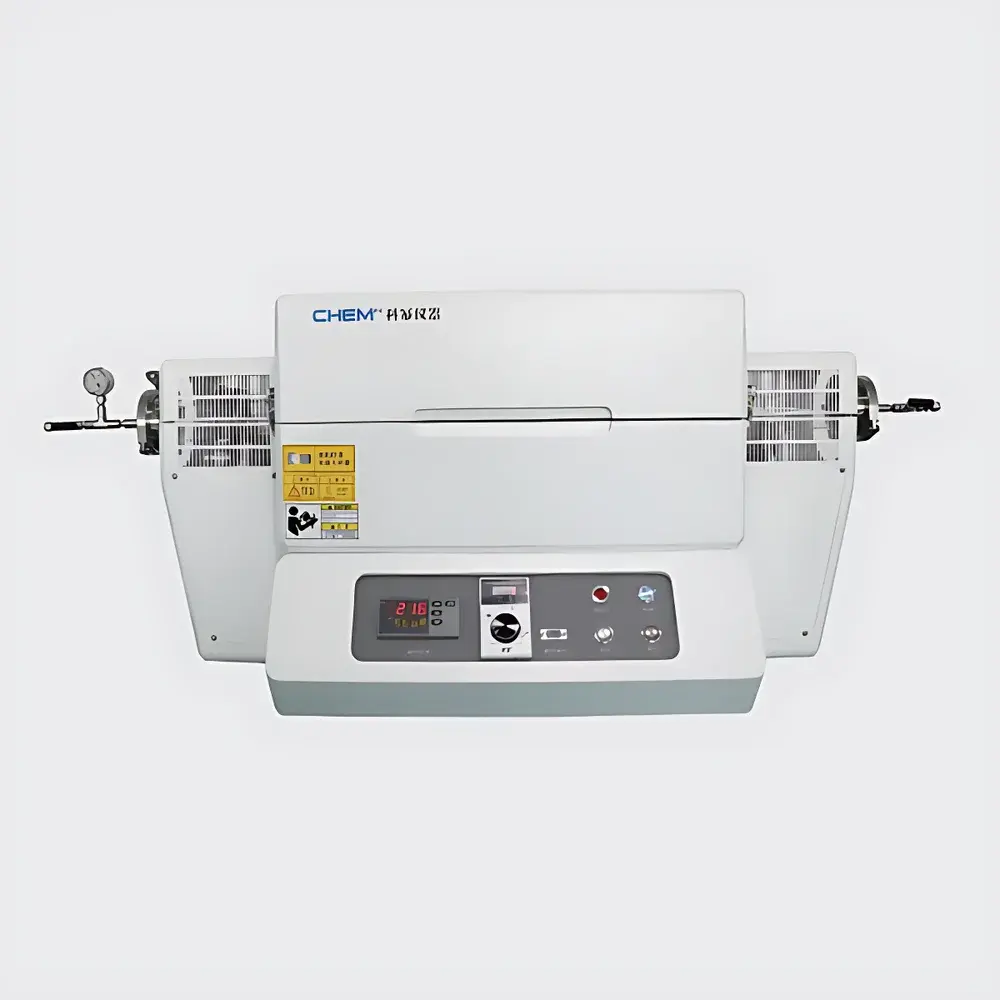
Ahkemi TFR-1200-60-I-440 Laboratory-Scale Rotating Tube Furnace
| Brand | Ahkemi |
|---|---|
| Origin | Anhui, China |
| Model | TFR-1200-60-I-440 |
| Maximum Temperature | 1200 °C |
| Rated Operating Temperature | 1100 °C |
| Temperature Control Accuracy | ±1 °C |
| Heating Zone Length | 440 mm |
| Tube Dimensions | φ60 mm or φ100 mm × 1000 mm (custom-shaped) |
| Rotation Speed Range | 0–10 rpm (adjustable) |
| Power Rating | 3 kW |
| Heating Method | Resistance Wire Heating |
| External Dimensions | 880 × 420 × 520 mm |
| Net Weight | 50 kg |
| Cooling System | Dual-layer forced-air cooling |
| Surface Temperature at Max Temp | ≤60 °C |
| Control System | Fuzzy PID with auto-tuning + 30-segment programmable ramp-soak profile |
| Safety Features | Over-temperature alarm, thermocouple break detection, emergency stop button |
| Vacuum/Atmosphere Compatibility | Yes (via 316L stainless steel flanges, vacuum gauge, needle valve, and flexible hose fittings) |
| Insulation Material | High-purity alumina microcrystalline fiber, vacuum-formed |
| Power Supply | AC 220 V, 50/60 Hz |
Overview
The Ahkemi TFR-1200-60-I-440 is a laboratory-scale rotating tube furnace engineered for controlled thermal processing under inert, reducing, oxidizing, or vacuum atmospheres. Its core design integrates precise temperature regulation with continuous rotational motion of the reaction tube—enabling uniform heat transfer, enhanced mass transport, and improved homogeneity in solid-state reactions, catalyst activation, powder sintering, and precursor decomposition. The furnace employs resistive heating via high-stability resistance wire elements symmetrically arranged parallel to the quartz tube axis, ensuring radial and axial thermal uniformity across the 440 mm active heating zone. The furnace chamber is constructed from high-purity alumina microcrystalline fiber formed under vacuum, offering low thermal conductivity, high structural integrity at elevated temperatures, and minimal outgassing—critical for reproducible process outcomes in research and development environments.
Key Features
- Rotational capability (0–10 rpm, continuously adjustable) ensures consistent mixing and exposure of solid samples to uniform thermal gradients, minimizing thermal stratification and promoting complete reaction conversion.
- Dual-layer forced-air cooling system maintains external shell surface temperature at ≤60 °C even during extended operation at 1200 °C—enhancing operator safety and enabling benchtop integration without auxiliary cooling infrastructure.
- Fuzzy PID temperature controller with self-tuning algorithm delivers stable setpoint tracking and rapid recovery from load-induced disturbances; supports up to 30 programmable ramp-hold segments for complex thermal profiles.
- High-integrity vacuum/atmosphere interface includes 316L stainless steel flanges, precision needle valves, analog mechanical vacuum gauges (0–760 Torr), and chemically resistant silicone/viton hose fittings—compatible with standard vacuum pumps and gas manifolds.
- Quartz reaction tube (φ60 mm or φ100 mm × 1000 mm, custom geometry available) provides optical transparency for in-situ observation and excellent thermal shock resistance; compatible with most non-hydrofluoric acid chemistries.
- Integrated safety architecture includes over-temperature cutoff, thermocouple failure detection, and a front-panel emergency stop switch—meeting baseline requirements for GLP-compliant laboratory equipment operation.
Sample Compatibility & Compliance
The TFR-1200-60-I-440 accommodates powdered, granular, pelletized, and fibrous samples within its rotating quartz tube. It supports batch processing of materials including metal oxides, battery cathode precursors, ceramic powders, supported catalysts, and MOF derivatives. The furnace complies with general electrical safety standards (IEC 61010-1) and thermal equipment best practices for academic and industrial R&D labs. While not certified to UL or CE as a complete system, its component-level design—including Class H insulation, grounded chassis, and fail-safe interlocks—aligns with ISO/IEC 17025 environmental condition monitoring expectations. Vacuum operation down to 10−2 mbar is achievable using standard two-stage rotary vane pumps; optional digital pressure controllers and residual gas analyzers may be integrated for advanced process validation.
Software & Data Management
The embedded controller logs real-time temperature, setpoint, and alarm status to internal non-volatile memory (retains ≥10,000 data points). Optional RS485 Modbus RTU interface enables connection to SCADA systems or third-party DAQ platforms (e.g., LabVIEW, MATLAB, Ignition) for automated data acquisition, remote parameter adjustment, and audit-trail generation. When deployed in regulated environments, the system supports manual documentation workflows aligned with FDA 21 CFR Part 11 principles—though full electronic signature compliance requires external validation of connected software layers. All thermal profiles are exportable in CSV format for post-run analysis and reporting.
Applications
- Thermal decomposition and calcination of lithium-ion battery cathode materials (e.g., NMC, LFP precursors)
- Controlled oxidation/reduction of transition metal catalysts under flowing gas atmospheres
- Synthesis of doped semiconductor nanoparticles via carbothermal reduction
- Heat treatment of metal-organic frameworks (MOFs) for porosity tuning and activation
- Uniform annealing of thin-film-coated substrates mounted on rotating fixtures
- Gravimetric studies of volatile loss kinetics using coupled thermobalance configurations
FAQ
What is the maximum recommended continuous operating temperature?
The rated continuous operating temperature is 1100 °C; 1200 °C is permissible for short-term (<2 h) calibration or process qualification runs.
Can the furnace operate under positive pressure?
Yes—when equipped with appropriate pressure-rated quartz tubing and reinforced flange seals, it supports pressures up to 0.5 bar(g); consult factory for pressure-rated configuration options.
Is the rotation speed synchronized with temperature ramping?
No—the rotation speed is manually or externally controlled independently of thermal programming, allowing decoupled optimization of kinetic and mixing parameters.
What thermocouple type is used, and where is it located?
A Type K thermocouple is embedded in the furnace wall adjacent to the heating zone centerline, providing direct measurement of chamber ambient temperature—not tube surface temperature.
Does the system include vacuum pump or gas flow controllers?
No—these are field-installed accessories; the furnace provides standardized ports and mounting interfaces compatible with commercial vacuum and mass flow control hardware.



