
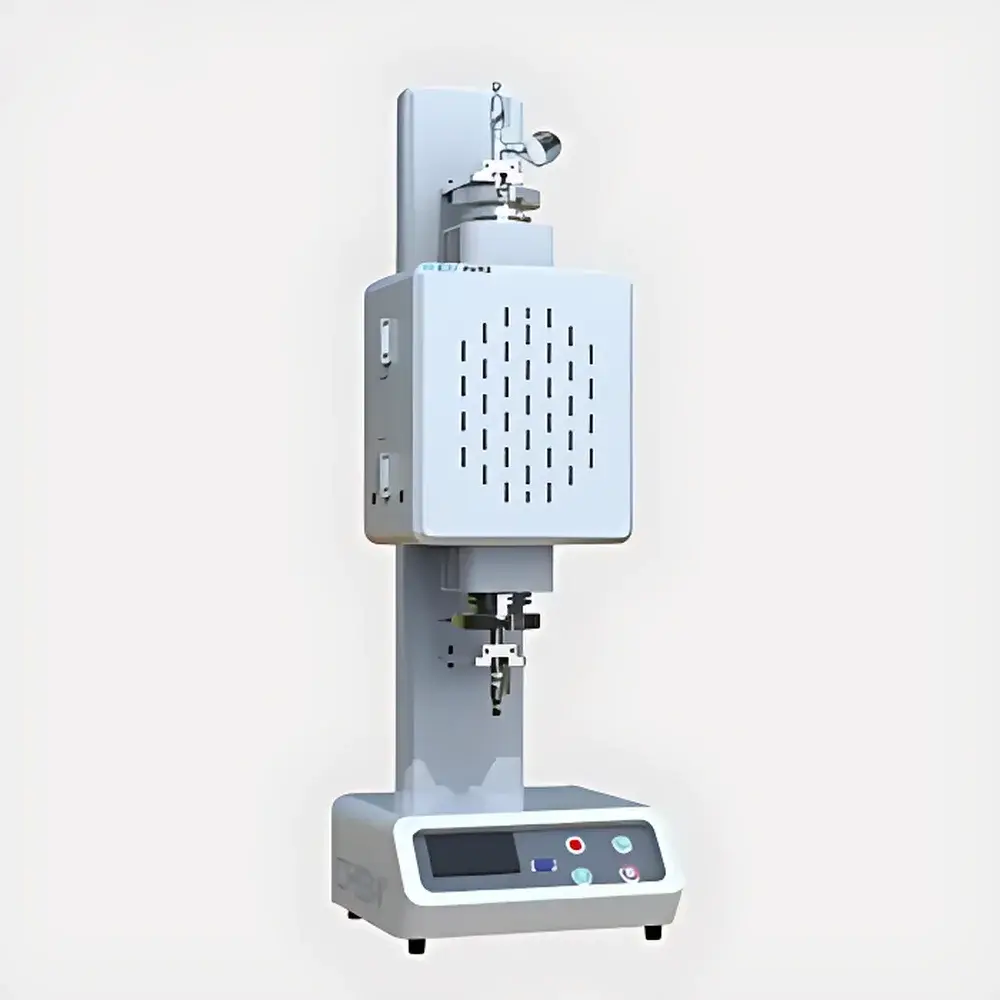
Ahkemi TFV-1200-50-I-220 Vertical Mini Tube Furnace
| Brand | Ahkemi |
|---|---|
| Origin | Anhui, China |
| Model | TFV-1200-50-I-220 |
| Max Temperature | 1200 °C |
| Temperature Control Accuracy | ±1 °C |
| Rated Power | 1.5 kW |
| Max Heating Rate (to 1200 °C) | ≤10 °C/min |
| Heating Element | Molybdenum-doped Fe-Cr-Al Alloy |
| Internal Chamber Dimensions | 340 × 300 × 1200 mm |
| Tube Diameter Options | Φ30 mm or Φ50 mm |
| Tube Length | 500 mm |
| Heating Zone Length | 200 mm |
| Thermocouple Type | K-type |
| Voltage/Frequency | AC 220 V, 50/60 Hz |
| Net Weight | 24 kg |
Overview
The Ahkemi TFV-1200-50-I-220 is a compact, vertically oriented open-type tube furnace engineered for precise thermal processing under controlled atmospheres—including inert gas, reducing gas, vacuum, or reactive gas environments. Its design integrates fundamental principles of conductive and radiative heat transfer within a vertically aligned cylindrical geometry, enabling uniform axial temperature distribution across the 200 mm active heating zone. Unlike conventional horizontal tube furnaces, this vertical configuration facilitates gravity-assisted sample handling—ideal for suspension-based thermal treatments such as fluidized-bed chemical vapor deposition (CVD), rapid thermal annealing, and quenching protocols requiring vertical sample insertion and extraction. The furnace operates up to 1200 °C (short-term) with a rated working temperature of 1100 °C, making it suitable for ceramic sintering, catalyst activation, thin-film synthesis, and high-temperature material characterization in academic laboratories and R&D facilities.
Key Features
- Open-frame vertical architecture with top- and bottom-flanged support platforms for rapid furnace tube exchange and in-situ process adaptation
- High-purity alumina fiber insulation lining ensuring low thermal mass, fast thermal response, and minimal energy loss
- Molybdenum-doped Fe-Cr-Al heating elements offering extended service life at elevated temperatures and resistance to oxidation in air or inert atmospheres
- Intelligent 30-segment programmable PID temperature controller with K-type thermocouple feedback loop and real-time ramp/soak profiling
- Dual-tube diameter compatibility (Φ30 mm and Φ50 mm quartz tubes) supporting both small-batch sample processing and expanded fluidized-bed configurations
- Integrated flange ports for gas inlet/outlet, vacuum connection, and optional thermocouple feedthrough—fully compatible with standard Swagelok and VCR fittings
Sample Compatibility & Compliance
The TFV-1200-50-I-220 supports diverse sample formats: solid rods, crucibles, powder beds, and suspended particulates. When configured with a fused silica sand core (5–15 µm pore size) inserted into the quartz tube, the system functions as a vertical fluidized-bed reactor—enabling homogeneous gas–solid interaction during CVD or surface modification experiments. All structural materials comply with RoHS Directive 2011/65/EU. The furnace meets general safety requirements per IEC 61010-1:2010 for laboratory electrical equipment. While not certified for Class I Div 1 hazardous locations, its sealed flange interfaces and optional purge monitoring make it appropriate for use in ISO 14644-1 Class 7 cleanrooms when integrated with external gas cabinets and exhaust scrubbers.
Software & Data Management
The embedded PID controller includes USB and RS485 communication interfaces for integration with third-party data acquisition systems (e.g., LabVIEW, MATLAB, or custom SCADA). Temperature profiles, ramp rates, soak durations, and real-time deviation logs are exportable in CSV format. Optional firmware upgrade enables audit-trail functionality compliant with GLP and GMP documentation standards—recording operator ID, timestamped setpoint changes, and thermal excursion alerts. No proprietary software license is required; configuration is performed via intuitive front-panel navigation or ASCII command protocol over serial link.
Applications
- Chemical vapor deposition (CVD) of metal oxides, nitrides, and carbides on nanoparticle substrates using fluidized-bed geometry
- Controlled-atmosphere sintering of advanced ceramics (e.g., Al2O3, ZrO2, SiC) and battery electrode materials
- Thermal annealing of 2D materials (graphene, MoS2) and semiconductor heterostructures
- Decomposition kinetics studies of metal-organic frameworks (MOFs) and coordination polymers
- Rapid thermal processing (RTP) for phase transformation analysis and grain growth inhibition
- Quenching experiments requiring vertical sample drop through controlled thermal gradients
FAQ
What tube materials are compatible with this furnace?
Standard operation uses high-purity fused silica (quartz) tubes rated to 1100 °C in oxidizing atmospheres. For higher-temperature inert or reducing conditions, recrystallized alumina or molybdenum tubes may be used—subject to mechanical mounting verification.
Can the furnace operate under vacuum?
Yes—equipped with standard CF-35 or KF-25 vacuum flanges (optional); maximum recommended vacuum level is 10−2 mbar using a two-stage rotary vane pump.
Is the heating zone length adjustable?
No—the 200 mm heating zone is fixed by element winding geometry; however, axial positioning of samples relative to the zone center can be fine-tuned using custom graphite or ceramic sample holders.
Does the system include gas flow control?
Gas mass flow controllers (MFCs) and mixing manifolds are not included but are fully compatible via standardized 1/4″ NPT or Swagelok connections on the base flange.
What maintenance is required for long-term stability?
Annual inspection of heating element continuity, thermocouple calibration traceability (per ISO/IEC 17025), and replacement of degraded alumina fiber insulation—typically after ~5,000 cumulative hours at ≥1000 °C.



