
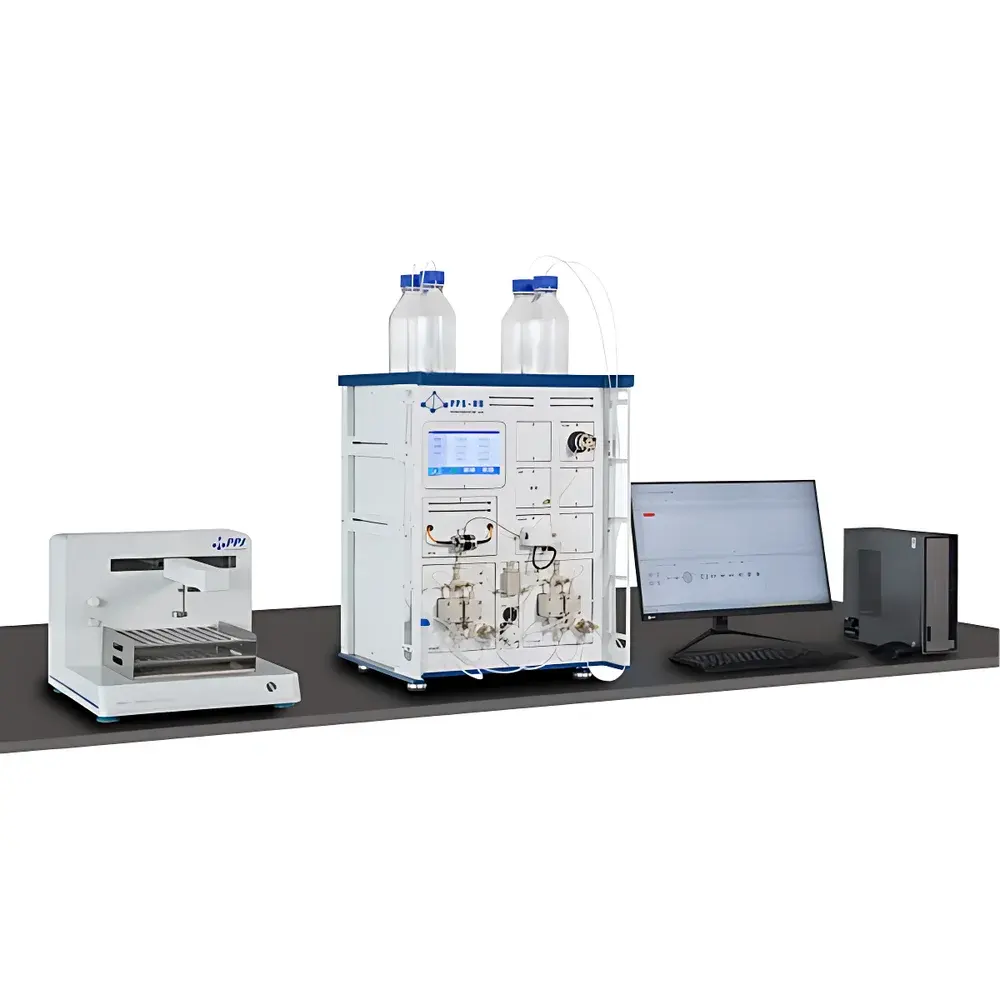
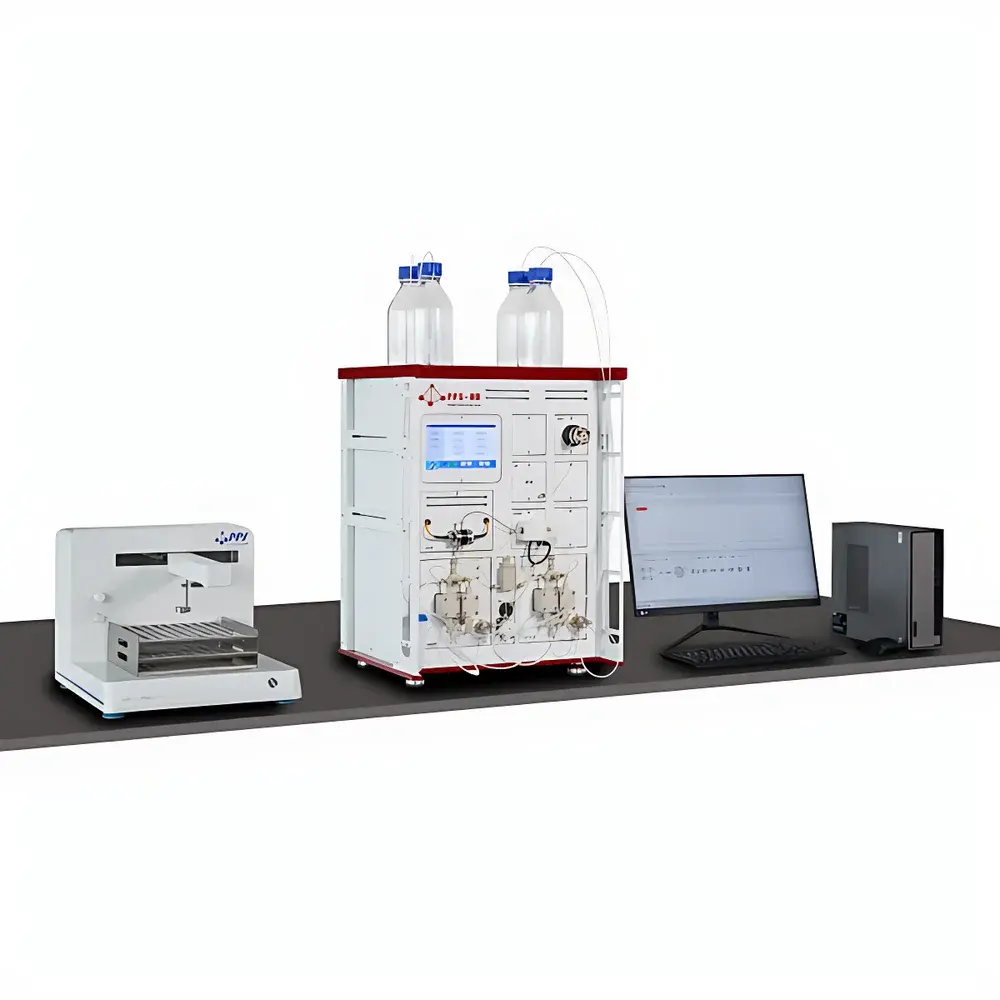
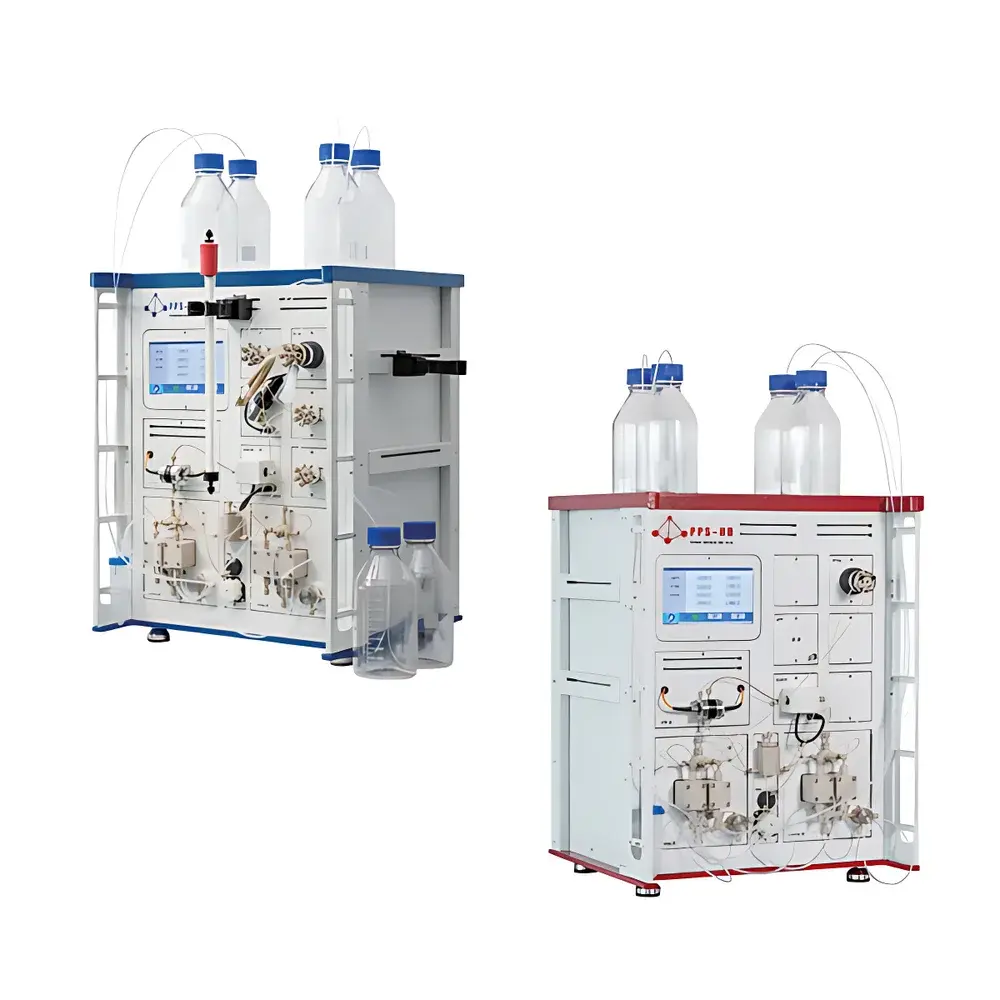
AICHUN PPS-HD Modular Protein Purification System
| Brand | AICHUN |
|---|---|
| Origin | Zhejiang, China |
| Model Variants | PPS-10HD, PPS-100HD, PPS-PilotHD |
| Pump Flow Ranges | 0.001–10 mL/min (PPS-10HD), 0.01–100 mL/min (PPS-100HD), 1–400 mL/min (PPS-PilotHD) |
| Max Pressure | 20 MPa (PPS-10HD), 10 MPa (PPS-100HD), 2 MPa (PPS-PilotHD) |
| UV Detection | 200–400 nm (standard), up to 800 nm (optional) |
| Conductivity Range | 0.00–1000.00 mS/cm |
| Gradient Accuracy | ±0.6% to ±2% (model-dependent) |
| System Dimensions (W×H×D) | 482 × 661 × 432 mm |
| Weight | ≤65 kg (fully configured) |
| Power | 100–240 VAC, 50/60 Hz |
| Compliance | Audit Trail-enabled PPSN Software (21 CFR Part 11 ready) |
Overview
The AICHUN PPS-HD Modular Protein Purification System is an engineered platform for high-fidelity, scalable chromatographic purification of recombinant proteins, peptides, oligonucleotides, polysaccharides, viral vectors, and small-molecule natural products. Built on a dual-pump, low-dead-volume fluidic architecture, the system operates on the principle of gradient-elution liquid chromatography—utilizing precise solvent blending, real-time UV absorbance (280 nm primary), conductivity, pH, and temperature monitoring to resolve target biomolecules from complex feedstocks. Its modular hardware design enables seamless adaptation across discovery-scale micro-preparative workflows (PPS-10HD), mid-scale process optimization (PPS-100HD), and pilot-scale GMP-aligned production (PPS-PilotHD). All models integrate biocompatible wetted materials—including PEEK, titanium, and sapphire—ensuring chemical resistance to common aqueous and organic mobile phases (e.g., acetonitrile, isopropanol, guanidine HCl, urea, and low-pH buffers). The system’s compact footprint (482 × 661 × 432 mm) supports benchtop deployment or integration into 4°C cold rooms—critical for thermolabile samples such as monoclonal antibodies, enzymes, and extracellular vesicles.
Key Features
- Modular front-access architecture: All valves, detectors, and column manifolds are mounted on the instrument’s frontal panel for intuitive maintenance, tubing replacement, and flow-path reconfiguration without disassembly.
- Three-tier scalability: PPS-10HD (0.001–10 mL/min, 20 MPa), PPS-100HD (0.01–100 mL/min, 10 MPa), and PPS-PilotHD (1–400 mL/min, 2 MPa) share identical control logic, software interface, and detector compatibility—enabling method transfer from lab to pilot scale with minimal revalidation.
- High-precision dual plunger pumps: Volumetric accuracy ±1.0% (PPS-10HD/PPS-100HD) and ±1.5% (PPS-PilotHD); repeatability RSD < 0.5% under standard operating conditions (viscosity 0.8–2 cP, pressure < 3 MPa).
- Low-bandwidth fluidics: Total delay volume from UV cell to fraction collector is 300 µL (UV-to-outlet) and 500 µL (system-wide), minimizing peak dispersion and preserving resolution during fast gradients or narrow peaks.
- Multi-parameter real-time detection: Simultaneous UV (200–400 nm, optional 200–800 nm), conductivity (0.00–1000.00 mS/cm), pH (0.00–14.00), temperature (0–99°C), and pressure (0–20 MPa) monitoring with calibrated, traceable sensors.
- Audit-ready PPSN software: Compliant with ALCOA+ principles; includes electronic signatures, full audit trail (user actions, method changes, run logs), and exportable raw data in vendor-neutral formats (CSV, ASCII) for third-party analysis.
Sample Compatibility & Compliance
The PPS-HD system accommodates diverse sample matrices—from clarified E. coli lysates and mammalian cell culture supernatants to plasma-derived fractions and synthetic oligonucleotide crude mixtures. Its biologically inert flow path tolerates pH 1–13, solvents including 100% acetonitrile and 70% isopropanol, and chaotropic agents up to 8 M urea or 6 M guanidine hydrochloride. Regulatory readiness is embedded at the firmware and software levels: PPSN supports 21 CFR Part 11-compliant user access controls (role-based permissions), electronic signature capture, and immutable audit logs required for GLP and GMP environments. While not pre-certified, the system meets foundational requirements for ISO 13485-aligned workflows and aligns with ICH Q5A (viral clearance), USP (analytical instrument qualification), and ASTM E2500-13 (risk-based qualification of laboratory equipment).
Software & Data Management
PPSN software provides a deterministic, non-programming interface for method development, execution, and post-run analysis. Users define gradient profiles, collection triggers (time-, UV-threshold-, or conductivity-based), and calibration sequences via drag-and-drop graphical editors—not code. All methods store metadata (operator ID, timestamp, instrument serial number, versioned firmware/software build), enabling full traceability. Raw chromatograms are saved with embedded detector calibration coefficients and sensor drift corrections. Data exports support CSV, PDF reports, and XML metadata schemas compatible with LIMS and ELN platforms. Optional secure remote access allows off-site monitoring via TLS-encrypted web interface—subject to institutional firewall policies and network segmentation requirements.
Applications
- Recombinant protein purification: Affinity (Ni-NTA, Protein A), ion exchange (IEX), size exclusion (SEC), and hydrophobic interaction (HIC) chromatography for mAbs, Fc-fusions, and enzyme variants.
- Oligonucleotide and mRNA process development: Desalting, polishing, and analytical SEC of antisense oligos, siRNA, and lipid nanoparticle (LNP)-encapsulated mRNA.
- Viral vector purification: AAV and lentivirus capture and intermediate polishing using affinity ligands (e.g., AVB Sepharose) or ion-exchange resins under controlled shear and temperature.
- Natural product isolation: Fractionation of plant extracts, microbial metabolites, or marine-derived compounds using reverse-phase or normal-phase gradients.
- Method scouting and DoE studies: Rapid parallel screening of resin types, buffer compositions, and gradient slopes with automated fraction collection and UV peak integration.
FAQ
What regulatory standards does the PPS-HD system support?
The PPS-HD system—with PPSN software enabled—is designed to meet core elements of 21 CFR Part 11, including audit trails, electronic signatures, and role-based access control. It supports IQ/OQ documentation templates aligned with USP and can be integrated into GLP/GMP quality systems with site-specific validation protocols.
Can I upgrade my PPS-10HD to PPS-100HD functionality?
Hardware upgrades (pumps, valves, pressure sensors) are possible within the same chassis; however, pressure-rated components (e.g., pump heads, tubing, fittings) must be replaced to accommodate higher flow rates and lower maximum pressures. Consult AICHUN Technical Support for retrofit feasibility and qualification requirements.
Is the UV detector compliant with pharmacopeial absorbance linearity requirements?
Yes—the DET-HD-M detector demonstrates ±2% linearity over 0–2 AU (280 nm, 2 mm pathlength), satisfying USP and EP 2.2.25 specifications for quantitative protein analysis.
How is system suitability verified before a critical purification run?
PPSN includes built-in system suitability tests: pump precision (RSD), gradient accuracy (±% B), UV noise/drift, and conductivity baseline stability. Automated reports compare results against pre-defined acceptance criteria and flag deviations prior to method execution.
What maintenance intervals are recommended for long-term reliability?
Daily: Purge pumps and flush flow cells with water/methanol. Weekly: Inspect tubing for cracks, replace inlet filters, verify sensor calibrations. Annually: Replace pump seals, recalibrate all detectors, and perform full pressure leak test per ISO 13485 Annex C guidelines.



