
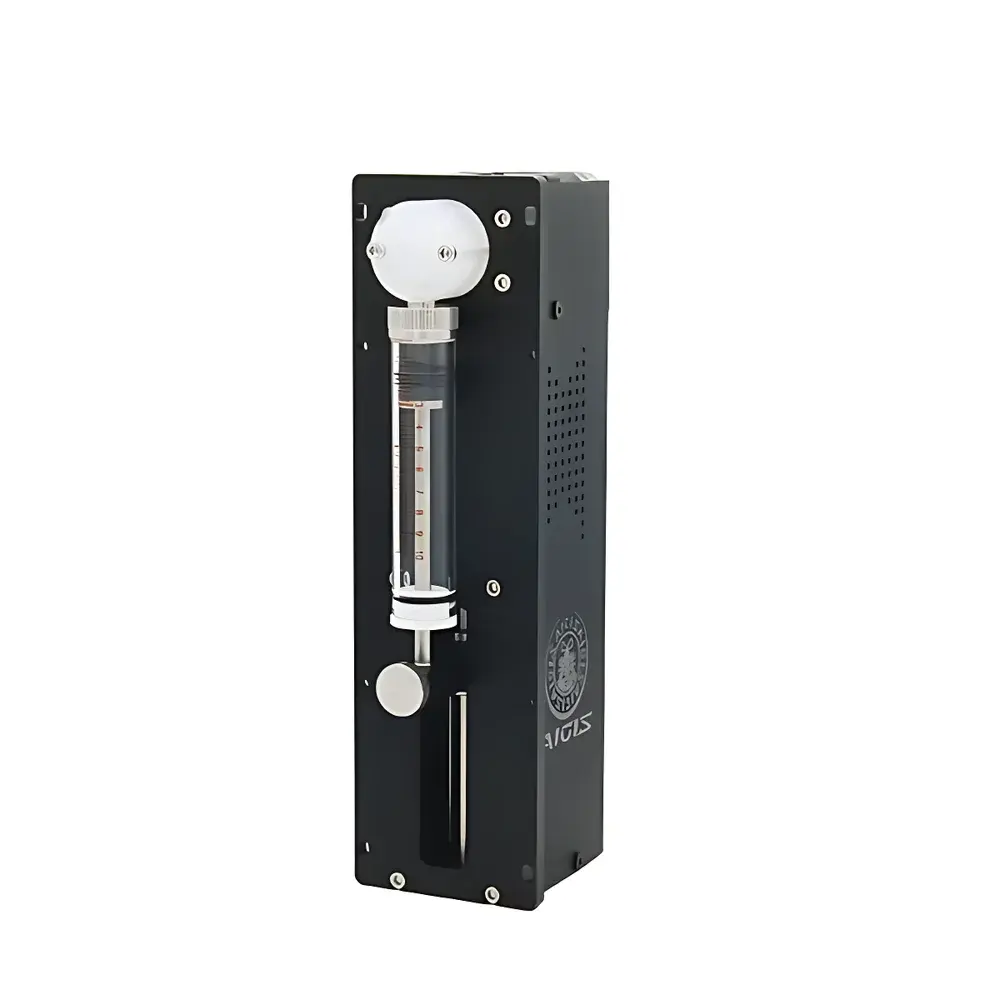
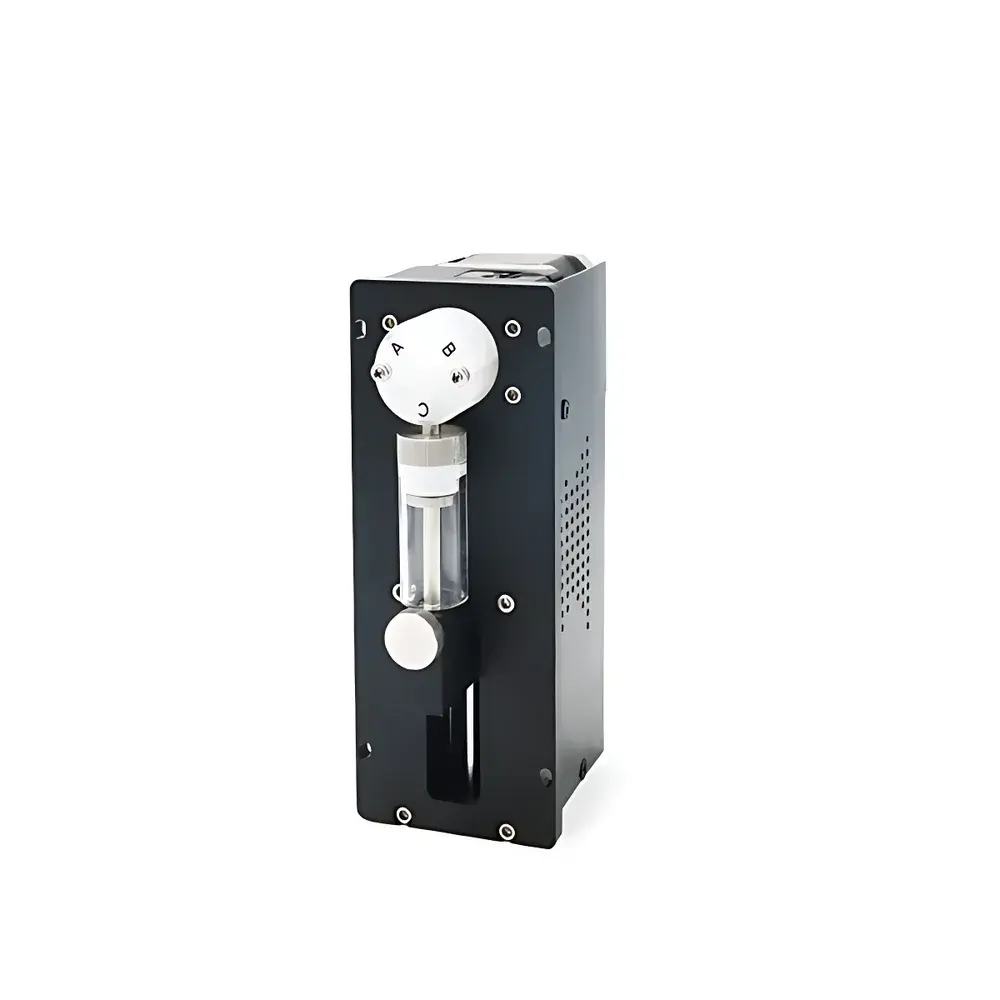
AIGIS AGS-PB03-PT-L10-S-C Industrial Syringe Pump
| Brand | AIGIS |
|---|---|
| Origin | Fujian, China |
| Manufacturer Type | Original Equipment Manufacturer (OEM/ODM) |
| Product Category | Domestic |
| Model | AGS-PB03-PT-L10-S-C |
| Instrument Type | Industrial Syringe Pump |
| Interface Configuration | 2/3/6/8/10/12-channel |
| Port Thread | 1/4-28 UNF internal |
| Wetted Materials | Borosilicate Glass (syringe), Ceramic, PEEK, PPS, PCTFE, PVDF, PFA |
| Accuracy | ≤1% of full stroke |
| Precision (Repeatability) | 0.3–0.5% of full stroke |
| Rated Stroke | 30 mm (3778 steps) / 60 mm (7556 steps) |
| Minimum Step Resolution | 0.0079 mm/step |
| Full-Stroke Operation Time Range | 5–1200 s |
| Valve Switching Time | ≤250 ms |
| Maximum Fluidic Pressure Rating | 0.7 MPa |
| Power Supply | DC 24 V / 3 A |
| Communication Interfaces | RS232, RS485 |
| Operating Temperature | 5–55 °C |
| Operating Humidity | ≤95% RH (non-condensing) |
Overview
The AIGIS AGS-PB03-PT-L10-S-C is an industrial-grade multi-channel syringe pump engineered for high-reliability, long-duration fluid delivery in automated laboratory and process environments. It operates on a precision stepper motor-driven linear actuation principle, translating digital step commands into controlled plunger displacement within calibrated syringes. Unlike peristaltic or piston-based positive displacement pumps, this system delivers volumetric accuracy through direct mechanical coupling between the motor and syringe plunger—eliminating compressibility errors and slip-related drift common in elastomeric tubing systems. Its architecture supports synchronized or independent control of up to 12 fluidic channels, making it suitable for complex reagent dispensing, gradient generation, sequential injection, and parallel sample processing workflows. Designed for integration into larger analytical platforms—including HPLC sample introduction modules, microfluidic assay controllers, and continuous flow synthesis rigs—the pump meets the mechanical stability and timing fidelity requirements of GLP-compliant and regulated QC/QA laboratories.
Key Features
- Multi-channel flexibility with configurable port count (2/3/6/8/10/12), enabling scalable fluid handling without hardware redesign.
- Ultra-low step resolution of 0.0079 mm/step ensures fine-grained control over low-volume injections (sub-microliter precision achievable with appropriate syringe sizing).
- High repeatability (0.3–0.5% RSD over full stroke) maintained across extended operation cycles—critical for method transfer and inter-laboratory reproducibility.
- Chemically inert wetted path constructed from borosilicate glass syringes, ceramic valve bodies, and high-performance polymers (PEEK, PPS, PCTFE, PVDF, PFA), supporting compatibility with aggressive solvents, acids, bases, and halogenated media.
- Fast valve switching (<250 ms) minimizes dead volume and cross-contamination risk during channel multiplexing or reagent changeover.
- Robust pressure tolerance (up to 0.7 MPa) accommodates backpressure from narrow-bore capillaries, packed columns, or membrane filters without flow deviation.
- Dual serial communication interfaces (RS232 and RS485) support both point-to-point and multi-drop networked control—compatible with LabVIEW, Python-based automation frameworks, and PLC-integrated SCADA systems.
Sample Compatibility & Compliance
The AGS-PB03-PT-L10-S-C is validated for use with standard Luer-lock and 1/4-28 UNF-threaded syringes ranging from 10 µL to 100 mL capacity. Its modular valve manifold accepts custom fluidic routing configurations, including T-valves, multi-position selectors, and passive mixing tees. All wetted materials comply with USP Class VI biocompatibility standards and exhibit no detectable leachables under ISO 10993-12 extraction protocols. While not certified to IEC 61000-6-2/6-3 for EMC immunity, its DC-powered design and shielded RS485 interface ensure stable operation in typical laboratory electromagnetic environments. The device adheres to general safety principles outlined in IEC 61010-1 for electrical equipment used in measurement, control, and laboratory applications.
Software & Data Management
The pump operates via ASCII command protocol over RS232/RS485, allowing seamless integration with third-party software environments. A comprehensive command set enables real-time parameter adjustment—including flow rate, stroke length, dwell time, valve position, and acceleration profile—without interrupting active runs. Optional firmware upgrades support audit trail logging (timestamped command history) and user-level access control, aligning with FDA 21 CFR Part 11 expectations for electronic records when deployed in regulated manufacturing or pharmaceutical development settings. Raw operational data (e.g., elapsed time per step, actual vs. commanded position) can be streamed continuously for post-run trajectory analysis and performance trending.
Applications
- Automated calibration standard preparation in environmental testing labs (EPA Method 525.3, ASTM D7260).
- Controlled reagent addition in kinetic assays and enzyme activity profiling (e.g., coupled NADH oxidation monitoring).
- Gradient elution support in preparative chromatography systems requiring precise solvent blending.
- Microreactor feeding in continuous flow organic synthesis, where stoichiometric precision directly impacts yield and impurity profiles.
- Cell culture media perfusion in bioreactor scale-down models compliant with ISPE GAMP5 guidelines.
- Calibration fluid delivery in online water quality analyzers (e.g., TOC, conductivity, ion chromatography modules).
FAQ
What syringe sizes are supported?
Standard Luer-lock syringes from 10 µL to 100 mL are compatible; custom mounting fixtures are available for non-standard geometries.
Can the pump operate in closed-loop mode with external feedback?
No—this is an open-loop stepper-driven system. Position verification requires optional external encoder integration or inline flow sensor pairing.
Is firmware update capability built-in?
Yes—firmware updates are performed via RS232 using vendor-provided utilities and require no hardware modification.
Does the device meet IP rating requirements for humid environments?
It carries no formal IP rating, but its conformal-coated PCBs and sealed valve housings enable reliable operation at ≤95% RH (non-condensing), as verified per IEC 60068-2-30.
How is calibration traceability maintained?
Factory calibration certificates are provided with each unit, referencing NIST-traceable flow standards; end-user recalibration procedures follow ISO/IEC 17025-compliant methodology documentation.



